
Discover Introduction to Modern SI Units: The Scientific Language Behind Every Measurement, seven base units, defining constants, SI prefixes, the 2019 revision, and their importance in science, engineering, and microbiology.
Introduction
Imagine a scientist in India measuring the length of a microbe. An engineer in Germany designing a machine. A physicist in Japan measuring the energy of a particle. They live in different countries. They speak different languages. But they can understand each other’s measurements.
How is that possible?
The answer is the International System of Units, more commonly known as the SI system.
Modern science requires precise and common measurements, from the microscopic scale of a bacterial cell to the astronomical scales of the cosmos. The SI supplies that common language. It is used in science, technology, engineering, medicine, industry, and international commerce. The SI was officially adopted in 1960 and has developed as science has progressed.
But the modern SI is much more than a list of units such as meter, kilogram, and second. Behind these very familiar units there is a fascinating story of scientific progress—from physical objects and historical standards to the fundamental constants of nature.
What Is the SI System?
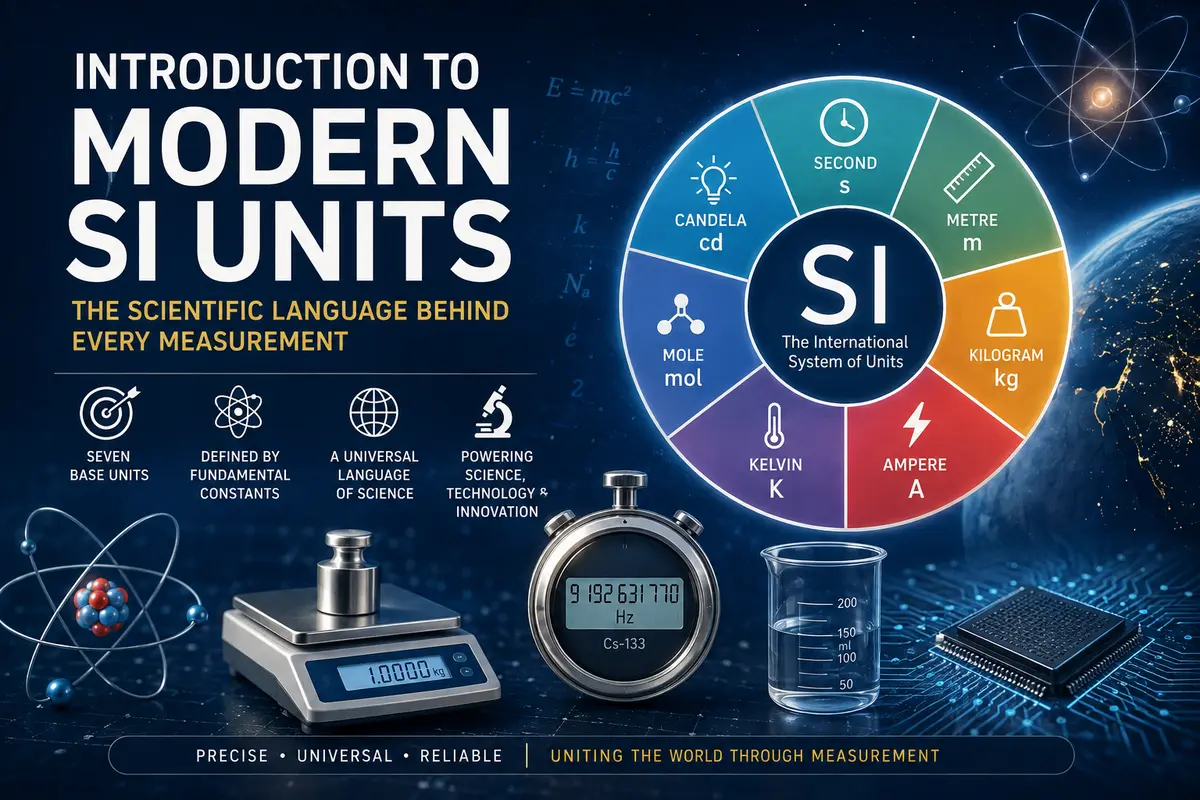
SI is the abbreviation for Système International d’Unités, the International System of Units. It is the international treaty used to define and express measurements. It gives a uniform framework where measurements can be treated mathematically and reproduced with high accuracy. The modern SI has seven base units:
| Physical Quantity | SI Base Unit | Symbol |
|---|---|---|
| Time | second | s |
| Length | metre | m |
| Mass | kilogram | kg |
| Electric current | ampere | A |
| Thermodynamic temperature | kelvin | K |
| Amount of substance | mole | mol |
| Luminous intensity | candela | cd |
These seven units provide the familiar framework of the SI, while the modern system itself is defined through seven fundamental constants.
Why Do We Need Standard Units?
Measurement appears easy.
If you say a table is 2 meters long, most people immediately understand what you mean.
But imagine if every country—or even every laboratory—had a different definition of what a meter was.
It would be incredibly hard to communicate science. To make a measurement, you need three things:
A number + a unit + a good definition.
For instance: 2 m.
The number tells us how much. The unit tells us what scale is being used.
This is especially true for very small or very accurate measurements. In microbiology, for example, microorganisms can be measured in micrometers. In nanotechnology measurements may be in nanometers. Physicists may be dealing with quantities that must be defined with extraordinary precision. All these measurements have a common basis in the SI.
From Physical Objects to Constants of Nature
The history of measurement is really the history of increasing accuracy. Some units used to be tied to physical objects or certain physical conditions. For example, the kilogram used to be defined by a physical prototype. But the things of the world can alter.
They might be contaminated or damaged or lose small amounts of material. Scientists wanted something much more fundamental, something that didn’t depend on some particular object stored in a lab.
The solution was to relate measurements to constants of nature. The SI in its present form was essentially revised in 2018, with the new definitions coming into force on 20 May 2019. Four base units, the kilogram, ampere, kelvin, and mole, were redefined in terms of fixed values of fundamental constants. This was a major transformation in the history of measurement.
The Seven Constants Behind the Modern SI
The modern SI rests on seven defining constants. They include:
- Cesium-133 hyperfine transition frequency
- Speed of light in vacuum
- Planck constant
- Elementary charge
- Boltzmann constant
- Avogadro constant
- Luminous efficacy of specified monochromatic radiation
The precise numerical values of these constants are used to define the SI units.
This indicates that a physical reference object is no longer essential to modern measuring. Rather, it is linked to how nature behaves.
Introduction to Modern SI Units: The Seven SI Base Units Explained
1. Second — The Unit of Time
The SI base unit of time is the second (s). The frequency of a specific transition in the cesium-133 atom serves as the basis for its current description.
The precise number is 9,192,631,770 Hz.
An incredibly accurate method of measuring time is provided by this atomic definition. Modern technology like satellite navigation, telecommunications, scientific experimentation, and precision clocks depend on accurate time measurement.
2. Metre — The Unit of Length
The SI basic unit of length is the meter (m). The speed of light in a vacuum is related to its definition.
The precise speed of light is 299,792,458 meters per second.
Thus, the definition of the second and the speed of light are inextricably related to the modern meter. Therefore, we are eventually utilizing a unit related to one of nature’s fundamental constants when we measure the length of a laboratory table or the separation between celestial objects.
3. Kilogram—The Unit of Mass
The SI base unit of mass is the kilogram (kg). The Planck constant (h) is used to define the contemporary kilogram. Its precise value is:
One of the most significant modifications made to the SI in 2019 was 6.62607015 × 10⁻³4 J·s. The kilogram was connected to a fundamental constant of quantum physics rather than its previous reliance on a physical prototype.
4. Ampere — The Unit of Electric Current
The SI base unit of electric current is the ampere (A). The elementary charge (e) serves as the foundation for its current definition. The precise number is 1.602176634 × 10⁻¹⁰ C.
This links the fundamental charge carried by elementary particles like the proton and electron to electrical measurement.
5. Kelvin — The Unit of Temperature
The SI base unit of thermodynamic temperature is the kelvin (K). The Boltzmann constant (k) is used to define it. The precise number is 1.380649 × 10⁻²³ J/K.
In physics, chemistry, thermodynamics, and laboratory research, the kelvin is especially significant.
The Kelvin scale starts at absolute zero, in contrast to Celsius.
0 K = -273.15 °C
6. Mole — The Unit of Amount of Substance
Quantities that scientists can measure in the lab are linked to the tiny world of atoms and molecules through the mole (mol). The specific contents of one mole are: 6.02214076 × 10²³ elementary entities
The Avogadro constant is linked to this figure. Because it enables scientists to work quantitatively with vast quantities of atoms, molecules, and ions, the mole is essential to chemistry.
7. Candela — The Unit of Luminous Intensity
The SI base unit of light intensity is the candela (cd). The luminous efficacy of monochromatic radiation at a given frequency is related to its definition. 683 lm/W is the fixed value.
In photometry, lighting science, and optical technology, the candela is crucial.
Base Units and Derived Units: How Does the System Work?
The seven base units are only the beginning. Scientists can combine them mathematically to create derived units. For example:
1. Speed = Distance / Time; therefore, m/s
2. Acceleration = Velocity/Time, therefore m/s²
3. Force = Using Newton’s second law: F = ma. The SI unit becomes kg·m/s². This derived unit has a special name: newton (N)
Similarly,
- Energy = joule (J)
- Power = watt (W)
- Pressure = pascal (Pa)
- Frequency = hertz (Hz)
- Electric charge = coulomb (C)
The SI therefore behaves like a connected mathematical system rather than a collection of unrelated units.
What Makes the Modern SI Different?
The contemporary SI becomes very intriguing at this point. The base units were frequently used as the starting point for the other units prior to the 2019 change. These days, seven defining constants describe the entire SI. Although their definitions are now based on fixed values of fundamental constants, the seven well-known base units are still very helpful for education, measurement, and scientific communication.
To put it simply: The rules and constants of nature serve as the foundation for the current SI rather than an item that serves as a representation of measurement. That is the fundamental concept underlying contemporary SI units.
SI Prefixes: Making Very Large and Very Small Measurements Easier
Science deals with both enormous and microscopic quantities. Writing: 0.000001 meters. Every time would be inconvenient. Instead, SI prefixes make these measurements easier.
| Prefix | Symbol | Factor |
|---|---|---|
| kilo | k | 10³ |
| mega | M | 10⁶ |
| giga | G | 10⁹ |
| milli | m | 10⁻³ |
| micro | µ | 10⁻⁶ |
| nano | n | 10⁻⁹ |
| pico | p | 10⁻¹² |
1 kilometer = 1,000 meters, while,
1 micrometer = 0.000001 meters and,
1 nanometer = 0.000000001 meter.
The SI currently recognizes 24 prefixes, extending from extremely large to extremely small scales.
Why Are SI Units Important in Microbiology?
SI units are more than just mathematical ideas for microbiology students. They are a common component of laboratory science. The unit of measurement for a bacterial cell is micrometers (µm).
The nanometer (nm) scale can be used to explain a virus. Depending on the situation, temperature might be expressed in degrees Celsius or Kelvin (K).
While concentrations and quantities are reported in standardized units, mass might be measured in grams or kilograms. Microbiology students can therefore accurately evaluate scientific literature, laboratory results, research papers, and experimental data by having a solid understanding of SI units.
SI Units in Everyday Life
We may not realize it, but SI units are everywhere. When you:
- measure your height.
- weigh an object,
- check temperature,
- calculate electricity,
- measure distance,
- determine speed,
- Calculate energy.
You are using concepts connected to standardized measurement. In science and engineering, however, the importance is much greater because even a tiny measurement error can affect an experiment, machine, medical result, or technological system.
Why Was the 2019 SI Revision Revolutionary?
There was more to the 2019 revision than just a wording adjustment. It signified a shift in measurement theory. Definitions based on physical artifacts and particular experimental settings gave way to definitions based on basic constants in the scientific community.
This led to the development of a measurement system that is solely dependent on the constant characteristics of nature, according to NIST.
The contemporary SI is defined by seven defining constants, according to the BIPM. This offers a solid basis for upcoming scientific advancements and ever-more-accurate measurement tools.
The Future of SI Units
Science continues to push measurement to new levels of precision. Scientists now work with:
- quantum technologies,
- atomic clocks,
- nanotechnology,
- advanced spectroscopy,
- particle physics,
- precision engineering,
- space science.
The modern SI is designed to support these developments because its definitions are connected to fundamental constants rather than fragile physical reference objects. As measurement technology improves, scientists can develop better ways to realize these definitions in laboratories around the world. The underlying definitions remain stable even as experimental techniques evolve.
Conclusion
There is considerably more to the International System of Units (SI) than just a way to write meters, kilograms, and seconds. Measurements can be understood, compared, and replicated globally thanks to the common scientific language. The traditional seven base units of the modern SI—meter, kilogram, second, ampere, kelvin, mole, and candela—remain, but its deeper basis now consists of seven defining constants of nature.
By redefining four units in terms of basic constants, the 2019 revision represented a significant advancement in metrology. Modern measurements are therefore more closely connected to the immutable principles of nature. The same basic measurement system links everything, from the minuscule microorganisms measured in micrometers to the enormous distances explored in astrophysics.
That is the real significance of modern SI units: they give science a common language—and give that language a foundation in nature itself.
FAQs
1. What does SI stand for?
Answer: SI stands for Système International d’Unités, or International System of Units.
2. How many SI base units are there?
Answer: There are seven SI base units: meter, kilogram, second, ampere, kelvin, mole, and candela.
3. When was the modern SI introduced?
Answer: The SI was established internationally in 1960, while the major modern revision took effect on 20 May 2019.
4. What is the SI unit of length?
Answer: The SI base unit of length is the meter (m).
5. Why are SI units important in science?
Answer: They provide an internationally consistent and coherent language for measurement, allowing scientific results to be compared and reproduced worldwide.
References
- Bureau International des Poids et Mesures (BIPM) — The International System of Units (SI Brochure). Official BIPM SI Brochure
- National Institute of Standards and Technology (NIST) — SI Units. NIST SI Units
- NIST — Definitions of SI Base Units. NIST SI Base Unit Definitions
- NIST—Meet the Constants. NIST—Meet the Constants
- BIPM—The SI—International System of Units. BIPM – The SI