
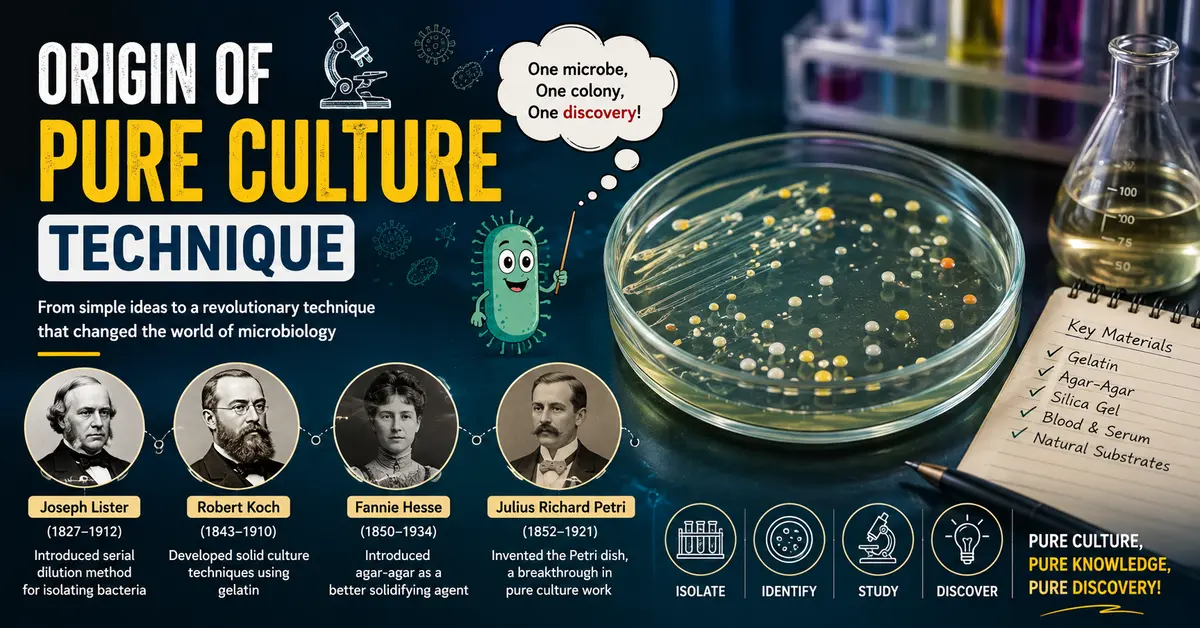
Explore the origin of pure culture technique, including the contributions of Joseph Lister, Robert Koch, Fannie Hesse, agar-agar, gelatin, and the Petri dish. Learn how pure culture methods revolutionized microbiology by enabling the isolation and study of individual microorganisms.
Introduction
You order a plate of biryani, but someone mixes it with noodles, ice cream, and salad. Would you know the real taste of biryani? Of course not!
Microbiologists had the same problem. When many different microorganisms grew together, they couldn’t identify which one was causing a disease or performing a specific function. So they needed a way to separate one microorganism from the crowd—just like picking one student from a noisy classroom.
This simple idea led to the Pure Culture Technique, which allows scientists to isolate and grow only one type of microorganism, making it easier to study its characteristics accurately.
Joseph Lister (1827–1912), a physicist, physician, and pioneer in antiseptic surgery, described a technique for isolating bacteria from aqueous suspensions by successive dilutions until the highest dilutions would contain only one of the desired organisms. Prior to 1860, there was no reliable method for isolating organisms in pure culture. However, it was really challenging to ascertain this point.
Using a microscope, microbiologist Schroeter saw the growth of diverse bacteria in isolated colonies of varied colors on slices of rotting potatoes in 1872. He noticed that every microorganism in a single colony was always identical. Thus, it was established that isolated colonies of any one type of organism require a solid nutritional surface. In this case, each isolated colony represents a pure culture.
Learn more about the history of microbiology and the pioneers of microbial research.
USE OF GELATIN IN THE Origin of Pure culture Technique
In keeping with this idea, efforts were made to find materials that would aid in creating a wet, sticky nutritional surface on glass. Koch created a clear, solid jelly on flat pieces of glass in 1880 using 5–10% gelatin, different nutrients, and test compounds. But the gelatin melted in the summer. Since it was a protein, various bacteria, particularly molds, frequently broke it down and liquefied it. Nonetheless, it is currently employed in pure culture research of viruses, cancer cells, human cells, plants, and insects after being technically altered.
Explore Robert Koch’s discoveries and Koch’s postulates in detail.
FIRST USE OF AGAR-AGAR
Mrs. W. Hesse proposed agar agar, sometimes known as agar, as a gelatin replacement in 1881. This gum is a polymer that comes from the seaweed Gelidium spp., which was used to make jellies back then. It has no nutritional value and is completely indigestible for the majority of bacteria. Agar is colorless, transparent, and only melts in boiling water. Once melted, it doesn’t set again until it reaches about body temperature (40°C). In order to create reasonably stiff gels, it is currently frequently used in culture media at concentrations of 1.5 to 3.0 percent.
Learn more about agar and microbiological culture media.
Soon after agar was originally used as a solidifying agent, it was found that the presence of organic materials like commercial agar or contaminants in the soil inhibited a number of significant species of chemolithotrophic microbes. Agar is easily broken down and liquefied by a variety of heterotrophic species of soil and marine microorganisms. Therefore, the search for an inorganic solidifying agent was necessary. It was discovered that silica (SiO₂ ) could be used to make silica gel instead of agar. Silica gel preparation is simple, but it does involve careful consideration of factors including pH, temperature, silica content, and different ions.
Explore how culture media are used in modern microbiology laboratories.
OTHER SOLIDIFYING AGENTS
Solid microbiological media can be prepared using a variety of materials besides agar, gelatin, or silica gel. Serum, blood, and whole mixed eggs are frequently employed either on their own or as the foundation for combinations since they coagulate easily when heated to 80°C or above. Additionally, slices of meat, bread, potatoes, and carrots can be used as natural solid nutritional medium to grow a variety of microorganism species.
ORIGIN OF PETRIDISH
Koch’s pupil R.J. Petri proposed the straightforward technique of pouring the melted nutrient medium into round, shallow plates and covering them right away with a glass cover to avoid dust contaminating the pure culture. This eliminated contamination and allowed for a longer analysis of the cultures. These dishes, known as Petri plates, are used extensively nowadays.
Conclusion
The history of microbiology underwent a sea change with the creation of the pure culture technique. Joseph Lister’s serial dilution approach, Robert Koch’s gelatin-based culture technique, Fannie Hesse’s introduction of agar, and Julius Richard Petri’s creation of the Petri dish were all significant advancements in the isolation and cultivation of microbes.
These developments made it possible for researchers to get pure cultures, precisely identify diseases, examine microbial traits, and provide the groundwork for contemporary microbiology. Today, the pure culture technique remains one of the most significant laboratory methods in medical, industrial, environmental, and research microbiology.
Frequently Asked University Questions (Previous 5 Years)
Long Answer Questions (8–10 Marks)
- Discuss the history and development of the pure culture technique.
Short Answer Questions (2–5 Marks)
- Define pure culture.
- What is the Pure Culture Technique?
- Who invented the pure culture technique?
- What is the importance of a pure culture?
- What is the difference between pure culture and mixed culture?
- What are the characteristics of a pure culture?
- Write a short note on the Petri dish.
- Why is agar preferred over gelatin as a solidifying agent?
- What is the role of Joseph Lister in microbiology?
- Mention the properties of agar-agar.
Viva Questions
- Can a pure culture be prepared from a mixed broth?
- Why is aseptic technique important?
- Why is agar used in culture media?
- Which method is best for obtaining a pure culture?
- What is contamination?
FAQs
1. Who invented the pure culture technique?
Answer: The Pure Culture Technique was pioneered by Joseph Lister in 1878 through the serial dilution method. It was later significantly improved by Robert Koch, who introduced solid culture media (gelatin and later agar), making pure culture isolation practical and reliable.
2. What is a pure culture derived from?
Answer: A pure culture is derived from a single microorganism (one cell or one colony), which is isolated and grown under sterile conditions to produce a population of genetically identical cells.
3. What is the pure culture technique?
Answer: The pure culture technique is a microbiological method used to isolate and grow a single type of microorganism free from contamination, allowing its characteristics to be studied accurately.
4. Who came first, Robert Hooke or Antonie van Leeuwenhoek?
Answer: Robert Hooke came first.
Robert Hooke observed microscopic structures (including cork cells) in 1665.
Antonie van Leeuwenhoek first observed living microorganisms in 1674–1676.
Short answer: Robert Hooke came first (1665), followed by Antonie van Leeuwenhoek (1674–1676).
5. Can a pure culture be prepared from a mixed broth?
Answer: Yes. A pure culture can be prepared from a mixed broth by using microbiological isolation techniques such as the streak plate, spread plate, pour plate, or serial dilution method to separate and grow a single microorganism.
References
- Prescott’s Microbiology. (2020). McGraw-Hill Education.
- Brock Biology of Microorganisms. (2021). Pearson Education.
- Microbiology: An Introduction. (2018). Pearson Education.
- Ananthanarayan and Paniker’s Textbook of Microbiology. (2021). Universities Press.
- Microbiology. Tata McGraw-Hill Education.
- Joseph Lister. (1878). On the Nature of Fermentation and Other Biological Phenomena.
- Robert Koch. (1881). Methods for the Study of Pathogenic Organisms.
- Fannie Angelina Hesse. Historical contributions to microbiological culture media.
- Julius Richard Petri. (1887). Development of the Petri dish for microbiological culture techniques.