
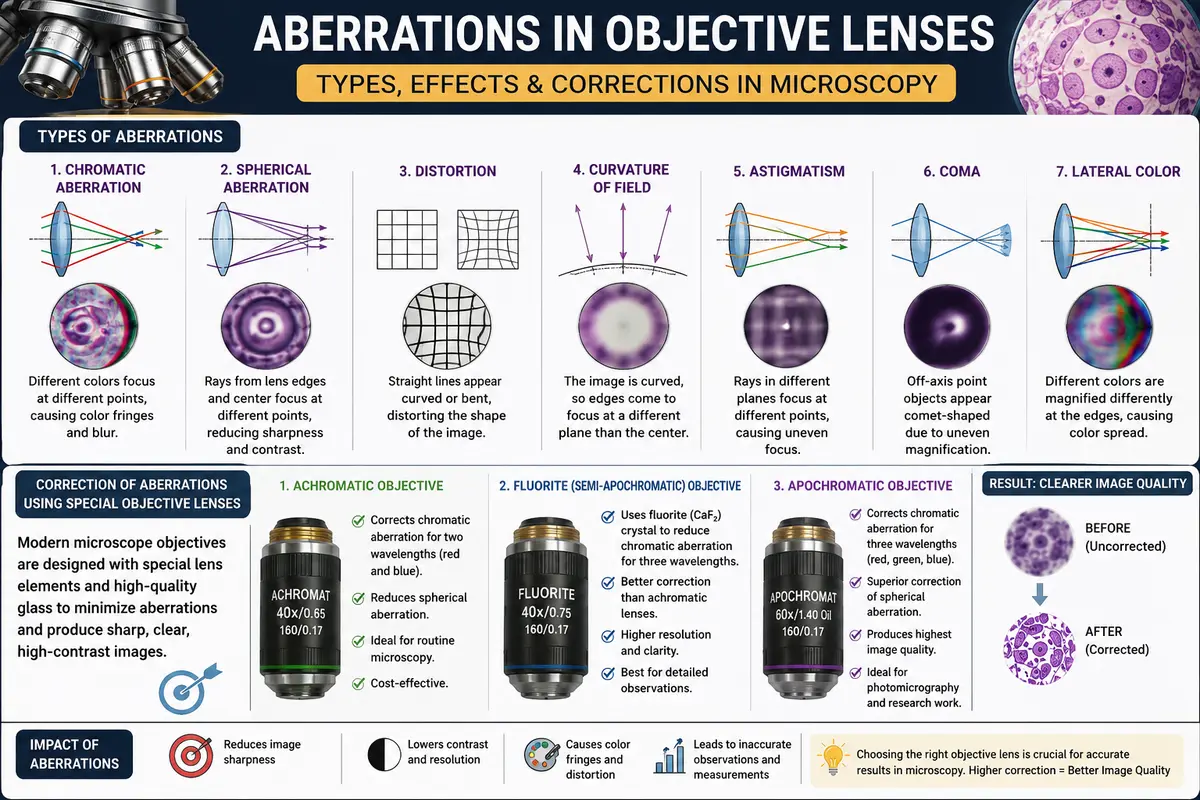
Learn about aberrations in objective lenses, including chromatic aberration, spherical aberration, distortion, astigmatism, coma, and their corrections using achromatic, fluorite, and apochromatic objective lenses in microscopy. Aberrations in objective lenses are optical defects that reduce the quality of microscopic images by preventing light rays from focusing accurately.
Introduction
Aberrations in the objective lens are a bit like the embarrassing selfie you took with a camera lens that’s gone a bit haywire—your face comes out all blurry or weirdly distorted. Try to picture it—your face is stretched horizontally, covered in color, or just generally looking a bit wonky. Now imagine that’s what happens to the image you’re trying to get when an objective lens just can’t get the light all focused in the same place—that’s what causes the problems of image defects known as aberrations.
The reason this happens is because some light rays get to their focus point way too early or way too late, or the different colors in the light decide to focus at their own pace (in different places). As a result, the image just gets all muddled, and its accuracy goes out the window.
And the worst bit is you get a whole host of different aberrations cropping up—things like spherical aberration, where the light rays all meet at different points; chromatic aberration, where reds and blues and greens all focus separately, and you end up with a picture that’s a bit of a mess; coma, where things start off as a normal object but then get all stretched out like a comet; and astigmatism, where the image is perfectly clear in one direction but not at all in another.
And then there’s the distortion, where straight lines end up looking all curved. In short, an aberration is just a big word for a picture that’s not coming out right because the light just can’t seem to focus, which is why, these days, people design the lenses on microscopes to be as perfect as possible so that you get a nice, sharp, and clear picture to look at.
Perfect lens systems have yet to be designed. All lens systems contain aberrations or optical flaws to variable degrees, depending on the designer’s skill and the complexity of the design challenge. Lens systems are constructed of lenses with spherical surfaces, which do not provide ideal images. This flaw can be greatly mitigated by combining lens shapes and different glasses.
For a deeper understanding of microscope optics and objective lenses, explore this detailed microscopy resource.
Types of Aberrations in Objective Lenses
The principal defects in the image are the result of
- Chromatic aberration in the objective lens.
- spherical aberration in objective lens
- distortion aberration in objective lens
- curvature of field aberration in objective lens,
- astigmatism in objective lens
- coma aberration in objective lens and,
- lateral color aberration in the objective lens.
(1) Chromatic aberration in objective lens
This results from the failure of a simple double convex lens to focus light rays of various wavelengths in the same plane, creating blurred, multicolored images. It may be lessened by reducing the aperture of the lens or, better still, by using a lens composed of more than one material (compound lens).
Read more about chromatic aberration and optical image formation in microscopy.
(2) Spherical aberration in objective lens
This refers to the greater power in the outer portion of a spherical surface than in the inner portion. Spherical aberration in objective lenses causes some of the light, which should be in the central spot, to diffuse out into the ring structure. This causes a loss in contrast in the normal microscopic preparation.
It may be overcome by judicious combinations of convergent and divergent lens elements, properly shaped to minimize the variation of focal power with aperture.
(3) Distortion aberrations in objective lens
This type of aberration renders a square object as a rectangle with curved sides. Distortion is caused by the lens surface having demagnifications at the marginal and central portions of the image.
(4) Curvature of field aberration in objective lens
Curvature of field aberration in objective lens is caused by a spherical lens, which produces a curved image of a flat object because the outer portions of the image come to focus at a different distance from the central portions of the image.
(5) Astigmatism aberrations in objective lens
If a marginal point object is drawn out into separate linear images lying at different distances from the lens surface, it results in a condition called “astigmatism.” It causes a general deterioration of the image. An astigmatic image can never be focused sharply except for when it is parallel or perpendicular to a radius of the field.
(6) Coma aberrations in objective lens
Coma aberrations in objective lenses are defects in which different circular concentric zones of the lens surface give different magnifications to an off-axis image, resulting in a point object being imaged as a comet-shaped image.
(7) Lateral color aberrations in objective lens
The presence of this defect results in light of one being imaged at a greater magnification than light of another color, causing an off-axis image of a point object to be spread out into a spectrum or spread of colors.
Corrected objective lenses and their types
The objective lenses are redesigned or corrected to remove various types of aberrations and also to achieve high resolution. Explore different microscope objective lenses and their optical corrections for improved image quality.
Some of the redesigned obj lenses are as follows: –
(I) Achromatic objective or achromat
It corrects both spherical and chromatic aberrations. They are coming for the chromatic aberration of two colors, red and blue. These are adequate for a microscope that does not need high resolution. They are also available as plain achromats with additional correction curvature of field.
(II) Apochromatic objective lens
It is a better and more expensive lens, which is more finely compensated spherically (for three colors) and chromatically (for three color aberrations). It produces high-quality images that reveal true color specimens without distorting their shape and is excellent for photomicrography.
(III) Fluorite or semiapochromatic objective lens
It has mineral fluorite incorporated into it It attains high-order correction for three colors chromatically. They are preferably achromates when stringent resolution is required in the center of fields.
Conclusion
“Aberrations in Objective Lenses—A Major Blow to Image Quality in Microscopy”
Its image quality is ultimately affected the most by the imperfections in objective lenses—and that’s not a good thing. Optical flaws like chromatic aberration, spherical aberration, distortion, a bent field of view, astigmatism, coma, and those colors creeping in at the edges all can greatly reduce image sharpness, contrast, and accuracy, which makes those microscopic observations you’re using them for less reliable. Which can be a real problem.
Modern mircoscopes go a long way in tackling some of these problems with specially corrected lenses like the achromatic type, the fluorite type (which is just a fancy name for semi-apochromatic), and the apochromatic type. Each one gives progressively better correction and higher image quality, so it’s not like they just provide a fix.
Choosing the right objective lens depends on the amount of precision you need. Achromatic objectives are fine for routine lab work, but if you need a bit higher resolution and brightness, then fluorite objectives would be a better bet. Then there are apochromatic objectives—these deliver the highest level of color correction, contrast, and detail, so if you need high-quality imaging, then they’re the ones to go with.
Knowing what’s going on with different types of aberrations and how some of these issues get sorted out can be a real help when it comes to choosing the right objective lens for the job. Whether you’re a student, a researcher, or just someone who works in a lab, understanding this stuff can make all the difference when it comes to getting accurate results from your microscope.
Continue learning microscopy with our complete collection of microscope notes for students.
Important University Exam Questions
I reviewed the available question papers and question banks of the last 5 years. This topic is not found literally every time in the question papers of SPPU (Savitribai Phule Pune University) every year, but questions on aberrations in objective lenses are asked regularly from the microscopy chapter. Also, similar types of questions are found in the microbiology question banks of other universities.
Long Answer (10–12 Marks)
- What is an aberration? Explain different types of aberrations in objective lenses.
- Explain chromatic and spherical aberrations in objective lenses with suitable diagrams.
- Describe optical aberrations in microscope objective lenses and their corrections.
- Explain corrected objective lenses. Add a note on achromatic, fluorite, and apochromatic objectives.
- Discuss various aberrations in objective lenses and explain how they are corrected.
Short Answer (5–6 Marks)
- Define aberration.
- Explain chromatic aberration.
- Explain spherical aberration.
- Explain coma aberration.
- Explain astigmatism.
- Explain distortion.
- Explain curvature of field.
- Explain lateral color aberration.
- Differentiate chromatic and spherical aberration.
- Write a note on corrected objective lenses.
Short Notes (3–4 Marks)
- Chromatic Aberration
- Spherical Aberration
- Coma
- Astigmatism
- Distortion
- Curvature of Field
- Lateral Color
- Achromatic Objective
- Apochromatic Objective
- Fluorite Objective
Viva / MCQ Questions
- What is an aberration?
- Which aberration causes color fringes?
- Which objective lens provides the highest correction?
- What is coma aberration?
- Define astigmatism.
- Which objective corrects chromatic aberration?
- Which objective is best for photomicrography?
- What is lateral color aberration?
- Define distortion.
- What is curvature of field?
These questions are the most searched and are also frequently asked in exams:
- What is aberration in objective lenses?
- Explain chromatic aberration in objective lenses.
- Explain spherical aberration in objective lenses.
- Explain different types of aberrations in objective lenses
- Explain corrected objective lenses with suitable examples.
- Differentiate achromatic, fluorite, and apochromatic objectives.
- Write a note on coma aberration.
- What is astigmatism in objective lenses?
- Explain distortion and curvature of field.
- How are aberrations corrected in microscope objective lenses?
FAQs
1. What is an aberration in objective lenses?
Answer: Aberration in objective lenses is an optical defect in which a lens fails to focus all light rays at the same point, resulting in a blurred, distorted, or colored image.
2. What are the 5 types of aberrations in an objective lens?
Answer: The five main types of aberrations in objective lenses are
Chromatic Aberration—Causes color fringes.
Spherical Aberration – Produces a blurred image.
Astigmatism – Causes uneven focus in different directions.
Coma – Makes off-axis points appear comet-shaped.
Distortion – Bends or warps the image shape.
3. What is chromatic aberration in an objective lens?
Answer: Chromatic aberration in objective lenses is an optical defect in which different colors (wavelengths) of light are focused at different points by a lens, causing blurred images and colored fringes around objects.
4. What is spherical aberration in an objective lens?
Answer: Spherical aberration in objective lenses is an optical defect in which light rays passing through the edge and center of a spherical lens focus at different points, producing a blurred and less sharp image.
5. Is astigmatism an aberration in objective lenses?
Answer: Yes. Astigmatism is an optical aberration in objective lenses in which light rays in different planes focus at different points, resulting in a blurred or distorted image.
References
- Prescott’s Microbiology (12th Edition), McGraw-Hill Education.
- Brock Biology of Microorganisms (16th Edition), Pearson.
- Fundamentals of Light Microscopy and Electronic Imaging – Douglas B. Murphy & Michael W. Davidson.
- Nikon MicroscopyU
- Evident Scientific (Olympus)