
Learn the role of intensifiers, mordants, and decolorizers in staining processes, their mechanism, types, examples, and importance in microbiology and Gram staining.
Introduction
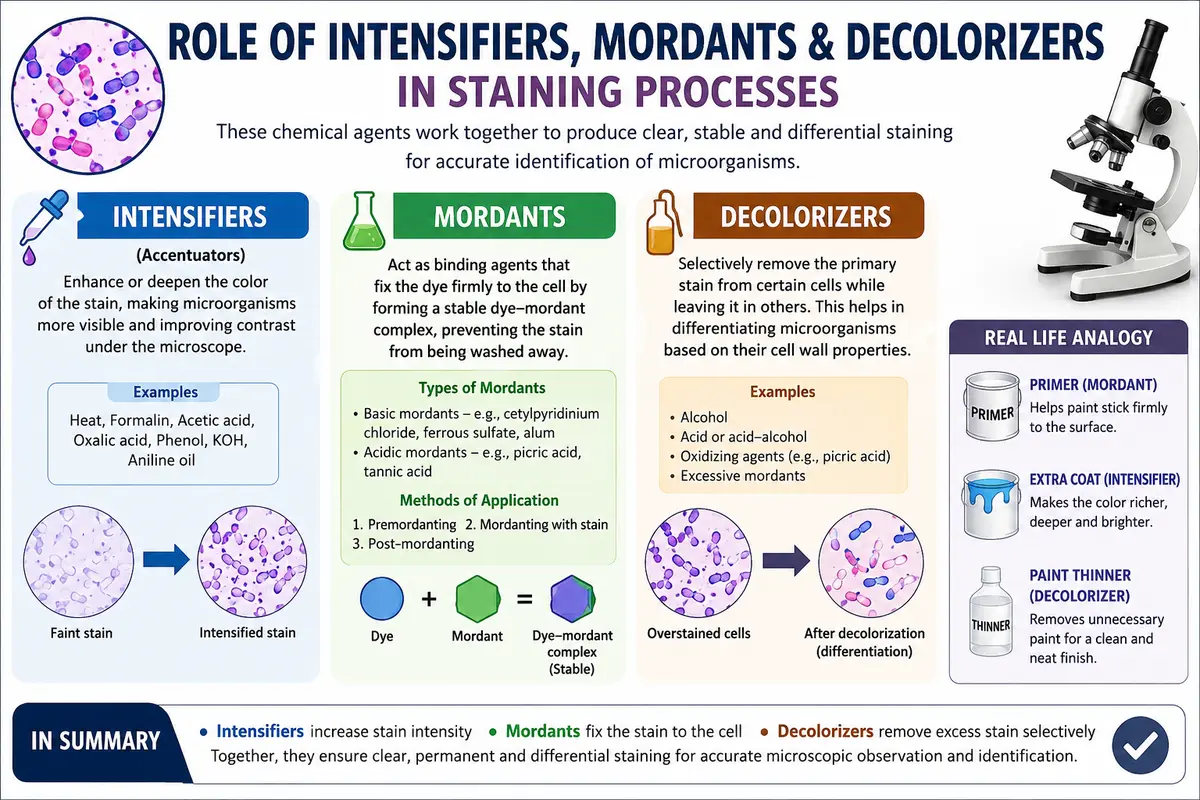
Consider yourself painting a wooden door or producing a stunning piece of art. To ensure that the paint sticks to the surface firmly, you first apply a primer. To make the color more vibrant and appealing, you then apply a second layer of paint. Lastly, you give the artwork a tidy, expert finish by using paint thinner or a cleaning solution to get rid of extra paint. These three straightforward processes—improving adhesion, boosting color, and eliminating extra paint—are very similar to how intensifiers, mordants, and decolorizers work in microbiological staining.
Staining is a crucial laboratory method used in pathology, histology, and microbiology to view microorganisms and cellular structures under a microscope. The majority of bacteria and other microorganisms are hard to detect clearly because they are almost colorless and transparent by nature. Even though dyes provide these creatures color, staining frequently needs additional chemical agents to yield distinct, long-lasting, and crisp results. Each of these agents—intensifiers, mordants, and decolorizers—performs a distinct and crucial function in the staining process.
Intensifiers improve contrast and make microorganisms more visible by increasing the stain’s brightness and depth. Mordants create a persistent dye–mordant complex that keeps the stain from being readily removed by acting as an adhesive or bridge between the dye and the cell. Conversely, decolorizers selectively eliminate the stain from some cells while leaving it on others. The fundamental idea behind differential staining methods, such as the Gram stain, is this selective removal; Gram-positive bacteria keep the original stain, whereas Gram-negative bacteria lose it during decolorization and are then counterstained.
These functions are aptly demonstrated by the painting example. In order to keep the paint securely adhered to the surface, the primer functions similarly to a mordant. The additional coat of paint acts as an intensifier, giving the color more depth and prominence. Lastly, the paint thinner works similarly to a decolorizer, eliminating unnecessary paint from specific areas to provide a clear, clean look. In the same way that these processes result in a visually appealing and long-lasting painted surface, intensifiers, mordants, and decolorizers combine to generate stained specimens that are clear, stable, and easily identifiable.
Because they improve staining quality, increase microscopic visibility, and allow precise differentiation of bacteria based on their structural and chemical features, these chemical agents are essential to microbiology. Many germs would remain pale, unclear, or impossible to differentiate from one another without their coordinated action, making scientific research, laboratory diagnostics, and microbial identification much more challenging. In order to assist precise diagnosis, research, and advancements in the biological sciences, intensifiers, mordants, and decolorizers are essential parts of staining procedures that convert unseen microorganisms into distinctive structures.
Role of Intensifiers and Mordants in staining
To make staining more intense, intensifiers, also known as accentuators, are employed. Although heat can be employed as a physical intensifier, chemical agents that are either basic or acidic in nature—such as formaline, acetic acid, oxalic acid, phenol, KOH, and aniline oil—are typically utilized as chemical intensifiers. Some of these act as both intensifiers and fixatives.
While mordants are chemical agents that have the ability to make dyes stain otherwise unstainable surfaces, intensifiers work by mixing with dye.
There are two types of mordants:
(a) Basic mordants: react with acidic dyes such as cetylpyridinium chloride, ferrous sulfate, and alum.
(b) Acidic mordants: react with basic dyes such as picric acid, tannic acid, etc. Mordants are used in three different ways:
(1) Premordanting: In Ringer’s method for cell wall staining, a 10% aqueous solution of tannic acid is applied to heat-fixed smears before a 0.5% crystal violet stain; in Dyar’s method, a 0.34% cetyl pyridinium chloride solution is applied to heat-fixed smears before a saturated aqueous congo red stain.
(2) Mordantings in conjuction with stain, e.g., mordant tannic acid is used in conjunction with basic fuchsin in Leifson’s stain for bacterial flagella.
(3) Post-mordanting: Heat-fixed smears are first stained with the primary stain crystal violet or gention violet and Gram’s iodine; a mordant is then added in a subsequent step.
- Direct staining: Carried out without mordant is called “direct staining.”
- Indirect staining: Staining brought about by the aid of a mordant is called indirect staining.
Mode of action of Mordant
It is possible to show how mordant and dye combine in vitro. The precipitates that come from these reactions are known as lakes because they are less soluble than the reactants. When mordants are present, dyes can be polygenetic (polychrome), producing a variety of colors with different mordants, or monogenetic, displaying a single color.
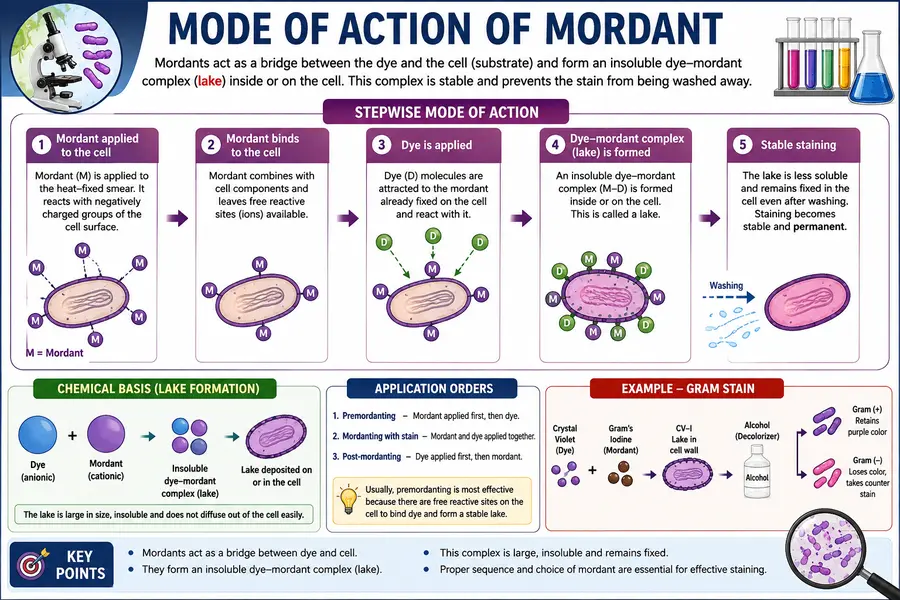
Mordants have been successfully employed with dyes in every feasible application order; however, changing the sequence may have an impact on the outcome. Applying the mordant to the substrate before applying the dye is standard procedure. Presumably, there are still unoccupied reactive radicals that can form salt lake combinations with dye once the mordant and substrate have combined.
This perspective doesn’t seem to apply to some mordants, including picric acid, which only contains one ionizing group. In this instance, the lake is likely mechanically trapped inside the structure of the substrate to which the picric acid was initially sorbed due to the creation of an insoluble color called picrate.
The triphenylmethane dye (crystal violet) iodine lake in the Gram stain may present a similar scenario, except instead of iodine, which is typically thought of as the mordant, the dye may anchor the lake to the cell.
Certain colors have little to no affinity for the cell or its constituent parts. Although mordant is not a dye in and of itself, it makes the dye stick. Some dyes have little or no affinity for the cell or its components. A mordant is a substance that itself is not a dye, but it causes the dye to adhere to or combine with the substrate in some way.
Role of decolorizer in staining
Regressive staining involves overstaining cells and using decolorizers to remove excess stain. The decolorizers listed below are used:
(1) Alcohol: It is a very powerful decolorizer for a variety of dyes. For instance, Gram staining uses it.
(2) Acid or a combination of acid and alcohol: It is believed that acid and alcohol function as solvents in which dye dissolves due to its higher solubility than in the structure or cell, hence eliminating the stain from the overstained structure or cell.Take acid-quick staining, for instance.
(3) By using oxidizers: These agents, such as picric acid, can oxidize dye to a colorless state, but they work very slowly.
(4) By using excessive mordants: The mordant dye complex is broken up when excessive mordant is present outside of the cells, and because there is less mordant in the cells than in the differentiating fluid, the dye transfers from the cell into the latter. Giemsa’s or Leishman’s staining techniques, for instance.
What is the role of intensifiers, mordants, and decolorizers in staining processes?
- Intensifiers: Enhance or deepen the color of the stain, making microorganisms more visible under the microscope.
- Mordants: Act as binding agents that fix the dye firmly to the cell by forming a stable dye–mordant complex.
- Decolorizers: Selectively remove the primary stain from certain cells, allowing differentiation between different types of microorganisms, such as Gram-positive and Gram-negative bacteria.
Conclusion
Intensifiers, mordants, and decolorizers are indispensable chemical agents that play complementary roles in the staining process. While intensifiers increase the intensity and visibility of stains, mordants strengthen the bond between the dye and the cellular components, ensuring stable and permanent staining. Decolorizers selectively remove the primary stain from specific cells, making it possible to distinguish microorganisms based on their structural and chemical differences.
Their coordinated action forms the basis of many differential staining techniques, particularly the Gram stain, which is widely used for bacterial identification. Without these agents, stained specimens would lack clarity, permanence, and diagnostic value. Therefore, a thorough understanding of the roles and mechanisms of intensifiers, mordants, and decolorizers is essential for accurate microscopic examination, microbial identification, disease diagnosis, and advancements in microbiological and histopathological research.
FAQs
1. What is a mordant in staining?
Answer: A mordant is a chemical substance that increases the affinity of a dye for a cell or tissue by forming a stable dye–mordant complex (lake). It helps the stain bind firmly to the specimen, making the staining more permanent and resistant to washing.
Example: Gram’s iodine is the mordant used in Gram staining.
2. What is the purpose of a mordant?
Answer: The purpose of a mordant is to fix the dye firmly to the cell or tissue by forming a stable dye–mordant complex, making the stain more intense, permanent, and resistant to washing.
3. What is the purpose of a decolorizer?
Answer: The purpose of a decolorizer is to selectively remove the primary stain from certain cells, allowing differentiation between microorganisms based on their staining characteristics, such as Gram-positive and Gram-negative bacteria.
4. Is 95% alcohol a decolorizer?
Answer: Yes. 95% alcohol is a commonly used decolorizer in Gram staining. It removes the primary stain from Gram-negative bacteria while Gram-positive bacteria retain the crystal violet–iodine complex.
5. What is an intensifier?
Answer: An intensifier is a chemical agent that enhances or deepens the color of a stain, making microorganisms or cells more visible and improving contrast under the microscope.
References
- Bancroft, J. D., & Gamble, M. (2019). Bancroft’s theory and practice of histological techniques (8th ed.). Elsevier.
- Cappuccino, J. G., & Welsh, C. T. (2020). Microbiology: A laboratory manual (12th ed.). Pearson.
- Forbes, B. A., Sahm, D. F., & Weissfeld, A. S. (2016). Bailey & Scott’s diagnostic microbiology (14th ed.). Elsevier.
- Levinson, W. (2023). Review of medical microbiology and immunology (18th ed.). McGraw-Hill Education.
- Pelczar, M. J., Chan, E. C. S., & Krieg, N. R. (1993). Microbiology: Concepts and applications. McGraw-Hill.
- Prescott, L. M., Harley, J. P., & Klein, D. A. (2017). Prescott’s microbiology (10th ed.). McGraw-Hill Education.
- Talaro, K. P., & Chess, B. (2021). Foundations in microbiology (11th ed.). McGraw-Hill Education.
- Tortora, G. J., Funke, B. R., & Case, C. L. (2021). Microbiology: An introduction (13th Global ed.). Pearson.
- Willey, J. M., Sherwood, L. M., & Woolverton, C. J. (2020). Prescott’s microbiology (11th ed.). McGraw-Hill Education.