
Discover: What was Joseph Lister’s contribution to antiseptic surgery? , his use of carbolic acid, his connection with germ theory, and how his work transformed modern surgical practices.
Introduction
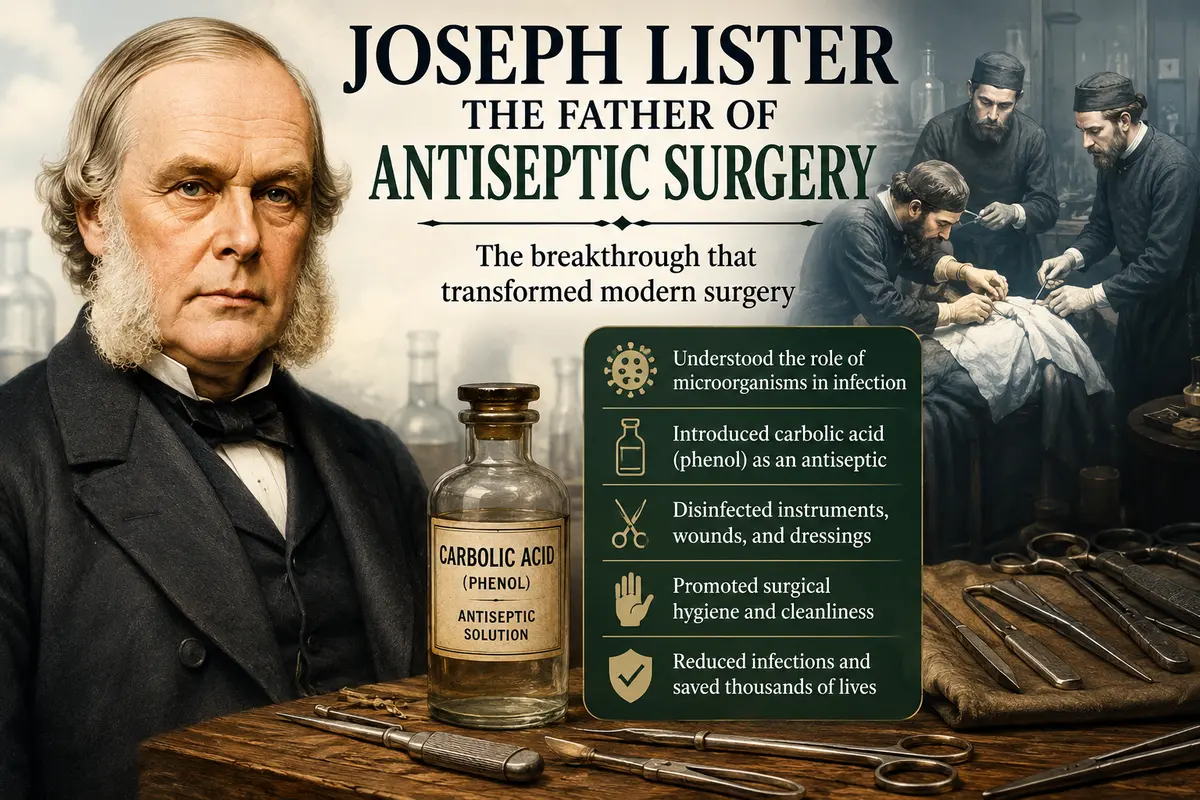
Joseph Lister (1827-1912) was a pioneering British surgeon who revolutionized the practice of modern surgery by developing antiseptic techniques to prevent infection in surgical procedures. Many patients died in the 19th century after what had been successful operations because wounds became infected very often. Inspired by the germ theory of Louis Pasteur, Lister proposed that microorganisms caused wound infections and introduced carbolic acid (phenol) to disinfect surgical instruments, wounds, dressings, and the surgeon’s hands. His work led to a great reduction in postoperative mortality and infection and established the basis for modern antiseptic and aseptic surgery.
What Was Joseph Lister’s Contribution to Antiseptic Surgery? The Revolutionary Breakthrough That Transformed Modern Surgery
One of the most important breakthroughs in medical history was made by Joseph Lister in antiseptic surgery. Surgery was very dangerous in the 19th century, with patients often catching serious infections after operations. Lister pioneered a systematic method of using antiseptics, namely carbolic acid (phenol), to kill off harmful micro-organisms and help prevent infection. His pioneering work dramatically improved surgical survival and helped establish the principles that developed into modern aseptic surgery.
Who Was Joseph Lister?
British surgeon and medical scientist Joseph Lister (1827–1912) is credited with transforming surgery from a risky procedure into one that was much safer.
Prior to Lister, surgeons tended to focus on speed when performing their operations. The importance of preventing the entry of microorganisms into wounds was not yet fully realized.
Lister’s work was heavily influenced by Louis Pasteur’s germ theory, which claimed that microorganisms could be responsible for fermentation and disease. Lister took these ideas and applied them to surgery. He devised ways to keep microorganisms from causing infections in surgical wounds.
What Was Surgery Like Before Joseph Lister?
In the early to mid-19th century, surgery was often associated with severe post-operative infections. Hospitals often had conditions like the following:
- Sanitation issues
- Non-sterile surgical instruments
- Use of contaminated dressings again
- Inadequate hand hygiene
- Surgical wounds, infected
- High mortality rate after surgery
A patient may survive the operation but die later from infections such as sepsis, gangrene, or wound infection. At that time, the relationship of microorganisms to surgical infection was not generally recognized.
Joseph Lister’s Major Contribution to Antiseptic Surgery
Lister’s greatest contribution was the development of a systematic antiseptic method for preventing infection during and after surgery.
Introduction of Carbolic Acid
Lister started to use carbolic acid (phenol) as a disinfectant. He learned that carbolic acid was being used to treat sewage and deduced that it might also kill the microorganisms associated with wound infection. He treated it with diluted carbolic acid;
- Surgical wounds
- Dressings and Salads
- Surgical Equipment
- The hands
- Surfaces relating to the surgical procedure
This was a big step in the control of hospital infection.
Antiseptic Treatment of Surgical Wounds
Lister’s use of carbolic acid on wounds, to prevent the multiplication of micro-organisms, was one of his major innovations. His philosophy was that prevention of microbial contamination would prevent wound infection. This shifted the surgeon’s approach from simply treating an infection after it took hold to preventing infection from taking hold in the first place.
Antiseptic Dressings
Additionally, Lister created techniques for applying antiseptic-treated bandages to wounds.
These dressings assisted in preventing contamination of surgical wounds.
The idea was straightforward:
Antiseptic protection combined with a clean wound reduces the chance of infection.
This development became a crucial component of his antiseptic system.
Antiseptic Surgical Instruments
Lister realized that wounds could get infected with bacteria from surgical equipment.
As a result, he encouraged the use of antiseptic techniques for surgical tools and apparatus.
This contributed to the development of the crucial idea that everything that comes into contact with a surgical wound should be kept as hygienic and uncontaminated as possible.
Antiseptic Spray
Lister also tried misting a solution of carbolic acid into the workspace. Reducing the amount of germs in the surrounding air and keeping them from contaminating the wound was the goal. This particular procedure was crucial to the development of antiseptic surgery, even though it was subsequently abandoned when surgical techniques advanced.
Lister and Louis Pasteur
Louis Pasteur’s work was directly linked to the development of antiseptic surgery.
Pasteur backed the emerging germ idea by proving that bacteria were the cause of fermentation.
Lister used these scientific concepts in surgery.
The contribution of Pasteur:
Microorganisms: pollution and illness
Lister’s application:
Prevent surgical infection by controlling germs.
As a result, Lister turned germ theory into a useful surgical technique.
The Famous Lister Experiment
Using antiseptic techniques to treat an open fracture was one of Lister’s key demonstrations. Because the incision was accessible to pollution and infection, open fractures were especially risky. Lister used antiseptic dressings and carbolic acid to treat the wound. The positive result confirmed his theory that infection may be avoided by managing microbes. This offered crucial proof of the efficacy of antiseptic surgery.
Importance of Joseph Lister’s Contribution
Joseph Lister’s contribution was much more than the introduction of carbolic acid. He established the idea that surgical infection could be prevented through scientific and systematic infection-control practices.
His work:
- Reduced postoperative infections.
- Improved patient survival after surgery.
- Encouraged better surgical hygiene.
- Supported the practical application of germ theory.
- Promoted antiseptic treatment of wounds and instruments.
- Helped establish modern infection-control practices.
- Created a foundation for modern aseptic surgery.
- Increased confidence in performing complex surgical operations.
What Is the Legacy of Joseph Lister?
Over time, hospitals and surgeons worldwide began to embrace Lister’s theories. His efforts helped bring about a significant change in the medical field:
Surgery now involved controlling the germs that could infect the patient in addition to removing damaged tissue.
Advanced sterilization, aseptic procedures, surgical hand preparation, sterile instruments, protective gear, and infection control procedures are all used in modern operating rooms. These methods emerged from the larger scientific revolution in the comprehension and management of microbes, to which Lister played a significant role.
Conclusion
By establishing antiseptic techniques to avoid infection, Joseph Lister transformed surgery. Inspired by Louis Pasteur’s developing germ theory, he disinfected surgical equipment, bandages, wounds, and other materials with carbolic acid (phenol). His methodical approach greatly decreased postoperative infections and contributed to the development of the scientific foundation for contemporary surgical infection management. Because of this, Joseph Lister is regarded as one of the forerunners of contemporary antiseptic surgery.
FAQs
1. What was Joseph Lister famous for?
Answer: Joseph Lister was famous for introducing antiseptic techniques into surgery to reduce infections and improve patient survival.
2. Which chemical did Joseph Lister use as an antiseptic?
Answer: Lister primarily used carbolic acid, also known as phenol, as an antiseptic.
3. How was Louis Pasteur connected to Lister’s work?
Answer: Pasteur’s research on microorganisms and germ theory influenced Lister’s understanding that microorganisms could cause wound infections.
4. Why was Lister important in microbiology?
Answer: Lister demonstrated how knowledge about microorganisms could be applied practically to prevent infection, creating an important connection between microbiology and clinical medicine.
5. What is the difference between antiseptic and aseptic surgery?
Answer: Antiseptic surgery focuses on destroying microorganisms using chemical agents, whereas aseptic surgery focuses primarily on preventing microorganisms from entering the surgical environment and wound.
References
- Lister, J. (1867). On the antiseptic principle in the practice of surgery. British Medical Journal, 2(351), 246–248. PubMed / BMJ record
- Lister, J. (1867). On a new method of treating compound fracture, abscess, etc., with observations on the conditions of suppuration. The Lancet. Royal College of Surgeons – Lister Archives
- Lister, J. (1868). An address on the antiseptic system of treatment in surgery. British Medical Journal, 2(394), 53–56. PubMed Central
- Royal College of Surgeons of England. (2017). Lord Joseph Lister of Lyme Regis (1827–1912): The father of modern surgery. Royal College of Surgeons of England
- Royal College of Surgeons of England. (2025). Joseph Lister in the Archives – “The Father of Antiseptic Surgery.” Royal College of Surgeons of England
- Royal College of Surgeons of England. (2025). Joseph Lister in the Library – “Careful procedure and attention to “detail”—applying Lister’s research. Royal College of Surgeons of England
- Lawrence, C. (2013). Joseph Lister and the performance of antiseptic surgery. Medical History, 57. PubMed Central
- Brand, R. A. (2010). The classic: On the antiseptic principle in the practice of surgery. 1867. Clinical Orthopaedics and Related Research, 468(8), 2012–2016. https://doi.org/10.1007/s11999-010-1320-x PubMed