
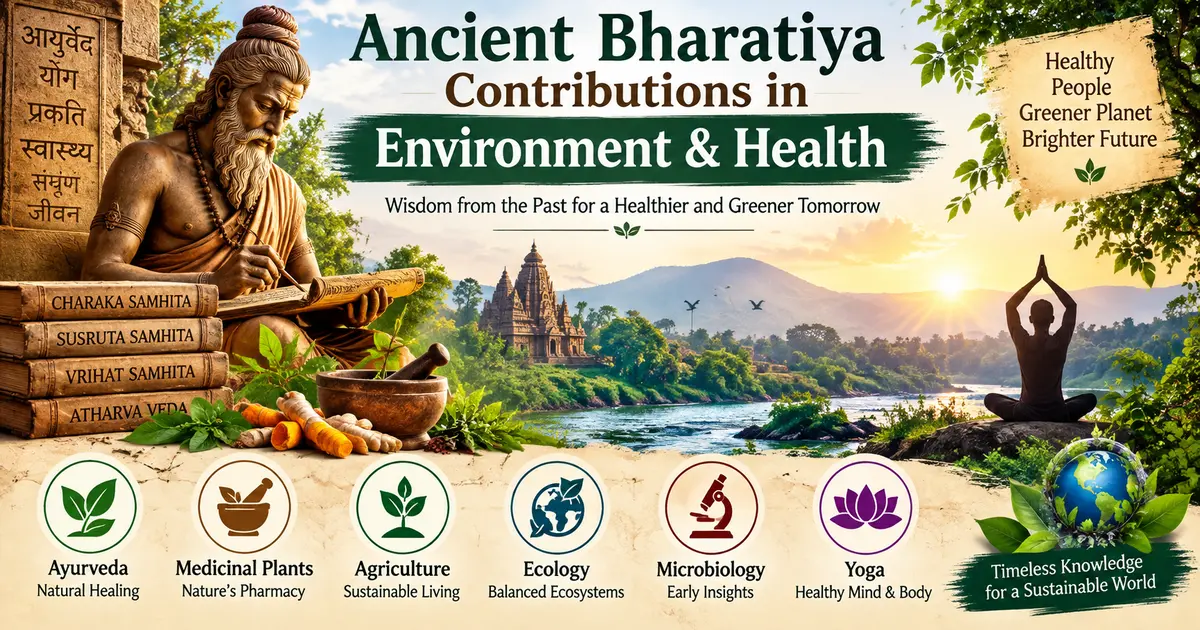
Discover the remarkable contributions of Ancient Bhartiya Contributions in Environment & Health, Ayurveda, medicine, surgery, medicinal plants, agriculture, ecology, microbiology, and yoga.

Introduction
Ancient Bharatiya traditions taught a close link between human health and the natural environment. They taught that water, fresh air, nutritious food, good personal hygiene, and a clean setting are all needed for a healthy life. The everyday use of plants such as neem, tulsi, amla, turmeric, and ginger shows how natural resources can help keep us well.
Simple practices such as bathing, washing hands, doing yoga, and staying active. Eating foods that match the season all help overall well‑being. Showing respect for trees, animals, water sources, and natural resources also helped keep the environment balanced. I see that these old ideas fit nicely with thoughts about preventive healthcare, hygiene, nutrition, environmental conservation, and living sustainably.
Ancient Bhartiya Contributions in Environment & Health
Ancient Bharatiya knowledge systems created a picture of how human beings, plants, animals, the environment, food, and health are linked. Ancient Bharatiya knowledge systems did not limit themselves to one field. Ancient Bharatiya knowledge systems linked observations from nature with agriculture, plant study, medicine, hygiene, ecology, and daily life. Traditions such as Āyurveda, yoga, and indigenous knowledge systems show examples of this whole approach. Ancient scholars studied plants for their properties.
Ancient scholars watched environmental changes. Ancient scholars developed farming methods. Ancient scholars stressed prevention of disease by using food, lifestyle, cleanliness, and balanced living. These contributions give a historical base for understanding how environment and human health interact.
Ethnic Studies and Indigenous Knowledge
Ethnic or indigenous studies look at the knowledge that different communities have built up over many generations. In Bharatiya society local groups developed understanding about medicinal plants, food plants, farming methods, forests, water systems, and traditional ways of staying healthy.
For example, rural and tribal communities used to recognize plants based on how they looked, where they grew, their smell, their taste, and how useful they were. This knowledge was shared from one generation to the next. It remains important today in the fields of ethnobotany and ethnomedicine.
Study of Plants: Anatomy and Structure
In India I notice people were very curious about plants and their many parts. They learned about plants by looking at roots, stems, leaves, flowers, fruits, and seeds. Different plant parts were selected for different purposes. For example:
- Roots were used in certain traditional preparations.
- Leaves were used as food or in household remedies.
- Flowers were used for medicinal, cultural, and aromatic purposes.
- Fruits and seeds were important sources of food and traditional medicines.
- Bark and other plant materials were also used in traditional preparations.
Today, plant science studies. Parts, like xylem, phloem, epidermis, and vascular tissues. Traditional plant knowledge came mostly from watching and trying things out.
Plant Physiology and Traditional Understanding
Plant physiology looks at how plants work. It includes things like how plants make food from sunlight, how they breathe, how they lose water, how they take in water, how they grow, and how they make plants. Ago people didn’t use the same words scientists use today. They still knew a lot about plants. Their farming methods showed they understood what affects plant growth. They knew about water, soil, sun, seasons, food for plants, and the weather.
This knowledge helped people choose the plants to grow. They also knew how to take care of their crops based on the environment where they lived.
Agriculture and Sustainable Practices
Agriculture played a role in the lives of people in ancient Bharatiya society. Traditional farming knowledge involved knowing about the soil, the rain, the seasons, how to water crops, the kinds of seeds and which crops to choose, how to take care of animals, and how to use resources. Farmers used things that were available around them and also used things to keep the soil healthy. Growing types of crops and choosing the right crops for the weather helped them not rely on just one kind of crop.
These old ways can be connected to today’s ideas, such as
- Sustainable agriculture
- Soil conservation
- Biodiversity
- Organic resource management
- Water conservation
- Climate-resilient farming
Ecology and Environment
Ancient Bharatiya thought often saw beings as members of a larger natural system. Forests, rivers, mountains, animals, plants, and water bodies were given practical importance. The protection of trees, sacred groves, water bodies, and biodiversity in different communities helped conserve local ecosystems. Traditional practices also encouraged use of natural resources.
The modern concept of ecology studies the relationships among organisms and their environment. Many traditional practices can be studied as examples of human interaction with ecosystems.
Āyurveda and Traditional Healthcare
Āyurveda is one of the major traditional systems of Indian medicine. It places importance on maintaining health as well as managing illness. It considers factors such as
- Food and nutrition
- Daily routine
- Seasonal routine
- Physical activity
- Sleep Hygiene
- Mental well-being
- Medicinal plants
For example, plants such as tulsi, neem, amla, turmeric, ginger, and ashwagandha have important places in traditional Indian practices. Modern research has investigated many plant-derived substances, but traditional use and modern clinical evidence should be considered separately.
Integrated Approach to Healthcare
One key idea in Indian health ideas is that health is seen in a whole way. Health was not about not having sickness. How you live, what you eat, how much you move, where you stay, how calm you feel, and how you talk with others were all seen as important for health. Today this idea matches ways of looking at health. In health care we focus on preventing sickness and promoting health. Keeping habits and cutting down on risky things are key parts of health care.
Contributions to Medicine
Ancient Indian medical texts have details about diseases, the signs that people show, the medicines used, how doctors checked patients, and the ways they treated them.
Charaka Samhita is closely linked to medicine and talks a lot about health and sickness. Sushruta Samhita is more connected to surgery and what doctors know about operations. Traditional medicine used things from plants, minerals, and animals. These days people study this knowledge through fields like ethnopharmacology, pharmacognosy, and the history of medicine.
Surgery and Sushruta
Sushruta is traditionally linked to the Sushruta Samhita, a classical Sanskrit medical book. The Sushruta Samhita includes discussions about procedures, anatomy, wounds, fractures, instruments, and surgical training. The Sushruta Samhita is historically significant because it gives evidence of organized knowledge in ancient India. Some procedures described in the Sushruta Samhita are especially important in the history of surgery.
Microbiology and Traditional Concepts of Infection
Modern microbiology grew from the discovery and labeling of microorganisms. Ancient Bharatiya texts obviously did not possess microscopes or classification systems for microbes. However, traditional health practices contained observations about cleanliness, contaminated environments, food preservation, water, wounds, and disease prevention. These practices can be studied historically with the rise of modern ideas about infection control and microbiology.

For example, keeping water clean and surroundings tidy and cleaning wounds are practices that have relevance to modern public health, although traditional explanations may differ from modern microbial theory.
Yoga and Health
Yoga is another gift from the ancient knowledge systems of Bharat. Yoga involves positions, breathing exercises focusing on the mind, and meditating.
In today’s world people do yoga to become more flexible, stay active, feel relaxed, manage stress, and improve health. Scientists have looked into the effects of yoga, but the proof varies based on the particular health result and the way yoga is practiced.
Environment and Health in Everyday Life
The connection between environment and health can still be observed in everyday life:

| Traditional Practice | Modern Connection |
|---|---|
| Protecting trees | Biodiversity and climate awareness |
| Clean water | Prevention of water-borne diseases |
| Personal hygiene | Infection prevention |
| Seasonal food habits | Nutrition and adaptation to climate |
| Medicinal plants | Ethnobotany and pharmacognosy |
| Yoga and physical activity | Physical and mental well-being |
| Traditional agriculture | Sustainable agriculture |
| Protection of forests | Ecosystem conservation |
| Proper waste practices | Environmental hygiene |
| Healthy lifestyle | Preventive healthcare |
Conclusion
Ancient Bharatiya contributions to environment and health show a connection between people and nature. This body of knowledge links plants, agriculture, ecology, medicine, surgery, nutrition, hygiene, and yoga. Ethnic studies and ethnobotany help us understand how traditional communities use plants in their lives. Ayurveda stands out as an example of a complete system for health.
The medical traditions linked to Charaka and Sushruta are parts of the history of Indian medicine. Yoga is still practiced widely today for mental well-being. When we look at these traditions through a lens and compare them with modern science, we gain useful insights. These insights reveal how healthcare evolved over time. They also highlight awareness of environmental issues. They show ways to live sustainably. Importantly, they remind us of the close relationship humans have with nature.
FAQs
1. Who is called the father of environmental history?
Answer: Alfred W. Crosby is widely regarded as the “Father of Environmental History.” His interdisciplinary research connected history with biology, ecology, geography, and medicine, particularly through works such as The Columbian Exchange and Ecological Imperialism.
2. What were five major achievements of ancient India?
Answer: Ancient India achieved major advancements in mathematics, medicine, astronomy, metallurgy, and education. It developed the concept of zero and the decimal system, made significant contributions to Āyurveda and surgery, advanced the study of astronomy and planetary movements, produced high-quality iron and steel, and established renowned centers of learning such as Takshashila and Nalanda.
3. What were the contributions of ancient India to medicine?
Answer: Ancient India made important contributions to medicine through Āyurveda, medicinal plants, disease prevention, diagnosis, and surgery. The works of Charaka focused on internal medicine and healthcare, while Sushruta contributed significantly to surgical knowledge and techniques. Ancient practices also emphasized hygiene, a balanced diet, preventive healthcare, and a healthy lifestyle. Yoga and traditional herbal medicine further supported physical and mental well-being.
4. What was the ancient Indian approach to protecting the environment?
Answer: The ancient Indian approach to environmental protection was based on living in harmony with nature. It emphasized protecting trees, forests, rivers, animals, soil, and water, using natural resources wisely, and maintaining cleanliness. Practices such as sacred groves, water conservation, sustainable agriculture, and respect for biodiversity reflected the belief that human health and environmental health are closely connected.
5. What are some contributions that came from ancient India?
Answer: Ancient India made significant contributions to medicine, Ayurveda, surgery, yoga, agriculture, plant studies, ecology, and environmental conservation. Ayurveda provided knowledge of medicinal plants and preventive healthcare, while Sushruta contributed to the development of surgical knowledge.
Yoga promoted physical and mental well-being. Traditional agriculture included knowledge of soil, seeds, water, crops, and seasons, while indigenous communities developed valuable knowledge of local plants and natural resources.
Ancient practices also emphasized personal hygiene, clean water, healthy food, conservation of trees and biodiversity, and sustainable use of natural resources, creating an important connection between environment and human health.
Reference
- World Health Organization. (2019). WHO global report on traditional and complementary medicine 2019. World Health Organization.
- World Health Organization. (2022). WHO traditional medicine strategy: 2014–2023. World Health Organization. Sharma, P. V. (1981).
- Caraka-saṃhitā: Agniveśa’s treatise refined and annotated by Caraka and redacted by Dṛḍhabala (Vols. 1–3). Chaukhambha Orientalia. Sharma, P. V. (1999).
- Suśruta-saṃhitā: With the English translation of the text and Ḍalhaṇa’s commentary (Vols. 1–3). Chaukhambha Visvabharati. Singh, R. H. (2002).
- Exploring the science of Ayurvedic therapeutics. Chaukhambha Surbharati Prakashan. Mukherjee, P. K., Nema, N. K., Venkatesh, P., & Debnath, P. K. (2011).
- Changing scenario for promotion and development of Ayurveda—Way forward. Journal of Ethnopharmacology, 135(2), 239–244. https://doi.org/10.1016/j.jep.2011.03.024 Patwardhan, B., Warude, D., Pushpangadan, P., & Bhatt, N. (2005).
- Ayurveda and traditional Chinese medicine: A comparative overview. Evidence-Based Complementary and Alternative Medicine, 2(4), 465–473. https://doi.org/10.1093/ecam/neh140 Posey, D. A. (Ed.). (1999). Cultural and spiritual values of biodiversity. United Nations Environment Programme.
- Food and Agriculture Organization of the United Nations. (2017). The future of food and agriculture: Trends and challenges. FAO. Gadgil, M., & Guha, R. (1992).