
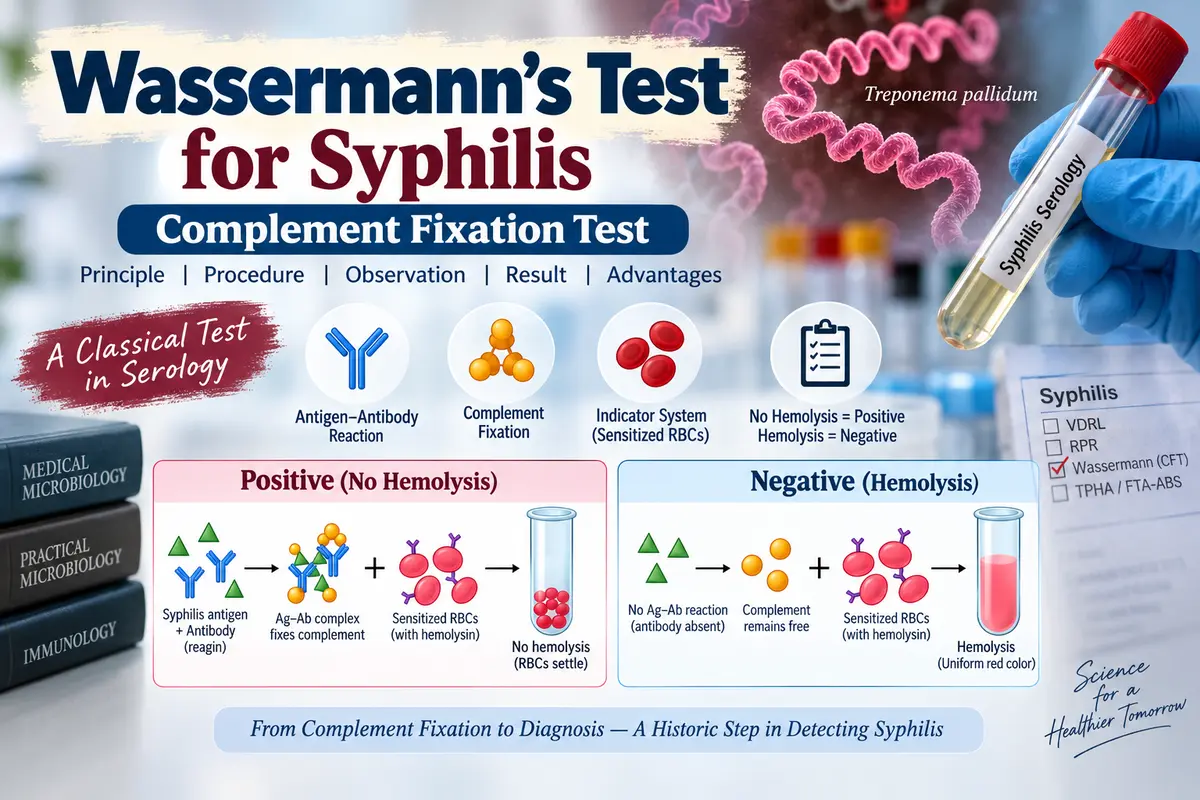
Complement Fixation Test (Wasserman’s test for syphilis): Learn the principle, procedure, observation, results, advantages, limitations, and complement fixation mechanism in detail.
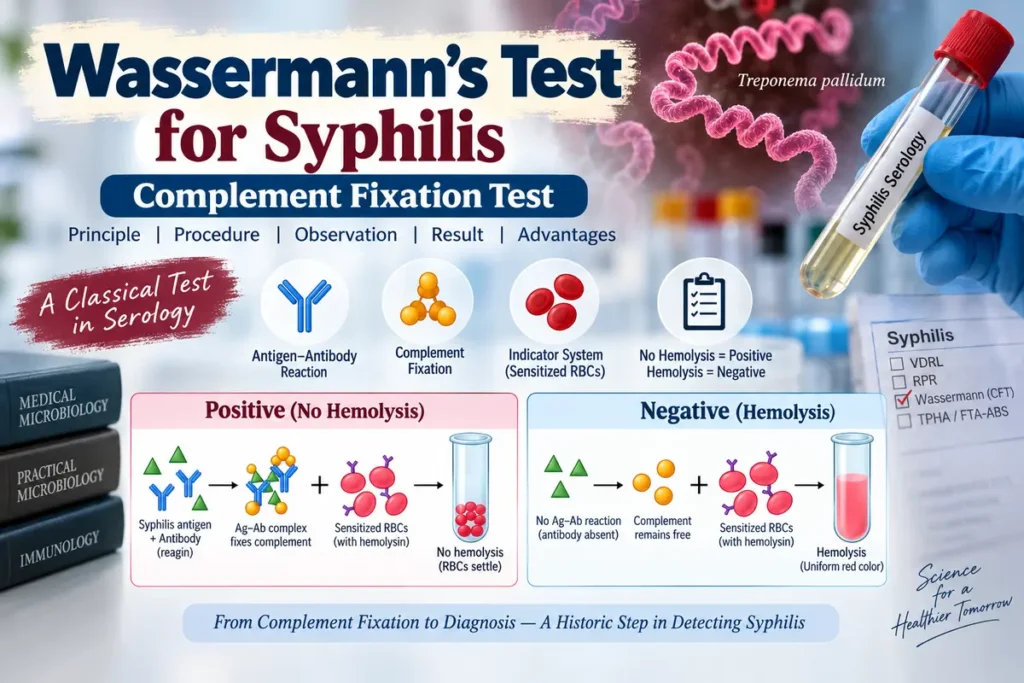
A) Complement Fixation Test
Introduction
Complements are special chemicals or protein components that are a part of our humoral immunity and aid in establishing antigen-antibody complexes, engulfing, degrading, and washing them away. They are found in the blood or attached near membranes. E.g., C1, C2, C3, C4 proteins, etc. The complement system is a collection of several proteins that interact with each other to initiate a series of reactions to assist in the defense of our immune system.
Complement Fixation Test
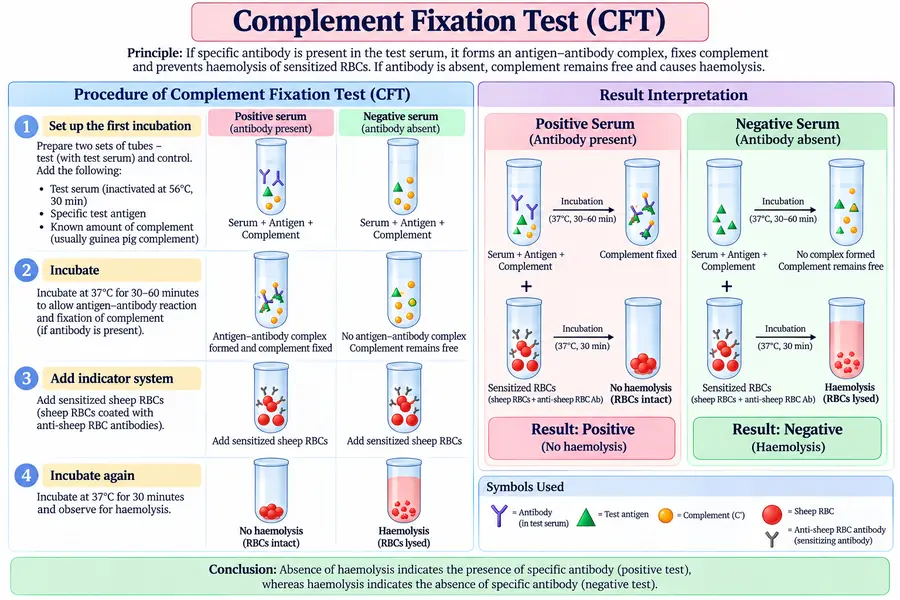
Explain the principle that the Ag‑Ab complex can only bind complement and that this binding changes how blood cells (RBC) lyse in the indicator system. When a sample contains the antibodies or antigens we want to detect the Ag‑Ab forms in the sample after we add the matching reactant—either an antigen or an antibody depending on what we are looking for. Because the complement is already captured by the Ag‑Ab complex, the indicator system cannot react with the added complement. This means that the indicator system shows no change.
Procedure
- A known antigen (viral Ag) is mixed with the patient’s serum.
- Then a measured amount of complement (Guineapig serum) is added to the test system.
- The test system is incubated at 37°C for one hour.
- After one hour an indicator system (sensitized RBC) is added to the test system.
- After one hour an indicator system (sensitized RBC) is added to the test system.
- It is then incubated again at 37°C for thirty minutes.
- If the antigen and antibody match, they form an antigen-antibody complex. Use up the complement.
- Observe the result.
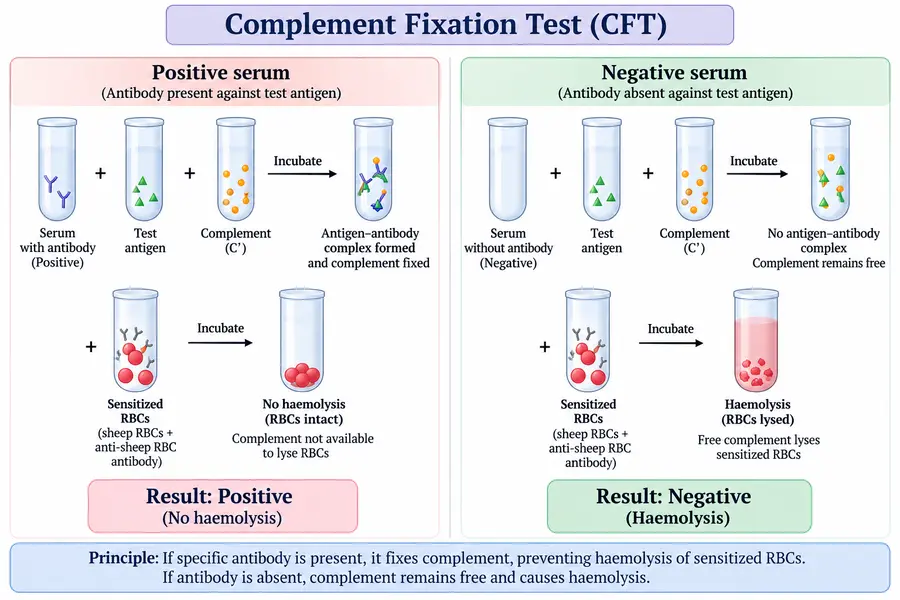
Observation
If hemolysis is observed, it indicates that the patient serum does not contain the antibody. Because of that, the complement system has not been activated to break up the sensitized blood cells, which would otherwise cause hemolysis.
If no hemolysis is observed, it is understood that the patient serum contains antibodies. The antibody reacts with the antigen to make an antibody complex and then fixes complement. Since the complement is already used, it is not available to break up the sensitized blood cells.
B) Wasserman’s test for syphilis
An application of the complement fixation test used for syphilis. Wasserman’s test is a test that was used a time ago to find out if someone had syphilis. Syphilis is an infection that spreads through sex and is caused by a germ called Treponema pallidum. The test was created by August von Wassermann, Albert Neisser, and Carl Bruck in 1906. It worked by using something called the complement fixation principle.
The usual Wassermann test is a kind of test that looks for antibodies. These antibodies are called reagins. They react with a type of antigen that is made from something called cardiolipin. This test was used a time ago to find the presence of these antibodies.
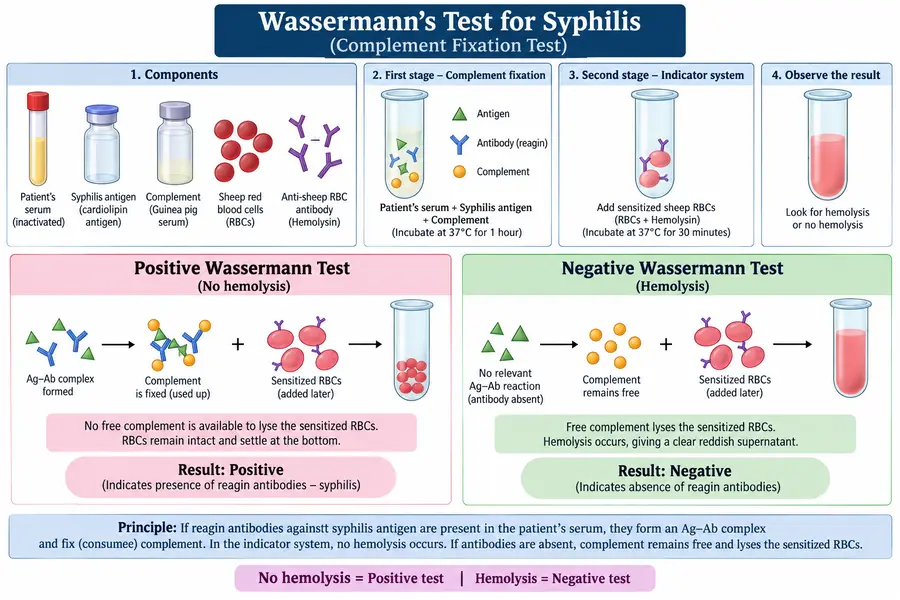
Principle
The test uses the complement fixation reaction. The patient’s serum is mixed with a syphilis antigen and a set amount of complement. If reagin antibodies are there, an antibody complex forms, and the complement gets fixed or used up. An indicator system that has sheep blood cells coated with anti-sheep red blood cell antibody (hemolysin) is added next.
- Positive test: The complement is fixed by the antigen-antibody complex, so there is not free complement left to break the sensitized red blood cells, so no hemolysis happens.
- Negative Test: There is no matching antigen-antibody reaction, so the complement stays free and the sensitized red blood cells break open.
Requirements / Components
- Patient’s serum
- Syphilis antigen (classically a lipoidal/cardiolipin-containing antigen)
- Complement, traditionally guinea-pig complement
- Sheep red blood cells (RBCs)
- Anti-sheep RBC antibody (hemolysin)
- Appropriate positive, negative, and reagent controls
- Test tubes, pipettes, and water bath/incubator
Procedure
First Stage – Complement Fixation
- Collect the patient’s serum.
- The patient serum is appropriately treated/inactivated to eliminate its own complement.
- Mix the patient’s serum with the syphilis antigen.
- Add a standardized amount of complement.
- Incubate the mixture to allow antigen–antibody interaction and complement fixation.
Second Stage – Indicator System
- Add sensitized sheep RBCs (sheep RBCs coated with hemolysin).
- Incubate the reaction mixture again.
- Observe the degree of hemolysis.
The indicator system detects whether complement remains available after the first antigen–antibody reaction.
Observation
| Observation | Interpretation |
| No hemolysis; RBCs remain intact and settle at the bottom. | Positive Wassermann reaction |
| Complete hemolysis; clear reddish supernatant | Negative Wassermann reaction |
| Partial/incomplete hemolysis | Doubtful/indeterminate reaction; requires appropriate interpretation or repeat testing |
The absence of hemolysis in a complement-fixation test indicates that complement has been consumed by the antigen–antibody reaction.
Result
- Positive Result: No hemolysis is observed. This indicates that the patient’s serum contains antibodies capable of reacting with the test antigen and fixing complement.
- Negative Result: Complete hemolysis is observed. This indicates that the specific complement-fixing reaction has not occurred, leaving complement available to lyse the sensitized sheep RBCs.
Advantages
- Historically important: It was one of the earliest serological tests developed for the diagnosis of syphilis.
- Based on a well-defined immunological principle: It demonstrates antigen–antibody-mediated complement fixation.
- Can demonstrate complement-fixing antibodies through an indirect indicator system.
- Useful historically in serological diagnosis and teaching of complement fixation reactions.
- It established the foundation for the development and standardization of subsequent serological tests for syphilis.
Limitations
The Wassermann reaction is now seen as a test from the past. It had problems with how it detected disease, how accurate it was, and how hard it was to do. It could also give positive results. Later, more precise and easier serological tests took their place. Today doctors usually test for syphilis with tests, like VDRL and RPR, and then add treponemal tests, based on the chosen diagnostic method.
Conclusion
The Complement Fixation Test (Wassermann’s test) is a serological test that shows how complement fixation works in diagnosing syphilis. A positive result is shown by no hemolysis because the complement is used up by the antigen–antibody reaction. When hemolysis occurs, the complement fixation test is negative.
Wassermann’s test was once very important in the history of syphilis testing. Today it is rarely used. Its limitations and the existence of more accurate tests have made it mostly obsolete. In conclusion, the Complement Fixation Test is an example that helps people learn about the principle, steps, and reading of the complement fixation reaction.
FAQs
1. What is the complement fixation test used for?
Answer: The Complement Fixation Test (CFT) is used to detect specific antibodies in a patient’s serum by determining whether they can fix complement in the presence of a specific antigen.
2. What is the complement fixation test?
Answer: The Complement Fixation Test (CFT) is a serological test used to detect specific antibodies in a patient’s serum based on their ability to fix (consume) complement in the presence of a specific antigen.
3. What is a complement in a complement fixation test?
Answer: Complement is a group of proteins present in blood serum that helps antibodies destroy or eliminate microorganisms.
In the complement fixation test, complement is used as an indicator to determine whether an antigen–antibody reaction has occurred.
4. What is Wassermann’s test?
Answer: Wassermann’s test is a complement fixation serological test historically used to diagnose syphilis by detecting reagin antibodies.
5. What disease does Wassermann’s test detect?
Answer: It was developed to detect syphilis, an infection caused by Treponema pallidum.
References
- Ananthanarayan, R. & Paniker, C. K. J. Ananthanarayan and Paniker’s Textbook of Microbiology. 11th Edition. Universities Press. — Sections on Treponema pallidum, syphilis, and serological diagnosis.
- Collee, J. G., Fraser, A. G., Marmion, B. P. & Simmons, A. Mackie & McCartney Practical Medical Microbiology. 14th Edition. Churchill Livingstone/Elsevier. — Sections on serological tests and complement fixation tests.
- Jawetz, Melnick & Adelberg. Medical Microbiology. McGraw-Hill. — Section on Treponema pallidum and laboratory diagnosis of syphilis.
- Tille, P. Bailey & Scott’s Diagnostic Microbiology. Elsevier. — Sections on immunologic/serologic diagnostic methods and syphilis.
- Wadsworth, A., Harris, N. M. & Gilbert, R. “The Complement Fixation Test for Syphilis: Standard Procedure of the American Public Health Association.” American Journal of Public Health, 1934; 24(7): 727–731.
- Shah, D. & Marfatia, Y. S. “Serological tests for syphilis.” Indian Journal of Sexually Transmitted Diseases and AIDS, 2019; 40(2): 186–191.