
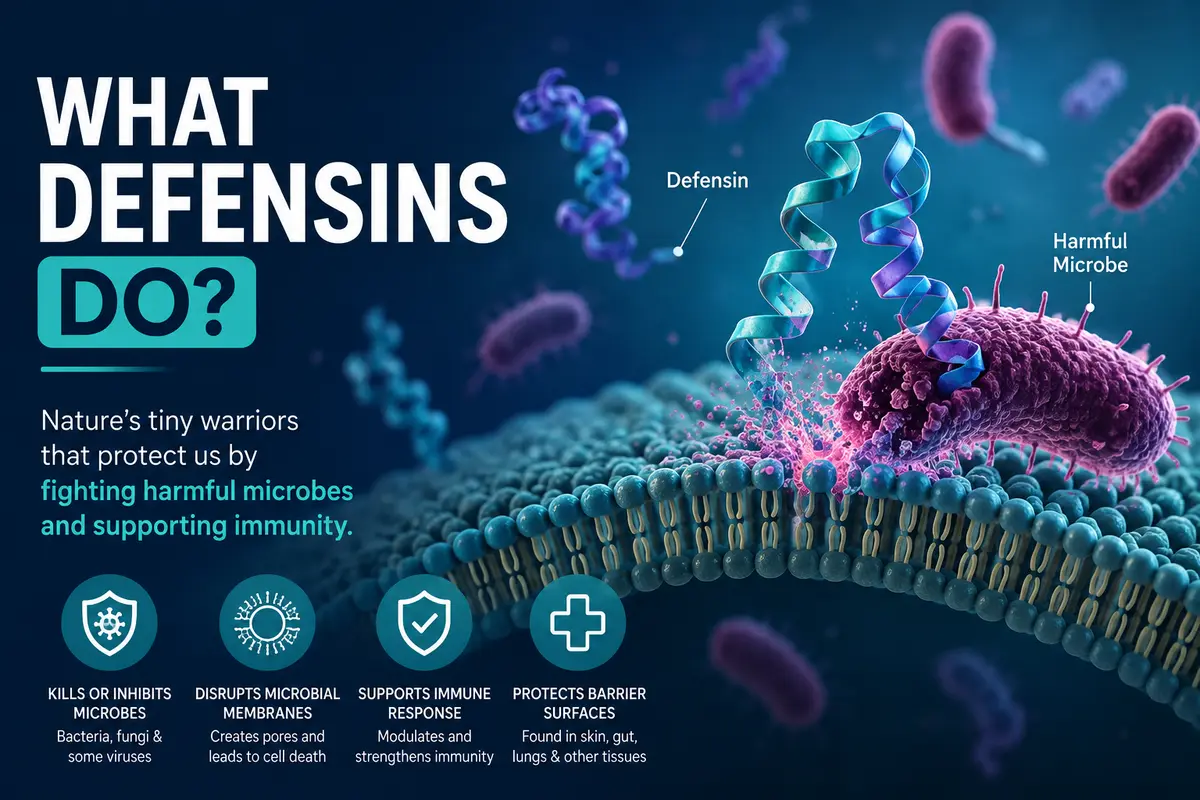
Learn about what defensins do, their structure, classification, functions, mechanisms of action, sources, and importance in innate immunity, antimicrobial research, and biotechnology.
Introduction
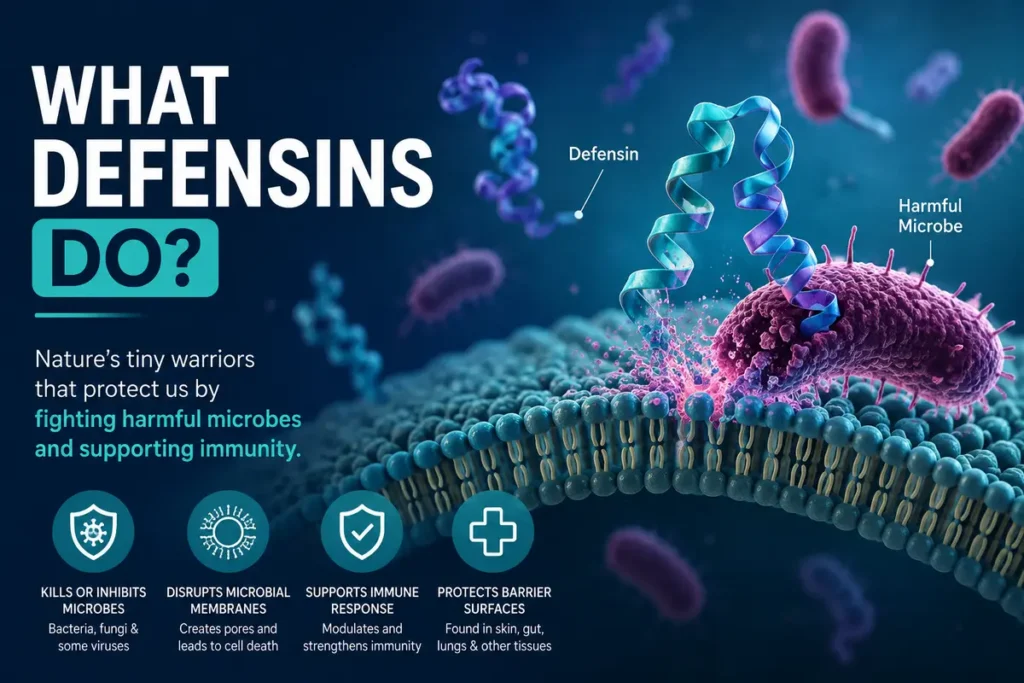
Defensins are peptides that are rich in cysteine. These peptides are part of the immunity system in humans, animals, plants, and many other living things. They work as natural defense tools against organisms like bacteria, fungi, and sometimes viruses and parasites.
Different from antibiotics that are usually made to focus on specific actions by microbes, defensins can work in many ways. They can break down cell membranes, connect with lipids in microbes, cause stress inside the cells, stop normal cell activities, and change how the body’s immune system reacts.
Because of this, defensins have become a focus for research in microbiology, immunology, molecular biology, plant pathology, biotechnology, pharmaceutical science, and the search for new antimicrobial medicines.
What Are Defensins?
Defensins are a family of small antimicrobial peptides that are identified by conserved cysteine residues and disulfide bonds. Many defensins contain six cysteines that form three intramolecular disulfide bonds, which help to keep their typical three‑dimensional shape stable.
Most defensins are fairly small. Often have a net positive charge. This positive charge lets defensins attach to charged microbial surfaces. The biological importance of defensins is not limited to antimicrobial action. Human defensins, for example, can also help recruit cells, send inflammatory signals, and regulate how the host immune system behaves.
In simple words, defensins are naturally produced antimicrobial peptides that help organisms protect themselves from invading microorganisms.
Key Characteristics of Defensins
| Characteristic | Description |
|---|---|
| Nature | Small antimicrobial peptides (AMPs) |
| Structure | Cysteine-rich with disulfide bonds |
| Charge | Many defensins are positively (cationically) charged. |
| Size | Generally small peptides |
| Main Function | Protect against invading microorganisms. |
| Target Microbes | Bacteria, fungi, and some viruses |
| Mechanism | Membrane disruption, target interaction, and immune modulation |
| Stability | Disulfide bonds provide structural stability. |
| Major Types | α-defensins, β-defensins, and θ-defensins |
| Sources | Humans, animals, plants, and other organisms |
| Role in Immunity | Important components of innate immunity |
| Research Importance | Potential applications in antimicrobial therapy, agriculture, and biotechnology |
What defensins do?
Microorganisms are always facing the defense systems of the host. Defensins offer a fast part of the natural protection. In animals, defensins help fight microbes in tissues and secretions such as the skin and the gut. Neutrophils and intestinal Paneth cells are sources of some human defensins.
In plants, defensins are part of the plants’ natural defense system. Are famous for stopping fungi. They are present in plant families and can be found in seeds, leaves, and flowers. This wide presence makes defensins interesting from a point of view as well as from a medical and farming point of view.
Structure of Defensins
The structure of defensins is one of their important biological characteristics. Many defensins have conserved cysteine residues that form disulfide bonds. These bonds play a role in keeping the peptide stable. They also help hold the three-shape that defensins need to work properly. Human α-defensins, for example, usually have six cysteines. These form three disulfide bonds. These bonds help stabilize a structure that is mostly made up of β-sheets.
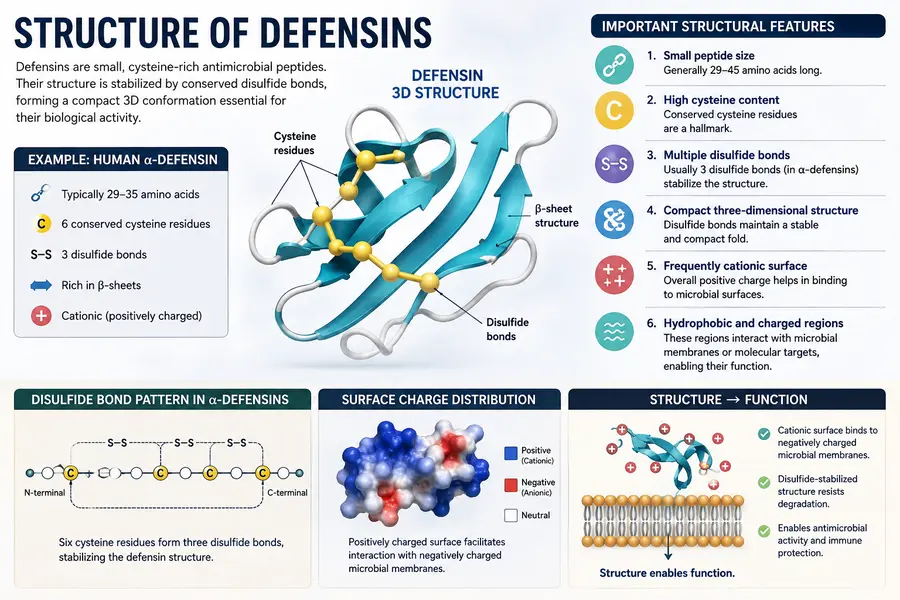
Important structural features:
- Small peptide size.
- High cysteine content.
- Multiple disulfide bonds.
- Compact three-dimensional structure.
- Frequently cationic surface.
- Hydrophobic and charged regions that facilitate interactions with microbial membranes or molecular targets.
Classification of Defensins
Defensins can be classified according to their evolutionary origin, structure, and organism. The major categories commonly discussed in biological and biomedical research include:
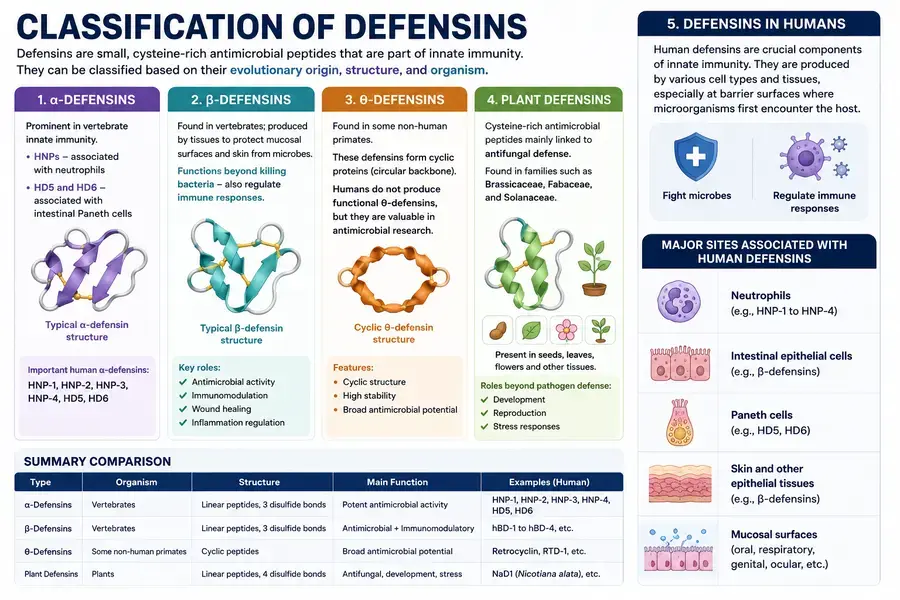
α-Defensins
α-defensins are prominent in vertebrate innate immunity. HNPs are associated particularly with neutrophils, whereas HD5 and HD6 are associated with intestinal Paneth cells. In humans, important α-defensins include HNP-1, HNP-2, HNP-3, HNP-4, HD5, and HD6.
β-Defensins
β-defensins are a group of defensins found in vertebrates. They are made by tissues and help protect mucosal surfaces and the skin from microbes. Their job goes beyond killing bacteria. They also influence the system, helping regulate immune responses.
θ-Defensins
The θ-defensins are a type of defensin that can be found in some non-human primates. They are made up of proteins that form a circle shape. Even though humans do not make θ-defensins as working proteins, they are very important in studies that look for ways to fight germs.
Plant Defensins
I find plant defensins remarkable. Plant defensins are cysteine-rich antimicrobial peptides that are especially linked to antifungal defense. Plant defensins have been found in plant families, such as Brassicaceae, Fabaceae, and Solanaceae. Plant defensins can be present in seeds, leaves, flowers, and other tissues. Plant defensins are especially intriguing because their roles can go beyond pathogen defense. Plant defensins can also be involved in development, reproduction, and stress responses.
Defensins in Humans
Human defensins are parts of innate immunity. Human defensins can be made by different cell types and tissues. Human defensins are especially important at barrier surfaces, where microorganisms first meet the host. Defensins help the host by fighting microbes and by regulating the immune system. Major sites associated with human defensins:
- Neutrophils
- Intestinal epithelial cells
- Paneth cells
- Skin and other epithelial tissues
- Mucosal surfaces
Mechanism of Action of Defensins
The antimicrobial mechanism of defensins is complex and can differ according to
- Defensin type
- Microbial species
- Membrane composition
- Lipid composition
- Peptide concentration
- Environmental conditions
- Ionic strength
- pH
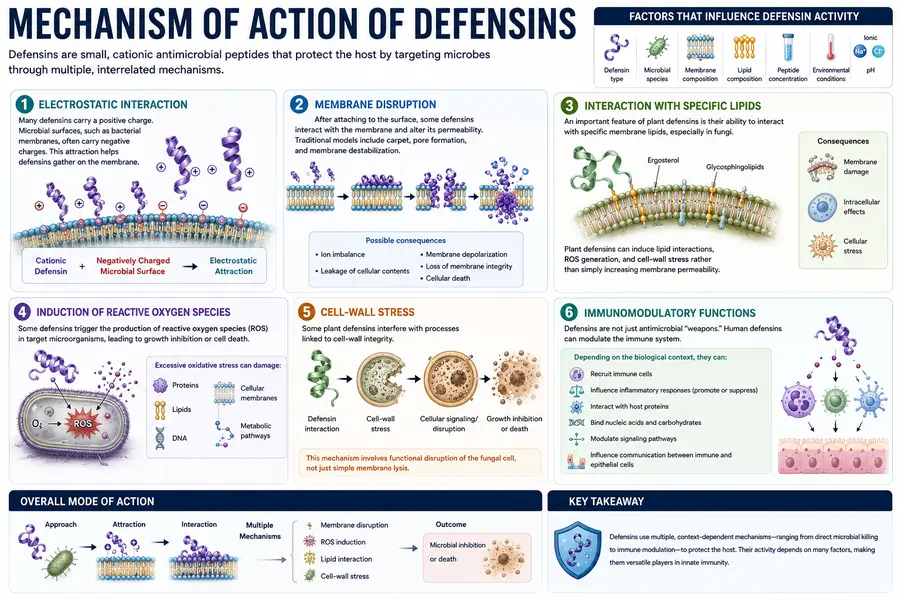
1. Electrostatic Interaction
Many defensins carry a charge. Microbial surfaces, bacterial membranes, often carry negative charges. This attraction helps defensins gather on the membrane.
2. Membrane Disruption
After attaching to the surface, some defensins can connect with the membrane and change how it lets things in. Traditional ideas used to describe how peptides affect the membrane include carpet actions, making holes, and making the membrane unstable. Defensins do not all work through basic membrane damage. Possible consequences include the following:
- Ion imbalance
- Leakage of cellular contents
- Membrane depolarization
- Loss of membrane integrity
- Cellular death
3. Interaction With Specific Lipids
An important feature of plant defensins is their ability to interact with specific membrane lipids. Some plant defensins recognize fungal membrane components, leading to damage that is linked to the membrane and causing reactions inside the cell. Research has shown that plant defensin actions can include lipid interactions and the creation of reactive oxygen species and stress on the cell wall instead of just making the membrane more permeable.
4. Induction of Reactive Oxygen Species
Some defensins can cause the creation of reactive oxygen species (ROS) in the microorganisms they target. This can help stop the growth of the microbe or lead to the death of the cell. Reactive oxygen species-related ways of working are very important in studies about plant defensins and fungus interactions. Excessive oxidative stress can damage:
- Proteins
- Lipids
- DNA
- Cellular membranes
- Metabolic pathways
5. Cell-Wall Stress
Some plant defensins interfere with processes that are linked to the integrity of the cell wall. This can lead to:
Defensin interaction → Cell-wall stress → Cellular signaling/disruption → Growth inhibition or death
This mechanism shows that defensin activity is not about breaking down membranes in a simple way. It involves steps that affect how the fungal cell functions. It highlights how defensins can act in an advanced and targeted way rather than just causing physical damage to membranes.
6. Immunomodulatory Functions
Defensins are not simply antimicrobial “weapons.” Human defensins can also influence the immune system. Importantly, defensins can sometimes promote or suppress inflammatory responses, depending on the cell type and biological context. Depending on the biological context, they can
- Recruit immune cells
- Influence inflammatory responses Interact with host proteins Bind nucleic acids and carbohydrates Modulate signaling pathways Influence communication between immune and epithelial cells
Factors Affecting Defensin Activity
Defensin activity is not determined only by its amino acid sequence. Important experimental factors include:
- Peptide concentration: Elevating concentration levels can impact the effectiveness of antimicrobial agents, although this connection isn’t consistently linear.
- pH: Changes in pH can affect peptide charge, structure, and target-cell interactions.
- Ionic strength: When there is a lot of salt, the electric attractions between defensins and microbial membranes can change.
- Microbial species: Different microorganisms have different membrane compositions and susceptibility levels.
- Temperature: Temperature can influence peptide stability and microbial physiology.
- Proteolytic degradation: Proteases may degrade defensins and reduce their activity.
- Lipid composition: Membrane lipid composition can strongly influence defensin binding and activity.
Potential Applications of Defensins
- Antimicrobial therapeutics: Defensins and defensin-derived peptides are studied as options or extra help to conventional antimicrobial drugs. Defensins and defensin-derived peptides show promise as alternatives or complements to antimicrobial drugs.
- Agriculture: Plant defensins might have uses in protecting crops and in resisting disease. Potential approaches include transgenic crops, breeding, peptide-based treatments, and plant defense enhancement. Plant antimicrobial peptides are being studied for use in agriculture and in food-related applications.
- Food preservation: Because antimicrobial peptides can stop microorganisms, scientists are studying peptides as possible tools to keep food fresh for longer.
- Biotechnology: Defensins can serve as useful models for designing new antimicrobial peptides.
- Pharmaceutical research: Defensin-inspired molecules may provide templates for developing new antimicrobial compounds.
Defensin Research: Important Questions for Researchers
- How does defensin sequence determine target specificity?
- Which microbial membrane components are recognized by individual defensins?
- How do microorganisms develop resistance to defensins?
- Can defensins be engineered to improve stability?
- Can defensin-derived peptides have improved therapeutic selectivity?
- How do defensins interact with host immune receptors?
- Can plant defensins improve resistance to crop pathogens?
- How can defensin production be optimized using recombinant systems?
- What structural features determine antifungal versus antibacterial activity?
- Can computational approaches predict defensin activity from sequence?
Frequently Asked Questions (FAQs)
1. Where are defensins produced?
Answer: Defensins are produced mainly by neutrophils, epithelial cells, Paneth cells, and other immune/barrier cells in humans.
2. What do defensins do?
Answer: Defensins protect the body against microorganisms by killing or inhibiting bacteria, fungi, and some viruses, while also helping regulate immune responses.
3. Where are defensins found, and what do they do?
Answer: Defensins are found in humans, animals, plants, and other organisms. They act as natural antimicrobial peptides, helping protect against bacteria, fungi, and some viruses as part of innate defense.
4. Where are defensins found?
Answer: Defensins are found in humans, animals, plants, and other organisms. In humans, they are mainly present in neutrophils, epithelial cells, skin, and mucosal tissues.
5. What are defensins?
Answer: Defensins are small, cysteine-rich antimicrobial peptides that form an important part of innate immunity. They help protect organisms against bacteria, fungi, and some viruses by disrupting microbial membranes and modulating immune responses.
References
- Ganz T. Defensins: antimicrobial peptides of innate immunity. Nature Reviews Immunology.
- Lehrer RI, Lu W. α-Defensins in human innate immunity. Immunological Reviews.
- Vriens K, Cammue BPA, Thevissen K. Antifungal plant defensins: mechanisms of action and production. Molecules.
- Parisi K et al. The evolution, function, and mechanisms of action for plant defensins. Seminars in Cell & Developmental Biology.
- Human defensins and immune functions review.
- Plant antimicrobial peptides: structures, functions, and applications. Botanical Studies.