
Learn what are chemokines and cytokines are, their types, functions, signaling mechanisms, receptors, and roles in immune response, inflammation, disease, and therapy.
Introduction
Suppose you slice your finger while cutting vegetables. Within a few minutes the injured area will turn slightly red and swollen, and your body will soon be repairing the wound without you even thinking about it. This incredible process is regulated by your immune system, like a city’s emergency response system. A fire emergency is when someone raises the alarm, the emergency responders get instructions, and the firefighters rush to the exact location. In much the same way the immune system relies on efficient communication among its cells.
Small signaling proteins known as cytokines and chemokines mediate this communication. When bacteria, viruses, fungi, or damaged cells are found, immune cells release cytokines, chemical messengers that alert, activate, and coordinate other immune cells.
When bacteria, viruses, fungi, or damaged cells are recognized, immune cells release cytokines, which operate as chemical messengers that warn, activate, and coordinate other immune cells. By telling cells when to proliferate, combat invasive pathogens, induce inflammation, or suppress the immune response after the threat has passed, they control immune responses.
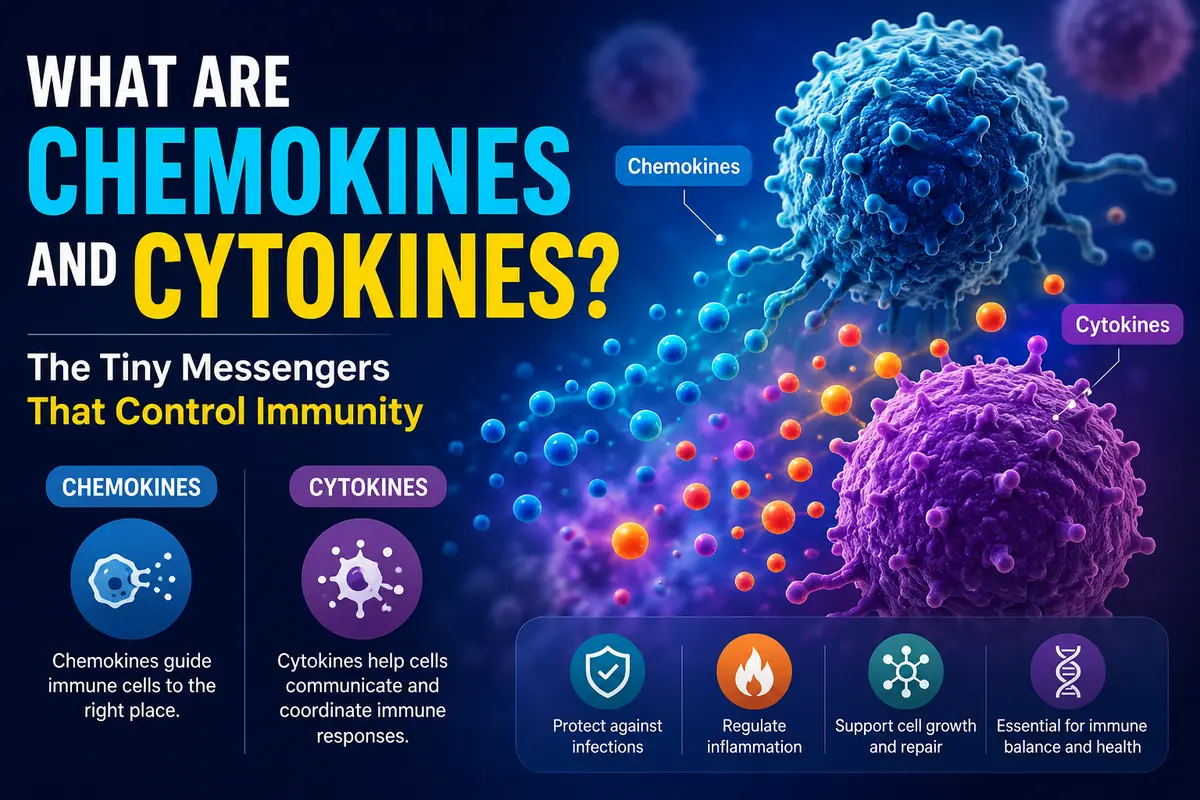
At the same time, chemokines, a specialized subset of cytokines, serve like a GPS navigation system by establishing a chemical pathway that sends immune cells such as neutrophils, macrophages, and lymphocytes to the exact site of infection or tissue injury. Therefore, chemokines direct immune cells where to go, whereas cytokines instruct them on what to do.
Using the cut finger as an example again, the wounded tissue initially produces cytokines that alert the immune system to the need for quick help. Chemokines quickly create a chemical gradient that accurately directs white blood cells to the lesion. These immune cells remove injured tissue, eradicate invasive microbes, and start the healing process. Anti-inflammatory cytokines inhibit excessive inflammation and restore normal tissue function when the tissue starts to heal.
As a result, cytokines and chemokines work together to create the body’s complex communication system, which guarantees that immune cells react to infections and wounds quickly, precisely, and effectively. Immune cells wouldn’t know how or when to react without cytokines, and they wouldn’t know where to go without chemokines. Host defense, inflammation, tissue healing, and the preservation of general immunological homeostasis all depend on their coordinated actions.
What are chemokines and cytokines?
The vertebrate immune system is made up of hundreds of millions of cells that are dispersed throughout the host’s body.
While some cells are sessile (stay in situ) in the epidermis, primary and secondary lymphoid tissues, and the mucosa of the respiratory, digestive, and genito-urinary tracts, others move through the blood and lymphatic systems.
The capacity of its many components to swiftly and effectively communicate with one another is crucial for the functioning of such a widely distributed organ system, allowing the appropriate cells to home to the suitable areas and conduct the required actions to eradicate invasive infections.
Cytokines are molecules that facilitate communication between immune system cells. While some cytokines are membrane-bound, most cytokines are soluble molecules. A cytokine can migrate from one place to another by interacting with its receptor on a target cell, which can alter the expression of chemokine receptors and adhesion molecules on the target membrane.
Additionally, cytokines can instruct an immune cell to modify its transcriptional program or raise or lower the activity of specific enzymes, which will change and improve its effector functions. Lastly, they have the ability to tell a cell when to die and when to live.
Immunologists first tried to categorize cytokines by designating them interleukins and numbering them according to the order in which they were discovered. The fact that interleukins facilitate communication between (Latin, inter) white blood cells (leukocytes) is reflected in this term. Interleukin 1 (IL-1), which is released by macrophages, and interleukin 2 (IL-2), which is released by activated T cells, are two examples.
Students will encounter cytokines like tumor necrosis factor and interferons, which are likewise “interleukins” in all but name, because many cytokines that were named before this attempt at simplifying nomenclature have resisted reclassification.
The subgroup of cytokines that share the unique function of mobilizing immune cells from one organ, or even from one region of an organ, to another is referred to as chemokines, even though the term “cytokine” applies to all molecules that communicate among immune cells.
Chemokines are members of the class of chemicals known as chemoattractants, which attract cells by affecting the expression of cell-surface adhesion molecules and the assembly, disassembly, and contractility of cytoskeleton proteins.
Chemokines draw cells that have the right chemokine receptors to areas with high chemokine concentrations. For instance, chemokines play a crucial role in drawing innate immune system cells to the infection site and encouraging T cells to migrate toward antigen-presenting cells in secondary lymphoid tissues.
Throughout an immune response, leukocytes alter the way they express chemokine receptors. They first migrate to the secondary immune organs, where they differentiate into mature effector cells, and then they move out into the infected tissues to combat the infection, reacting to various chemokine gradients as they do so. Chemokines can also direct cells to change their transcriptional pathways, as we will discover in a subsequent section.
Based on their molecular structures, chemokines are more logically categorized and named than interleukins. Although chemokines are technically classified as “cytokines,” common usage is changing so that the term “chemokine” refers to molecules that transport immune cells, while “cytokine” refers to any other immune system messenger molecule.
Cytokines, like all signaling molecules, can be further categorized according to the separation between the cell that secretes the signaling ligand and the cell that receives the chemical signal. Endocrine cytokines are those that operate on cells at a distance from the secreting cell, requiring them to travel through the bloodstream before they can reach their target.
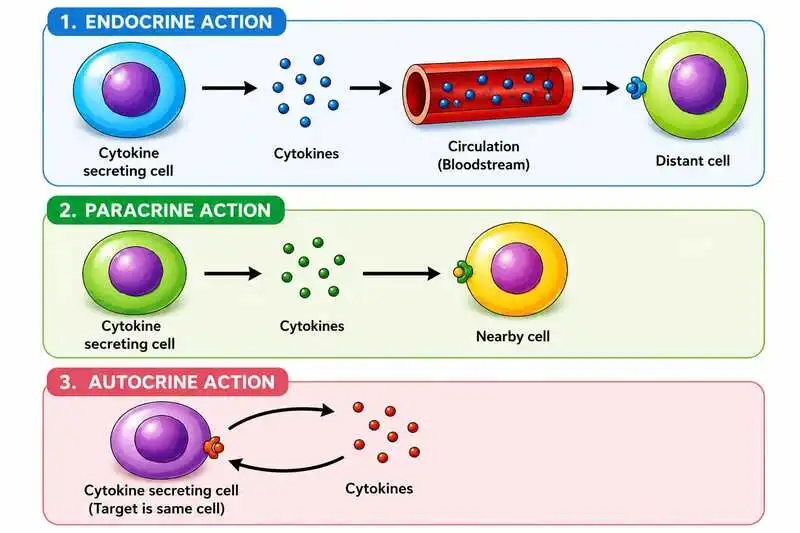
Paracrine cytokines are those that operate on cells close to the secreting cell so that the cytokine only needs to diffuse a few angstroms through tissue fluids or across an immunological synapse. A cell may occasionally need to receive a signal from a cytokine that it has released via its own membrane receptors. We call this kind of signaling autocrine.
Notably, T-cell interleukin IL-2 functions well in each of the three types. Many cytokines act over short distances in an autocrine or paracrine manner, in contrast to traditional hormones like insulin and glucagon, which often work over long ranges in an endocrine manner.
Difference between chemokines and cytokines
| Feature | Chemokines | Cytokines |
|---|---|---|
| Definition | Chemokines are a specialized group of cytokines that attract and direct the movement of immune cells. | Cytokines are small signaling proteins that regulate communication between immune and other body cells. |
| Primary Function | Guide immune cells to sites of infection, inflammation, or injury (chemotaxis). | Regulate immune responses, inflammation, cell growth, differentiation, and tissue repair. |
| Main Role | Cell migration and trafficking. | Cell signaling and immune regulation. |
| Target Cells | Mainly leukocytes (white blood cells). | Various immune and non-immune cells. |
| Production | Produced by macrophages, dendritic cells, endothelial cells, fibroblasts, and other cells. | Produced by T cells, B cells, macrophages, dendritic cells, NK cells, and many other cell types. |
| Mechanism of Action | Bind to chemokine receptors (CCR and CXCR) to direct cell movement. | Bind to specific cytokine receptors to activate intracellular signaling pathways. |
| Biological Effects | Recruitment of neutrophils, monocytes, lymphocytes, and other immune cells. | Activation or suppression of immune responses, inflammation, hematopoiesis, antiviral defense, and tissue repair. |
| Examples | CXCL8 (IL-8), CCL2 (MCP-1), CXCL10, CCL5 (RANTES). | IL-1, IL-2, IL-6, TNF-α, IFN-γ, IL-10, TGF-β. |
| Relationship | Chemokines are a subgroup of cytokines. | Cytokines include chemokines, interleukins, interferons, tumor necrosis factors, and growth factors. |
Conclusion
Chemokines and cytokines are essential signaling molecules that regulate the immune system by coordinating communication between cells. While cytokines control a wide range of immune responses, including inflammation, cell growth, and tissue repair, chemokines primarily direct the migration of immune cells to sites of infection or injury.
Together, they maintain immune homeostasis and ensure an effective defense against pathogens. However, an imbalance in their production can contribute to chronic inflammation, autoimmune diseases, allergies, and cancer.
Understanding the functions and interactions of chemokines and cytokines has greatly advanced modern immunology and has led to the development of targeted therapies for many immune-related disorders. Continued research in this field holds significant promise for improving disease diagnosis, prevention, and treatment.
FAQs
1. What are cytokines?
Answer: Cytokines are small signaling proteins released by immune and other cells that help regulate the body’s immune response. They enable cells to communicate, coordinate inflammation, fight infections, promote tissue repair, and control the growth and activity of immune cells. Examples include interleukins (ILs), interferons (IFNs), tumor necrosis factors (TNFs), and chemokines.
2. What is the difference between chemokines and cytokines?
Answer: All chemokines are cytokines, but not all cytokines are chemokines.
3. What do cytokines and chemokines do?
Answer: Cytokines and chemokines help coordinate the body’s immune response. Cytokines regulate communication between immune cells, control inflammation, and support tissue repair, while chemokines direct immune cells to sites of infection, injury, or inflammation where they are needed most.
4. Are chemokines and cytokines the same?
Answer: No, chemokines and cytokines are not the same. Chemokines are a specialized subgroup of cytokines that mainly guide the movement of immune cells. In contrast, cytokines have broader functions, including regulating immune responses, inflammation, cell growth, and tissue repair.
5. What are chemokines?
Answer: Chemokines are a specialized group of cytokines that direct the movement of immune cells to sites of infection, inflammation, or injury. They play a key role in immune cell migration and help coordinate the body’s immune defense.
References
- Abbas, A. K., Lichtman, A. H., & Pillai, S. (2024). Cellular and Molecular Immunology (11th ed.). Elsevier.
- Kuby Immunology. Owen, J. A., Punt, J., & Stranford, S. A. (2023). Kuby Immunology (10th ed.). W. H. Freeman and Company.
- Murphy, K., & Weaver, C. (2022). Janeway’s Immunobiology (10th ed.). Garland Science.
- Delves, P. J., Martin, S. J., Burton, D. R., & Roitt, I. M. (2023). Roitt’s Essential Immunology (14th ed.). Wiley-Blackwell.
- Goldsby, R. A., Kindt, T. J., Osborne, B. A., & Kuby, J. (Earlier editions). Immunology (6th ed.). W. H. Freeman.
- Akdis, M., Burgler, S., Crameri, R., et al. (2011). Interleukins, from 1 to 37, and interferon-γ: Receptors, functions, and roles in diseases. Journal of Allergy and Clinical Immunology, 127(3), 701–721.
- Zlotnik, A., & Yoshie, O. (2012). The Chemokine Superfamily Revisited. Immunity, 36(5), 705–716.
- Turner, M. D., Nedjai, B., Hurst, T., & Pennington, D. J. (2014). Cytokines and chemokines: At the crossroads of cell signaling and inflammatory disease. Biochimica et Biophysica Acta (BBA) – Molecular Cell Research, 1843(11), 2563–2582.