
Learn what is an example of cytokine therapy is with real-life examples. Explore interferon, interleukin-2, how cytokine therapy works, its benefits, uses, and side effects.
Introduction
Picture Your City With a Well-Trained Emergency Response Team When there is fire, firemen rush in, police control traffic, and medical teams help injured people. But these teams don’t operate in isolation—they rely on emergency radio messages that tell them where to go, when to act, and how strong the response should be.
Your immune system works in roughly the same way.
Instead of radio signals, immune cells communicate with small signaling proteins called cytokines. These chemical messengers control the body’s defense against infections, injuries, and even cancer.
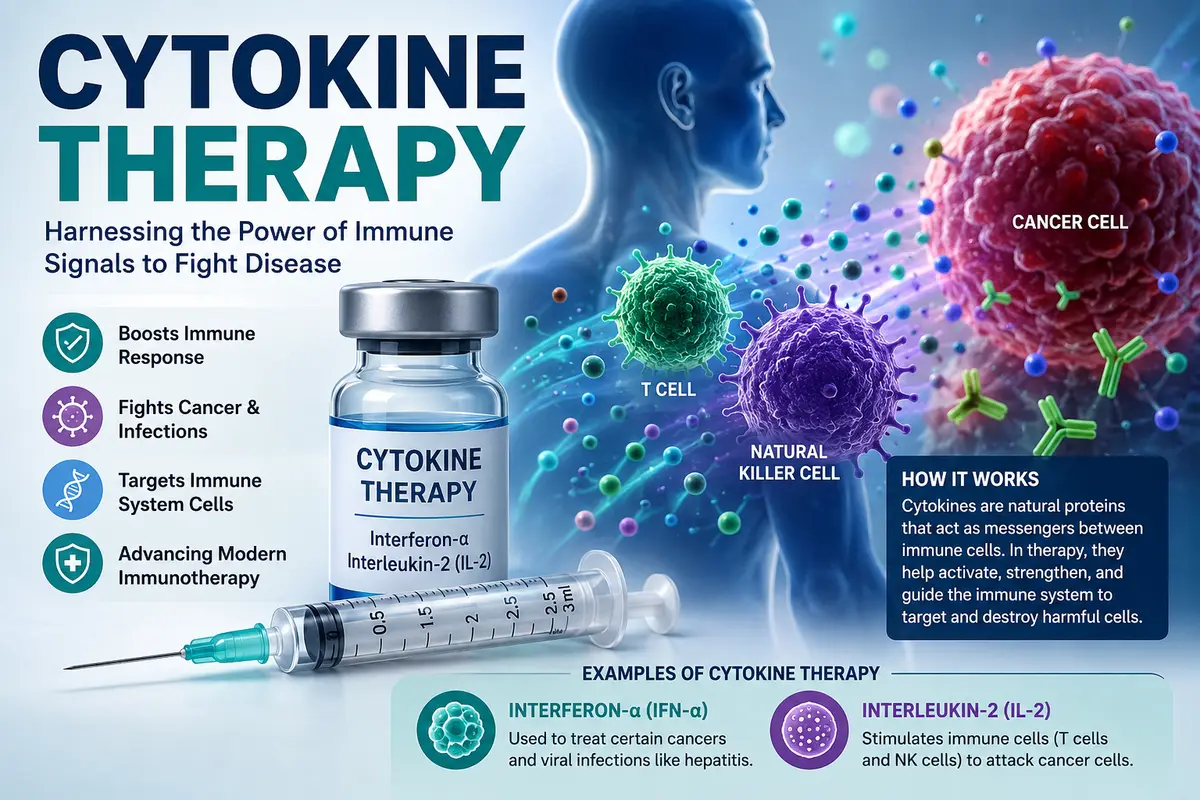
Cytokine therapy takes advantage of this natural communication system by using laboratory-produced or naturally occurring cytokines as medicines. These treatments can boost the immune system to combat diseases or regulate immune responses when the body requires additional support.
Interferon-alpha (IFN-α) is a classic example of cytokine therapy, having been used to treat certain cancers (e.g., melanoma) and viral infections (e.g., hepatitis). Another important example is Interleukin-2 (IL-2), a cytokine that stimulates immune cells to help the body attack cancer cells, particularly T cells and natural killer (NK) cells. These therapies illustrate how cytokines can be used as potent medicines to boost the body’s natural immune defenses.
Cytokine therapy: What is it? Common examples, how it works, benefits, side effects, and the latest advances in cytokine-based treatments. Explained in simple, student-friendly language.
What is an example of cytokine therapy?
Purified cloned cytokines, monoclonal antibodies to cytokines, and soluble cytokine receptors are now available and offer the prospect of specific clinical therapies to modulate the immune response. Interferons (see Clinical Focus Box 4-2), colony-stimulating factors such as G-CSF, and IL-2 have all been used clinically.
In addition, a number of reagents that specifically block the pro-inflammatory effects of TNF-a have been used therapeutically in some diseases. Specifically, soluble TNF-a receptor (Enbrel) and monoclonal antibodies to TNF-a (Remicade and Humira) have been used in the treatment of rheumatoid arthritis and ankylosing spondylitis in more than one million patients.
These anti-TNF-α drugs reduce proinflammatory cytokine cascades, help to relieve pain, stiffness, and joint swelling, and promote healing and tissue repair. Furthermore, as mentioned above, the recombinant form of IL-1Ra-anakinra (Kineret) has been shown to be relatively effective in the treatment of rheumatoid arthritis. Monoclonal antibodies against the IL-2R-α chain—basiliximab (Simulect) and daclizumab (Zenapax)—are also used clinically for the prevention of transplantation rejection reactions.
These are powerful reagents, but interfering with the normal course of the immune response is not without its own intrinsic hazards. The reduction in cytokine activity is accompanied by a higher risk of infection and malignancy, with an increased incidence of lymphoma seen in patients who are long-term users of the first-generation TNF-α-blocking drugs.
Furthermore, the technical challenges involved in modifying cytokines for regular, safe medical usage are far from insignificant. As previously mentioned, during an immune response, interacting cells may produce extraordinarily high local concentrations of cytokines near target cells.
However, it is challenging to achieve such high concentrations over a clinically significant time period when cytokines must be administered systemically. Moreover, many cytokines have very short half-lives; for example, intravenous recombinant human IL-2 has a half-life of about 7 to 10 minutes, necessitating repeated administration.
Lastly, cytokines can have unanticipated and unfavorable side effects despite being incredibly powerful biological response modifiers. For instance, administering recombinant IL-2 can cause moderate adverse effects, including fever, chills, diarrhea, and weight gain, as well as catastrophic ones like anemia, thrombocytopenia, shock, respiratory failure, and coma.
The application of cytokines and anti-cytokine therapies in clinical medicine has a lot of potential, and efforts to create safe and efficient cytokine-related strategies are ongoing, especially in medical specialties like organ transplantation, cancer, inflammation, and chronic allergic disease that have not yet responded well to more traditional methods.
According to the National Cancer Institute, cytokine therapy is a form of immunotherapy that uses proteins to strengthen the immune response against diseases.
Conclusion
Cytokine therapy is a powerful form of immunotherapy that uses the body’s natural signaling proteins to strengthen or regulate the immune system. Treatments such as interferon-alpha and interleukin-2 have shown that cytokines can help fight certain cancers, viral infections, and other immune-related conditions. While these therapies can be highly effective, they may also cause side effects and require careful medical supervision.
As research continues, newer cytokine-based treatments are becoming more targeted and safer, offering hope for patients with cancer, autoimmune disorders, and infectious diseases. Understanding how cytokine therapy works not only highlights the remarkable communication system of the immune system but also shows how modern medicine can harness these natural signals to improve human health.
FAQs
1. What is cytokine therapy used for?
Answer: Cytokine therapy is used to boost or regulate the immune system to treat diseases such as cancer, viral infections, autoimmune disorders, and certain immune deficiencies. It helps immune cells recognize and destroy harmful cells while improving the body’s natural defense mechanisms.
2. Which is an example of a cytokine used for therapy?
Answer: An example of a cytokine used for therapy is interleukin-2 (IL-2), which helps activate immune cells to fight certain cancers. Another common example is interferon-alpha (IFN-α), used to treat some cancers and viral infections.
3. Do cytokines fight cancer?
Answer: Yes. Cytokines can help fight cancer by activating and strengthening the immune system, enabling immune cells such as T cells and natural killer (NK) cells to recognize and destroy cancer cells. Some cytokines, like Interleukin-2 (IL-2) and Interferon-alpha (IFN-α), are used in cancer immunotherapy.
4. What are the 5 inflammatory cytokines?
Answer: The five major inflammatory cytokines are:
Tumor Necrosis Factor-alpha (TNF-α)
Interleukin-1 (IL-1)
Interleukin-6 (IL-6)
Interleukin-8 (IL-8)
Interferon-gamma (IFN-γ)
These cytokines help trigger and regulate inflammation during infections, injuries, and immune responses.
5. What are the side effects of cytokines approved for therapy?
Answer: Common side effects of cytokines used in therapy include the following:
Fever and chills
Fatigue (tiredness)
Muscle and joint pain
Nausea and loss of appetite
Low blood pressure
Skin rash
Flu-like symptoms
The severity of side effects depends on the type of cytokine, dose, and the patient’s overall health.
References
- Owen JA, Punt J, Stranford SA. Kuby Immunology. 9th ed. New York: W.H. Freeman; 2023.
- Abbas AK, Lichtman AH, Pillai S. Cellular and Molecular Immunology. 11th ed. Elsevier; 2024.
- Murphy K, Weaver C. Janeway’s Immunobiology. 10th ed. W.W. Norton & Company; 2022.
- Conlon KC, Miljkovic MD, Waldmann TA. Cytokines in the Treatment of Cancer. Journal of Interferon & Cytokine Research. 2019;39(1):6–21. doi:10.1089/jir.2018.0019.
- Waldmann TA. Cytokines in Cancer Immunotherapy. Cold Spring Harbor Perspectives in Biology. 2018;10(12):a028472. doi:10.1101/cshperspect.a028472.
- Kim CH, et al. Current Development Status of Cytokines for Cancer Immunotherapy. Pharmaceutics. 2023;15(12):2853. doi:10.3390/pharmaceutics15122853.
- National Cancer Institute (NCI). Cytokine Therapy. Available at: https://www.cancer.gov/publications/dictionaries/cancer-terms/def/cytokine-therapy
- National Center for Biotechnology Information (NCBI Bookshelf). Cytokines. Available at: https://www.ncbi.nlm.nih.gov/books/