
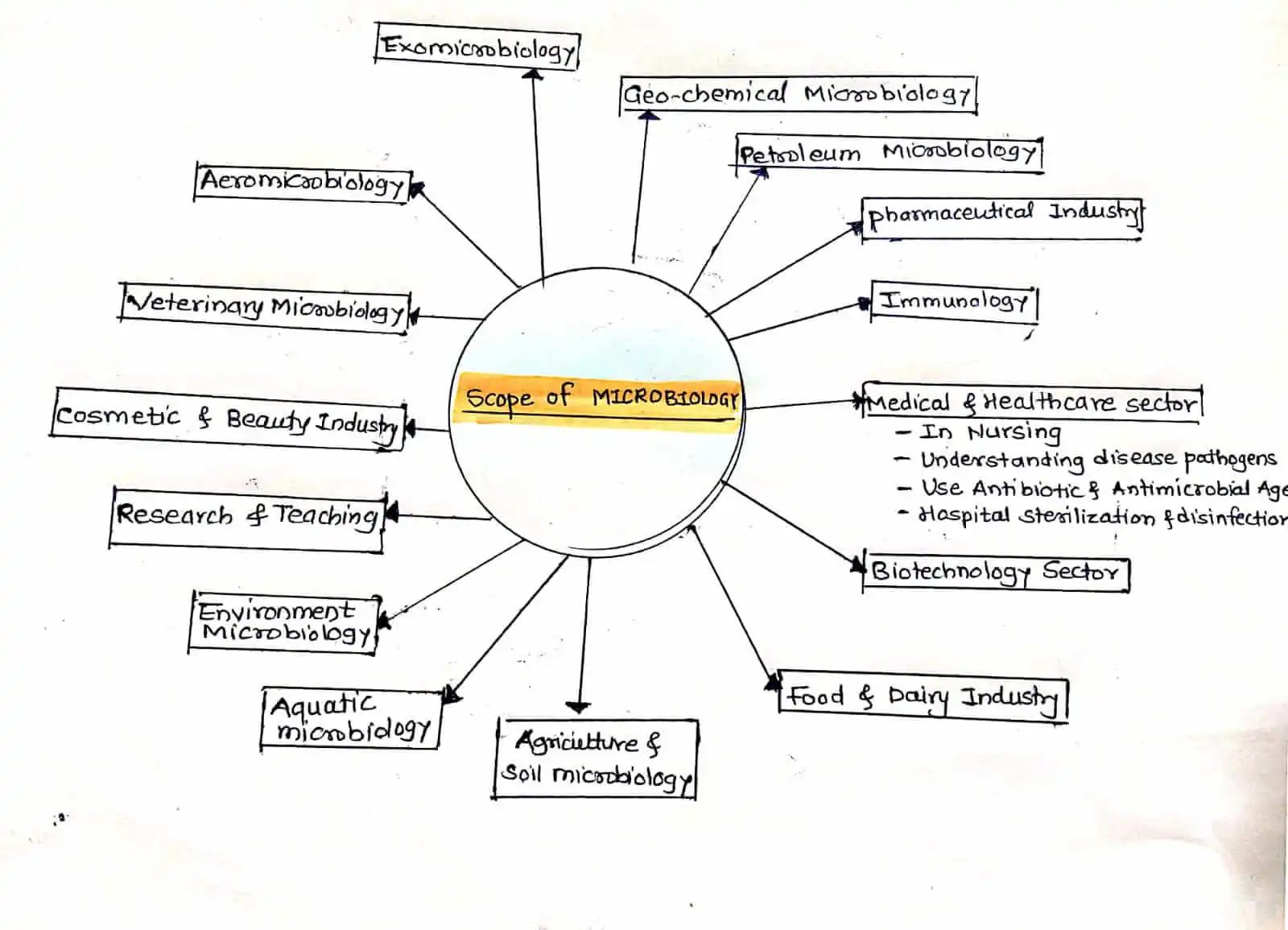

Here is a clear, complete, and student-friendly explanation of the scope of microbiology.
What are the scopes of microbiology? Discover 17 powerful career opportunities in healthcare, biotechnology, research, pharmaceuticals, food science, and environmental microbiology.
Scope of Microbiology (With Explanation)
Microbiology has a very large and growing scope because microorganisms are involved in health, industry, environment, food, research, biotechnology, and medicine. After COVID-19, the demand for microbiologists increased even more across the world.
A) Medical and healthcare Sector
- Diagnosis of diseases in hospitals
- Developing vaccines and antibiotics
- Infection control and hospital hygiene
- Working in pathology labs
- Research on viruses, bacteria, fungi
Job Roles:
Clinical Microbiologist, Lab Technician, Medical Scientist
1) Scope of Microbiology in Nursing
Microbiology is essential in nursing because nurses deal directly with patient care, infection prevention, and hospital hygiene. Understanding microbes helps nurses prevent infections, ensure patient safety, and provide scientific care based on evidence.
i) Infection Control
- Identifying routes of infection (air, water, contact, vectors).
- Preventing hospital-acquired infections (HAIs / nosocomial infections).
- Proper hand hygiene, aseptic techniques, sterilization, and disinfection.
ii) Patient Care & Nursing Practices
- Safe wound care, dressing changes, and catheter care.
- Handling infectious patients and isolation procedures.
- Maintaining sterile fields during medical procedures.
iii) Understanding Disease Pathogens
- Knowledge of bacteria, viruses, fungi, and parasites causing diseases.
- Helps in early recognition of symptoms and complications.
- Understanding the life cycle and transmission of microorganisms.
iv) Use of Antibiotics & Antimicrobial Stewardship
- Correct administration of antibiotics and antivirals.
- Understanding drug resistance and the importance of completing doses.
- Preventing unnecessary or wrong use of antimicrobials.
v) Laboratory Skills & Interpretation
- Collecting samples: blood, urine, sputum, wound swabs.
- Preventing contamination while handling specimens.
- Understanding lab reports: culture sensitivity, WBC counts, serology.
vi) Hospital Sterilization & Disinfection
- Knowledge of autoclave use, disinfectants, and antiseptics.
- Monitoring sterilized instruments and equipment safety.
- Maintaining hygiene in operation theaters and wards.
vii) Infection Prevention During Procedures
- IV cannulation, injections, catheterization, dressing, minor surgery.
- Proper PPE (gloves, masks, and gowns) usage.
- Preventing cross-infection between patients.
viii) Public Health & Community Nursing
- Control of communicable diseases in the community.
- Immunization programs, health education, and outbreak management.
- Home visits and educating families about sanitation & hygiene.
ix) Nursing Research & Evidence-Based Practice
- Conducting small research studies on infection trends.
- Applying microbiology knowledge to improve patient outcomes.
- Documentation & data collection for hospital infection committees.
Career Opportunities for Nurses
- Infection Control Nurse (ICN)
- Community Health Nurse
- Public Health Nurse
- OT Nurse / Surgical Nurse
- Laboratory Nurse
- Nurse Educator
- Hospital Quality Control Team Member
Short Exam-Friendly Answer (3–4 lines)
Microbiology in nursing helps nurses understand disease-causing microorganisms, infection transmission, sterilization, and antibiotic use. It plays a major role in patient care, hospital infection control, specimen handling, and public health. Knowledge of microbiology enables nurses to provide safe, scientific, and infection-free healthcare.
2) Scope of Microbiology in the Pharmaceutical Industry:
- Below is a clear, concise, exam-friendly, and interview-ready explanation of the scope of microbiology in pharmacy (English)—with points + short notes.
- Microbiology plays a crucial role in pharmacy because drug safety, sterility, and quality depend heavily on microbial control. Pharmaceutical industries require microbiologists in almost every stage—from drug manufacturing to vaccine development.
i) Pharmaceutical Microbiology:
- The scope of microbiology in pharmaceutical microbiology is the study of microorganisms that affect drug quality.
- Ensures medicines are free from harmful micro
- Helps in preventing contamination in tablets, syrups, injectables, etc.
ii) Drug Manufacturing & Quality Control (QC):
- Microbial limit testing of raw materials and final products.
- Sterility testing for injections, eye drops, and IV fluids.
- Environmental monitoring in production areas.
- Endotoxin testing, bioburden testing, and water quality testing.
iii) Quality Assurance (QA):
- Ensuring drugs meet GMP & regulatory microbial standards.
- Validation of sterilization techniques.
- Documentation, SOP preparation, and audits.
iv) Antibiotic Development:
- The scope of microbiology in antibiotic development is to isolate microorganisms to study antibiotic sensitivity.
- Helps in developing new antibacterial, antifungal, and antiviral drugs.
- Understanding drug resistance patterns.
v) Vaccine Development:
- Use of microbial strains to produce vaccines.
- Culture preparation, antigen development, and quality testing.
- Crucial in pharmaceutical biotechnology.
vi) Biopharmaceuticals & Biotechnology:
- Production of insulin, monoclonal antibodies, enzymes, and hormones.
- Recombinant DNA technology relies heavily on microbiology.
- Large scope in biotech/pharma companies.
vii) Clinical Microbiology (Hospital Pharmacy):
- Infection testing, sample analysis, and antibiotic advisory.
- Infection-control pharmacist roles are increasing worldwide.
viii) Industrial Fermentation:
- Microorganisms used for large-scale production of:
- Antibiotics (penicillin, streptomycin)
- Alcohols
- Vitamins
- Organic acids
- High demand in fermentation and API industries.
3) Scope of Microbiology in Immunology
- Immunologists have a very bright future because of fast developments in recombinant DNA technology and hybridoma technology.
Regulatory Affairs:
Ensuring microbiological guidelines are followed (WHO, US-FDA, GMP).
Documentation for audits, compliance, and product approval.
4) Scope of Microbiology in Research & Development (R&D):
- Development of new drug molecules.
- Probiotic formulation.
- Sterilization methods & antimicrobial testing.
- Huge scope in pharma R&D labs and academic research.
Career Opportunities
- Pharmaceutical Microbiologist
- QC/QA Executive
- R&D Scientist
- Vaccine Production Scientist
- Biotechnologist
- Clinical Microbiologist
- Regulatory Affairs Officer
- Fermentation Technologist
Short Exam-Friendly Answer
Microbiology in pharmacy deals with the study of microorganisms that influence drug preparation, safety, sterility, and effectiveness. It has wide scope in drug manufacturing, sterility testing, antibiotic development, vaccine production, quality control, biotechnology, fermentation technology, and pharmaceutical research.
Companies:
Sun Pharma, Cipla, Dr. Reddy’s, Biocon, Serum Institute
B) Biotechnology Sector:
- DNA/RNA research
- Microbial engineering
- Enzyme production
High-salary area with huge scope
C) Food & Dairy Industry:
- Food quality testing
- Fermentation (yogurt, cheese, bread, beer)
- Contamination testing
- Food safety officer roles
Companies:
Amul, Nestlé, Britannia, PepsiCo
D) Agriculture & Soil Microbiology:
- Fertilizer production
- Bio-pesticides
- Plant disease control
- Soil testing labs
This sector is expanding due to sustainable farming.
E) Environmental Microbiology:
- Water testing
- Wastewater treatment
- Pollution control
- Bioremediation (using microbes to clean oil spills)
Governments hire microbiologists for environmental projects.
F) Research & Teaching:
- Work in research labs: ICMR, CSIR, DRDO, NCDC
- Work as a scientist
- Become lecturer or professor
G) Forensic Science:
- Crime scene investigation
- DNA fingerprinting
- Biological sample analysis
H) Cosmetics & Beauty Industry:
- Testing cosmetic products
- Ensuring microbiological safety
- Product formulation research
I) Public Health Sector:
- Tracking infectious diseases
- Epidemiology
- Government health programs
- Vaccine development teams
J) Microbial Ecology
- The scope of microbiology in microbial ecology is closely related to soil microbiology.
- Microbial ecologists study the relationship between microorganisms and their habitat.
- They are concerned with the contribution of microorganisms to the carbon, nitrogen, and sulfur cycles in soil and in freshwater.
K) Veterinary Microbiology
- Scope of Microbiology in Veterinary Microbiology—This subdiscipline deals with the harmful effects of disease agents on domestic livestock and poultry. The spread and control of such pathogens are of major concern.
- The veterinary microbiologists are getting good jobs now in the dairy industry and big poultry farms.
- They may also establish their own small livestock or poultry units, as they are well-informed about the biology and microbiology of these animals. The government is also offering good subsidies to continue the achievement of the “White Revolution.”
L) Aeromicrobiology
- It deals with the study of the atmospheric environment, which includes pollutants as well as bacteria, bacterial spores, fungal spores, viruses, etc.
- As such it is the job of Aeromicrobiologists to study the microbial content of air present in domestic living areas, pharmaceutical units, food-processing or dairy plants, etc.
- To prevent nosocomial infections in hospitals and plant diseases in farms, it is necessary to take the survey of aerial flora of hospitals and farms, respectively.
M) Exomicrobiology
- It deals with the studies on exploration for life in outer space.
- Scope of Microbiology in Exomicrobiology is the scope of microbiology. Exo-microbiologists, or space microbiologists, had to find out how microbes can be useful at various levels in space exploration studies.
- For example, microbes can be used as indicators to test the effects of weightlessness, acceleration, radiation, a completely artificial atmosphere, and the many new experiences human beings may have in space travel.
- Studies are also carried out to detect the presence of microorganisms on the Moon, Mars, and Venus. These types of studies will help in solving many mysteries of outerspace areas.
- So many microbiologists have good opportunities to work in multifaceted outer space programs. NASA is the biggest institute where active studies on exomicrobiology are going on. In India, the Centre for Cellular and Molecular Biology [CCMB] at Hyderabad is involved in such studies.
N) Aquatic Microbiology
- It deals with the study of microorganisms and their activities in fresh, estuarine, and marine waters.
- Aquatic microorganisms and their activities are of great importance in many ways. They may affect the health of human and other animal life; they occupy a key position in the food chain by providing rich nourishment for the next higher level of aquatic life, and they play an instrumental role in the recycling of elements (i.e., mineralization).
- Aquatic microbiology has emerged as one of the major fields of applied microbiology. Urbanization and, consequently, the growing demand for water by communities; the importance of natural water as a major food source; the offshore exploration for oil and minerals; and the availability of novel drugs and enzymes from marine microorganisms have attracted the attention of so many dominant rulers all over the world.
- The microbiologists have the challenging opportunities for exploring the isolation of microorganisms producing valuable drugs, antibiotics, enzymes, and vitamins and also have ample opportunities to cultivate “seaweed” for the source of biomass to make delicious fermented foods such as “nori,” “shoyu,” etc.
O) Geochemical Microbiology (Bio-Extractive Metallurgy)
- It deals with the applied areas such as coal, mineral, and natural gas formations. It also highlights the recovery of minerals from low-grade ores with the help of microorganisms (microbial ore leaching).
- A separate branch known as “coal biotechnology” has emerged due to roles played by acid bacteria in coal mining.
- This is a very interesting and thrilling field where microbiologists can utilize their knowledge in extracting important as well as precious metals from mines. More and more microorganisms are now available, which can leach a variety of metals at very low cost with simple technology. Coal biotechnology is still one more promising field for microbiologists. The government-undertaking mining corporations as well as some big private mining companies are now offering lucrative jobs as metallurgic microbiologists.
P) Petroleum Microbiology
- Microorganisms are associated with petroleum in its formation, exploration, its recovery by drilling, the enhancement of recovery, its decomposition, and its utilization.
- Petroleum microbiology involves such studies, which require an interdisciplinary approach by taking cooperation from chemists, engineers, oil technologists, and geophysicists.
- This is also a very interesting and thrilling field for microbiologists, as microbiology is involved at each and every step in petroleum industries, especially in microbially enhanced oil recovery. Even microbes are useful in removing oil spills and thereby reducing the problems of oil pollution, evoking images of impending “ecological dooms” and helping in the survival of sea life. Microbiologists have achieved the skill of “bioremediation” to solve the problems of oil pollution through recombinant DNA technology. “Super hug” (genetically engineered Pseudomonas putida) is the best example of bioremediation conceptualized by Dr. Anand Chakravarty.
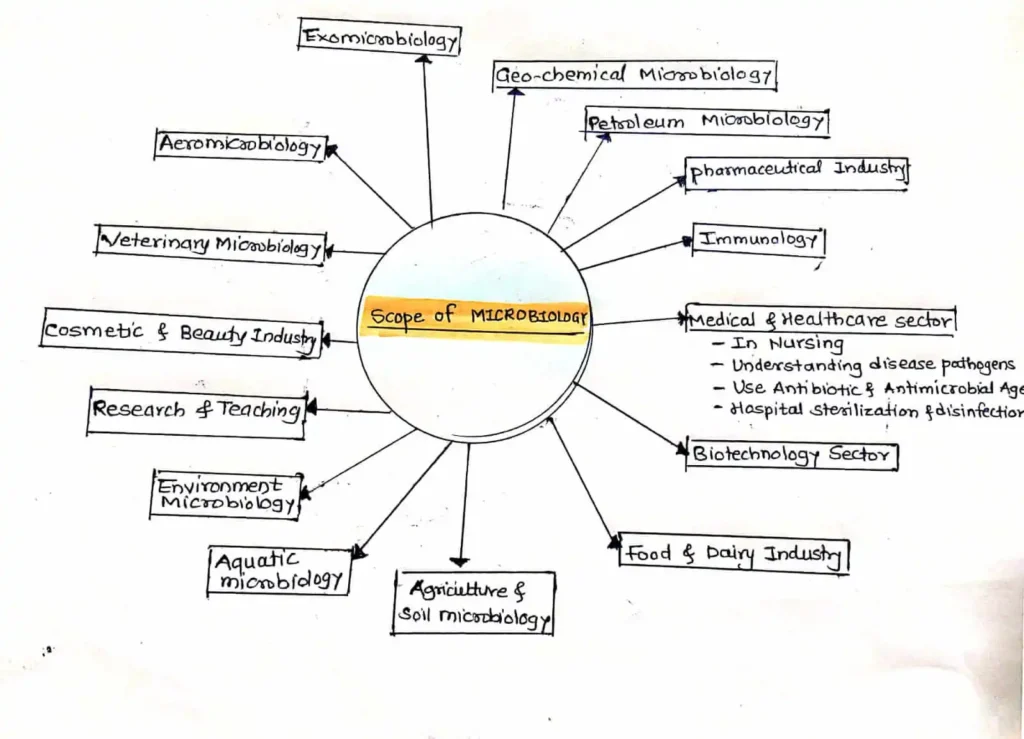
Overall Scope of Microbiology
Future Scope of Microbiology:
The future of microbiology is extremely bright due to new technologies:modern trends and future scope of microbiology
✔ AI-powered Microbiology
✔ Genetic Engineering & CRISPR
✔ Vaccine Development
✔ Industrial Enzyme Engineering
✔ Microbial Fuel Cells
✔ Bioinformatics & Genomics
✔ Stem cell and cancer research
✔ Space microbiology (microbes in space exploration)
Salary Scope (Approx.)
| Role | Salary Range |
|---|---|
| Lab Technician | ₹15,000 – ₹30,000/month |
| Microbiologist | ₹25,000 – ₹60,000/month |
| Research Scientist | ₹50,000 – ₹120,000/month |
| Quality Control Officer | ₹30,000 – ₹70,000/month |
| Food Microbiologist | ₹25,000 – ₹50,000/month |
(Varies by experience, company, and skills)
Conclusion
The scope of microbiology is very wide, covering healthcare, research, food, pharmaceuticals, biotechnology, agriculture, the environment, and forensic science. It offers strong career opportunities and excellent future growth.
Also Read: Microbiology
If you have any query, then contact us.