
Immunity explained with a clear definition, classification of immunity, innate and acquired immunity, active vs. passive immunity, differences, flowcharts, and exam-oriented questions.
Introduction
The field of immunology emerged from the fascinating observation that people who had recovered from certain infectious diseases seemed to gain protection against those diseases in the future. The word “immunity” comes from the Latin term “immunis,” which means “exempt,” highlighting this protective state against infectious illnesses. One of the earliest mentions of immunity can be traced back to Thucydides, the renowned historian of the Peloponnesian War.
In his account of a plague in Athens around 430 BC, he noted that only those who had survived the plague were able to care for the sick, as they wouldn’t catch the disease again. While ancient societies recognized this immunity phenomenon, it took nearly 2000 years before the idea was effectively transformed into a practical medical application.
Classification of immunity is a very important concept of microbiology and immunology. It helps us to understand how the body protects itself from infections and diseases.
Immunity Explained
Immunity is the ability of the host to recognize, resist, and eliminate foreign antigens or pathogens, thereby protecting the body from infection and disease, OR immunity is a complex biological defense mechanism involving innate and adaptive responses that enable the body to distinguish self from non-self and to neutralize or destroy harmful agents. Immunity is a complex biological defense mechanism involving innate and adaptive responses that enable the body to distinguish self from non-self and to neutralize or destroy harmful agents.
“Immunity is the state of sufficient biological defenses to avoid infection, diseases, or other unwanted biological invasions.”
“Immunity is the state of resistance of an organism to infection or disease caused by microorganisms or their products.”
— Jawetz, Melnick & Adelberg (Medical Microbiology)
“Immunity refers to the capacity of the body to defend itself against specific foreign antigens.”
— Roitt’s Essential Immunology
Classification of Immunity
The classification of immunity can be classified into two major categories: innate immunity and acquired immunity.
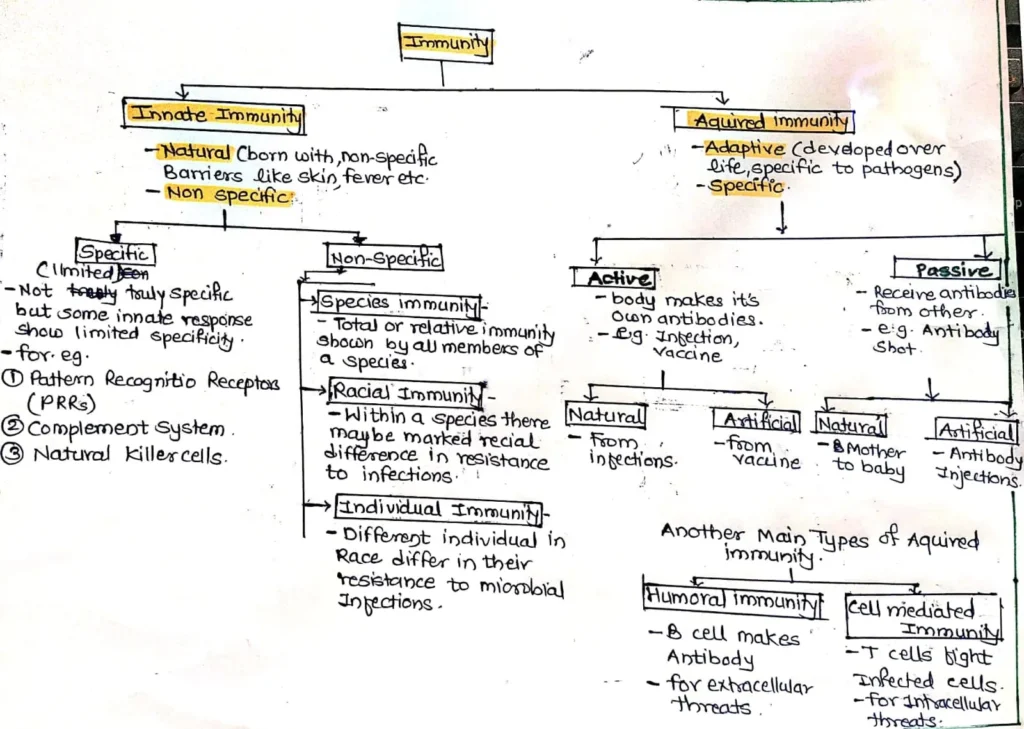
Immunity is classified as innate immunity (natural immunity) and acquired immunity (adaptive immunity).
I) Innate Immunity—
One of the classifications in immunity is innate immunity. Also called “natural immunity,” “native immunity,” “non-particular insusceptible framework,” or “conceived resistance framework.” According to the Classification of Immunity, innate immunity is the first line of defense present from birth.
Definition: The immunity that is present in an individual at birth prior to exposure to a pathogen or antigen that includes various elements that provide an initial response against infection is called innate immunity.
- Innate immunity is the first line of defense mechanism.
- Innate immunity not having any memory.
- It is the resistance of an individual due to his genetic and constitutional composition present from birth.
- It is not affected by prior contact with microorganisms or by immunizations.
- Innate immunity is the intrinsic framework of immunity that comes with human birth, like skin, chemicals in blood, etc.
- In innate immunity, some components of our body play a physical barrier role and try to prevent the body from infection.
- Important components of the intrinsic, insusceptible framework include: i) Attracting invulnerable cells to sickness sites by creating substance factors, such as particular compound intermediaries, called cytokines, which activate the supplement course to identify tiny organisms, stimulate cells, and increase the flexibility of neutralizer structures or dead cells. ii) Specific cells can identify and remove distant chemicals found in organs, tissues, blood, and lymph.
- Cells involve in innate immunity are neutrophils, eosinophils, Mast cells, Monocytes, Macrophages, killer cells, platelets, etc.
- Innate immunity may be specific against a particular organism (not truly specific, but some innate responses show limited specificity, e.g., pattern recognition receptors, i.e., PRRs, the complement system, and natural killer cells) or nonspecific.
Innate immunity can be further divided into specific and nonspecific innate immunity. Classification of innate immunity is considered at 3 different levels: a) species immunity, b) Racial Immunity c) Individual Immunity.
a) Species Immunity—It is complete or relative resistance to pathogens shown by all the members of a species. -Species innate immunity occurs due to physiological and biological differences between the tissues of different host species. -For example, all human beings are unsusceptible to plant pathogens.
b) Racial Immunity—There may be marked racial differences in resistance to infection within a species. -Various races within species may show differences in vulnerability to infections. -For example, resistance to Falciparum malaria in parts of Africa.
c) Individual Immunity – In a race different individuals differ in their resistance to microbial infections. -Innate immunity includes secretion of chemical signals, phagocytic activity, antimicrobial substances, and fever. -The cells involved in innate immunity are neutrophils, eosinophils, Mast cells, Monocytes, macrophages, killer cells, platelets, etc.
Factors Affecting Innate Immunity:
a) Age: The persons who are very young and the old persons are more susceptible to infectious disease than persons in other age groups.
b) Hormonal Influences: Endocrine disorders—diabetes mellitus, hypothyroidism, and adrenal dysfunction—make one more susceptible.
c) Nutritional Factors—Nutritional factors affect innate immunity. i.e., lower nutrition lowers both antibody-mediated and cell-mediated immunity.
II) Acquired Immunity:
In the classification of immunity, acquired immunity develops after exposure to antigens and provides specific protection.
- Acquired immunity is the third line of defense mechanism.
- It is often known as an immune response.
- This is stimulating and develops slower than the innate response. This is a specific type of immunity and has memory, so it provides long-term protection.
- Acquired immunity is the resistance that a person acquires in his life.
The acquired immunity is further divided into
(a) Active Acquired Immunity (b) Passive Immunity.
a) Active Acquired Immunity:
- 1) Active acquired immunity is the resistance developed by an individual due to antigenic stimulus.
- 2) It is also called adaptive immunity.
- 3) It involves active functioning of the host’s immune system, resulting in the synthesis of antibodies and/or the production of immunologically active cells.
- 4) This immunity is developed with time and has immunological memory.
- 5) Active acquired immunity is subdivided into
- i) Natural Active Immunity & ii) Artificial Active Immunity.
i) Natural Active Immunity:
-This type of immunity generally develops when person is exposed to live pathogens, which results in immunological memory (the immune system remembers all the pathogen that have attacked the body so that if any pathogen attacks again, the person will not fall ill.)
-It is natural immunity, as it is not stimulated by deliberate exposure.
-It results from either a clinical or an unclear infection by a parasite.
-For example, an attack of measles gives lifelong immunity.
ii) Artificial Active Immunity:
-It is stimulated when the antigens are incorporated in the human body through vaccines.
-It is the resistance stimulated by vaccines.
-This is because vaccines are preparations of live or killed microorganisms or their products.
b) Passive Acquired Immunity:
- 1) Passive acquired immunity is the resistance transmitted to a recipient in a readymade form.
- 2) In this type of immunity, preformed antibodies are administered.
- 3) There is no antigenic stimulus.
- 4) The host’s immune system is not actively involved in this type.
- 5) It is acquired through the transfer of antibodies or activated T-cells from an immune host and is short-lived, usually lasting only a few months.
- 6) It is the transfer of readymade antibodies (active immunity) from one person to another.
- 7) It provides immediate protection, but no memory develops, so a person is likely to get infected again by the same pathogen.
- 8) Passive immunization is used when there is a high risk of infection and insufficient time for the body to develop its own immune response.
- 9) Passive acquired immunity is subdivided into the following: i) Natural passive immunity ii) Artificial passive immunity.
i) Natural passive immunity:
-It is also known as maternal passive immunity.
-The antibodies are naturally transferred from mother to fetus during pregnancy.
-Around the third month of gestation, a mother’s antibody is passed through the placenta to the fetus.
-Passive immunity is also provided through the transfer of IgA antibodies found in the milk that are transferred to the gut of the infant, protecting against bacterial infections until the newborn can synthesize its own antibody.
ii) Artificial passive immunity:
-In this type of immunity, resistance is passively transferred by the administration of readymade antibodies.
-It is short-term immunization stimulated by the transfer of antibodies that can be administered in various forms, such as human or animal blood plasma, pooled human immunoglobulins for intravenous or intramuscular use, and monoclonal antibodies.
-It lasts only for a short period of time. -For example, tetanus immunoglobulin.
Difference Between Active and Passive Immunity:
Understanding the classification of immunity helps students differentiate between innate and acquired immune responses.
| Sr. no. | Active Immunity | Passive Immunity |
| 1. | It is produced actively by the host’s immune response. | It is received passively. There is no active host participation. |
| 2. | It is stimulated by infection or by immunogen. | Readymade antibodies are transferred. |
| 3. | It gives durable, effective protection. | It is transient and less effective. |
| 4. | The active immunity is effective only after a lag period. | It is immediate immunity. |
| 5. | Immunological memory is present. | There is no memory. |
| 6. | It is booster-effective. | It is not effective. |
| 7. | In this immunity, a negative phase may occur. | In this immunity, there is no negative phase. |
| 8. | It is not applicable |
Difference between innate and adaptive immunity:
| Features | Innate immunity | Adaptive immunity |
| Definition | It is naturally occurring immunity due to the genetic constituents and physiology of a person. | It is immunity mediated by T cells and B cells and characterized by immunological memory. |
| Involved cells | Natural killer cells, dendritic cells, mast cells, basophils, macrophages, etc. | Helper T cells (CD4+), killer T cells (CD8+), B cells, APCs (Antigen-Presenting Cells), etc. |
| Receptors | -No somatic rearrangement -Non-Clonal Distribution -Germline encoded | -A somatic arrangement is necessary. -Clonal Distribution -No germline encoding |
| Involved Molecules | Complement cells, interferons, cytokines, and APPs (Acute Phase Proteins) | Antibodies, cytokines |
| Time of Action | Immediate | Delayed |
| Response | 0-6 hrs (rapidly occurs) | required Days to weeks |
| Defence order | First line of defense | Third line of defence |
| Immunological memory | No | Yes |
| Immune response types | Non-specific inflammation, complement-mediated killing, phagocytosis-killing, phagocytosis | Specific Generation of antibodies, destruction of microorganisms with the help of T-helper cells and cytotoxic T-cells. |
| Subsequent exposure | Does not get active on repeated exposure. | Get active by subsequent exposure. |
| Reason Behind immune evasion | Caused by pathogenic virulence. | Caused by mutation of recognized antigen. |
| Allergy | Do not develop an allergic reaction. | Develop allergic reactions, i.e., immediate and delayed. |
| Presence | Always present in the body. | Generate in response to exposure to an external factor. |
| Another name | Natural immunity | Acquired immunity |
| Barriers | Skin, mucus-associated, gut-associated, temperature of body, pH of body etc. | Lymph nodes, spleen, and lymphoid tissues are the barriers. |
| Potency | Exhibit low potency. | exhibit higher potency. |
| Diversity | possesses less diversity. | possesses higher diversity. |
| Examples | Redness and swelling are caused by white blood cells around the wound. | Vaccination against the virus. |
Exercise:
1-mark question
- Define immunity
- Define innate immunity.
- Define Acquired Immunity.
- Enlist types of Acquired immunity
5-mark questions
- Give detailed information on immunity.
- Explain innate immunity.
- Difference between active and passive immunity.
10-mark question
- Describe acquired immunity in detail.
Conclusion: Classification of Immunity
A proper understanding of the classification of immunity is essential for microbiology, nursing, and medical students because it forms the basis of disease prevention and immunization.
Immunity is the body’s remarkable and highly effective defense system that protects us from infections, diseases, and harmful foreign substances. From early historical observations to modern immunology, the concept of immunity has evolved into a well-defined scientific framework that explains how the body recognizes self and non-self antigens. Understanding the definition and classification of immunity forms the foundation for studying disease prevention and immune responses.
The two major arms of classification of immunity—innate immunity and acquired (adaptive) immunity—work together in a coordinated manner to provide both immediate and long-term protection. Innate immunity acts as the first line of defense, offering rapid, non-specific protection through physical barriers, immune cells, and chemical mediators. In contrast, acquired immunity is highly specific, develops more slowly, possesses immunological memory, and ensures long-lasting protection through active and passive immune mechanisms.
A clear understanding of active and passive immunity, along with their differences, is essential for appreciating the role of vaccination, natural infections, and antibody therapy in disease control. The comparative analysis between innate and adaptive immunity further highlights how timing, specificity, memory, and immune components differ yet complement each other.
In conclusion, immunity is not a single mechanism but a complex, integrated defense network vital for survival and health. A thorough knowledge of immunity is crucial for students of microbiology, nursing, and medical sciences, as it forms the basis for understanding infections, immunization, immune disorders, and modern therapeutic strategies.
Frequently Asked Questions (FAQ) – Immunity
1. What is immunity and its classification of immunity?
Answer: Immunity is the ability of the body to resist and eliminate infections or foreign substances.
Classification of immunity is broadly divided into the following:
Innate (Natural) Immunity – present from birth, non-specific
Acquired (Adaptive) Immunity – develops after exposure, specific and has memory
Acquired immunity is further divided into active and passive immunity.
2. What is Type 4 immunity?
Answer: Type 4 immunity refers to cell-mediated immunity, mainly mediated by T lymphocytes.
It does not involve antibodies and is important in defense against intracellular pathogens, transplant rejection, and delayed-type hypersensitivity reactions.
3. How many types of immunities are there?
Answer: There are two main types of immunity:
i. Innate immunity
ii. Acquired immunity
Acquired immunity is further divided into active and passive immunity.
4. What are the four different types of immunity?
Answer: The four types of immunity are the following:
i. Innate immunity
ii. Active acquired immunity
iii. Passive acquired immunity
iv. Cell-mediated immunity (Type 4 immunity)
5. What is immunity?
Answer: Immunity is the state of resistance of the body against infections and diseases caused by microorganisms or their toxins.
6. What is type 2 immunity?
Answer: Type 2 immunity is associated with humoral immune response, mainly involving B-cells and antibodies (IgE and IgG).
It plays a role in defense against parasites and is also involved in allergic reactions.
7. What is the importance of immunity?
Answer: Immunity is essential because it
i. Protects the body from infections
ii. Prevents recurrent diseases
iii. Helps in recovery after illness
iv. Provides long-term protection through immunological memory
v. Forms the basis of vaccination and immunotherapy
8. What is the classification of immunity?
Answer: The classification of immunity includes innate immunity and acquired immunity. Acquired immunity is further classified into active and passive immunity.
Also Read:
15+ Important Scope of Microbiology – Best Jobs After Microbiology