
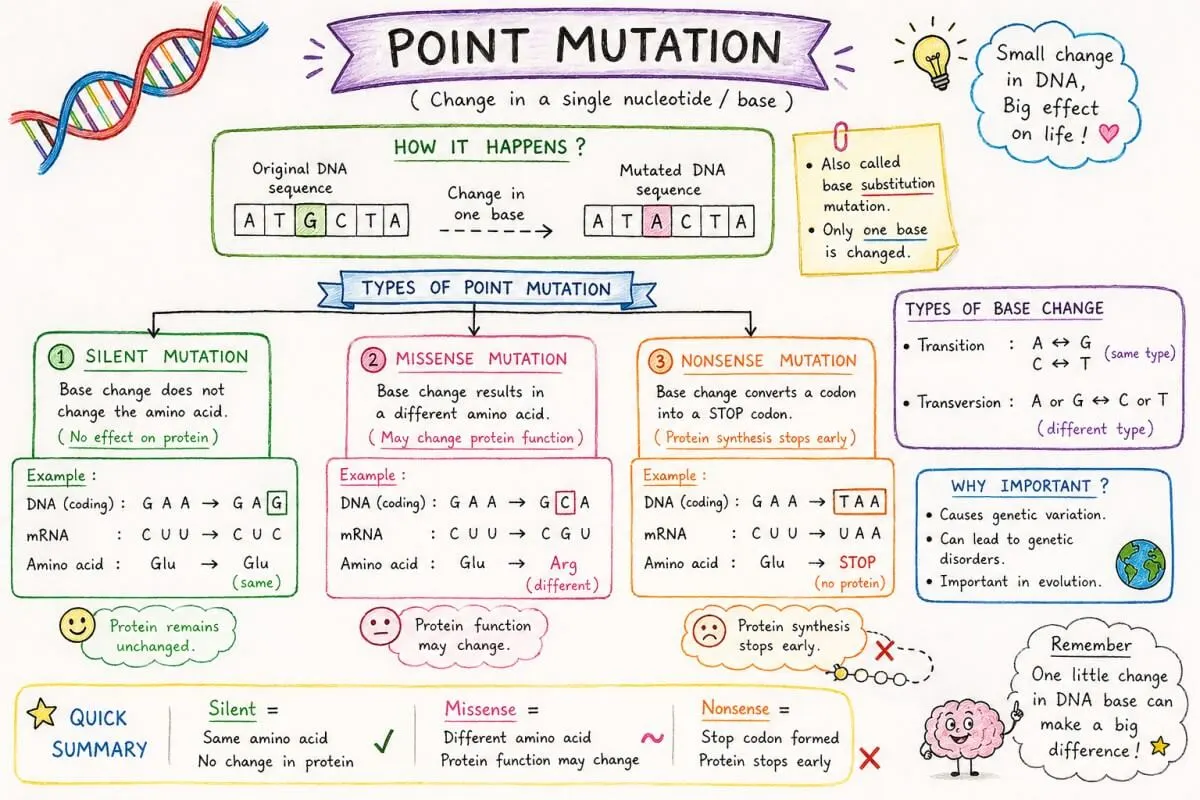
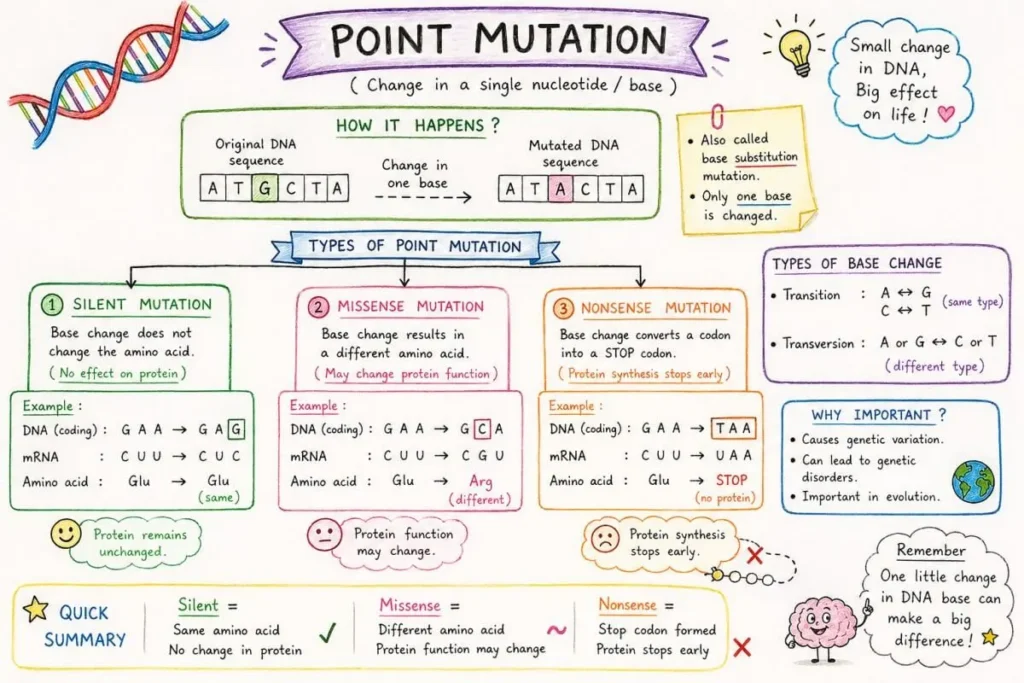
What if one DNA letter changes everything? Explore point mutation with simple examples, diagrams & real diseases in this easy, exam-ready guide!
Introduction
If your DNA could talk, it would probably say –
“Oh, I had such a perfect plan… and you changed one letter!”
DNA is the blueprint of our body. But sometimes there is a small “typo” in this blueprint… and that’s it! Thus begins the amazing story of science — Point Mutation!
Imagine the word “CAT” became “BAT”… just one letter changed, but the meaning changed completely. The same thing happened in our genes. A small change — and its consequences are sometimes funny, sometimes serious, and sometimes completely unexpected!
So, let’s begin a fun journey through this small but very interesting “mistake” of DNA — the world of Point Mutation!
Mutation
The constant alteration of an organism’s, virus’s, extrachromosomal DNA’s, or other genetic elements’ nucleotide sequence is referred to in biology as a mutation. Errors during DNA replication (particularly during meiosis) or other forms of DNA damage (like exposure to radiation or carcinogens) can result in mutations. These errors can then undergo error-prone repair (particularly [micro homolog-mediated end joining]), cause errors during other forms of repair, or cause errors during replication (translation).
DNA segments found on chromosomes are called genes. A change in the DNA nucleotide sequence is known as a gene mutation. A single nucleotide pair or longer gene regions of a chromosome may be impacted by this alteration.
A polymer of nucleotides is what makes up DNA. DNA is converted into RNA during protein synthesis, which is followed by translation to create proteins. Most frequently, changing nucleotide sequences causes proteins to stop working.
Changes in the genetic code brought about by mutations result in genetic variety and an increased risk of disease development. Point mutations and base-pair insertions or deletions are the two main categories of gene mutations.
There are three types of mutation: 1) Gene mutation, 2) Chromosomal mutation, and 3) Genomic mutation.
Define/definition Point Mutation
It is a genetic alteration in which a single nucleotide base in the DNA sequence is substituted, inserted, or deleted, potentially affecting gene function and protein synthesis. OR
It is a small change in just one nucleotide (A, T, G, C) in a long chain of DNA. OR
It is a type of mutation in DNA or RNA in which one single nucleotide base is added, deleted, or changed.
Point mutation definition biology
It is a type of genetic mutation in which a single nucleotide base in the DNA sequence is altered, either by substitution, insertion, or deletion. It is a change in just one base (A, T, G, C) in DNA. This change is small, but its effect on the gene and protein can be large.
What is a point mutation?
It is a type of gene mutation based on a change in genotype and phenotype, where a single nucleotide base in a DNA or RNA sequence is substituted, inserted, or deleted, which potentially affects gene function or protein synthesis. These are the most common types of gene mutation. Also called a base pair
Substitution, this type of mutation changes a single nucleotide base pair.
It happens when one nucleotide in a gene’s precise nucleotide sequence is spared by another. Compared to a frameshift mutation, a point mutation results in minimal phenotypic change. Cystic fibrosis, sickle cell anaemia, Tay-Sachs disease, phenylketonuria, and colourblindness are just a few of the notable inherited genetic illnesses. A single gene mutation is the cause of each of these conditions.
One nucleotide is altered by a point substitution mutation, which can be either synonymous or nonsynonymous. In order to preserve the generated amino acid sequence, a synonymous replacement swaps out one codon for another that codes for the same amino acid. A nonsynonymous replacement modifies the generated amino acid sequence by swapping out a codon with another codon that codes for a different amino acid.
Point mutation types
Based on a change in genotype and phenotype, the gene mutation is of two types: 1)Point mutation, 2)Frameshift mutation(insertion, Deletion).
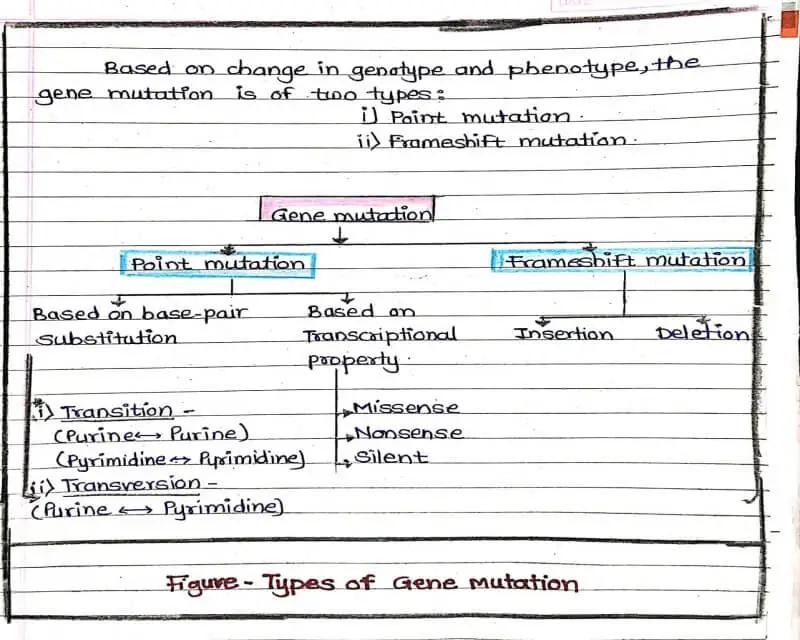
Types of Point Mutation :
A) Substitution, [(Transition mutation (type based on the base-pair substitution), Transversion mutation (type based on the base-pair substitution), Missense mutation ( type based on the transcriptional property), Nonsense mutation ( type based on the transcriptional property), Silent mutation ( type based on the transcriptional property).]
A) Substitution
One nucleotide is swapped out for another in substitution mutations, which are frequently brought on by chemicals or problems with DNA replication. These modifications are categorised as transitions or conversions. The most frequent transition is the one that switches a pyrimidine for a pyrimidine (C ÷ T) or a purine for a purine (A ÷ G). Base mispairing, nitrous acid, and carcinogenic base analogues like BrdU can all result in a transition.
A transversion, which swaps a purine for a pyrimidine or a pyrimidine for a purine (C/T ÷ A/G), is less frequent. The transformation of adenine (A) into cytosine (C) is an illustration of a transversion. A point mutation occurs when a gene’s single base pairs or other tiny base pairs are altered.
These mutations can be undone by either second-site reversion (a complementary mutation elsewhere that restores gene functionality) or another point mutation, in which the nucleotide is restored to its initial state (true reversion). These mutations that take place in a gene’s protein-coding region can be categorised as either synonymous or nonsynonymous substitutions, which can then be further subdivided into missense or nonsense mutations.
A Substitution Mutation occurs when one base pair is substituted for another. For example, Adenine (A) is accidentally substituted for Guanine(G). Substitution Mutation also has some types:
- Transition mutation (type based on the base-pair substitution).
- Transversion mutation (type based on the base-pair substitution).
- Missense mutation ( type based on the transcriptional property).
- Nonsense mutation ( type based on the transcriptional property).
- Silent mutation ( type based on the transcriptional property).
1. Transition mutation :
It is a type based on the base-pair substitution. It happens when one pyrimidine is swapped out for another pyrimidine or one purine for another purine. A nonsense mutation occurs when a codon that indicates an amino acid is changed to one of the STOP codons (TAA, TAG, or TGA). As a result, the messenger RNA produced by this mutant gene will stop translating too soon.
2. Transversion mutation:
It is a type based on the base-pair substitution. It occurs by the substitution of a purine by a pyrimidine and vice versa.
3. Missense mutation:
This kind of mutation produces a different amino acid by changing the nucleotide sequence. This modification modifies the final protein. The alteration could be harmful, advantageous to protein function, or have little effect on the protein. Using the example from before, the amino acid glycine will be created in place of arginine if the codon for arginine CGC is altered to GGC.
To get more information, refer our article on Missense Mutation: 8 Ultimate Insights to Master This Genetic Concept
4. Nonsense mutation:
This kind of mutation modifies the nucleotide sequence to code for a stop codon instead of an amino acid. A stop codon terminates the translation process and halts the synthesis of proteins. The amino acid sequence is shortened if this process is stopped too soon, and the resultant protein is almost always nonfunctional.
5. Silent mutation
This kind of mutation does not alter the protein that will be made, even when the DNA sequence has altered. This is due to the fact that the same amino acid can be encoded by several genetic codons. Codons are sets of three nucleotides that code for amino acids.
For instance, the DNA codons CGT, CGC, CGA, and CGG (A = adenine, T = thymine, G = guanine, and C = cytosine) code for the amino acid arginine. The amino acid arginine will still be generated even if the DNA sequence CGC is altered to CGA.
Point mutation diagram
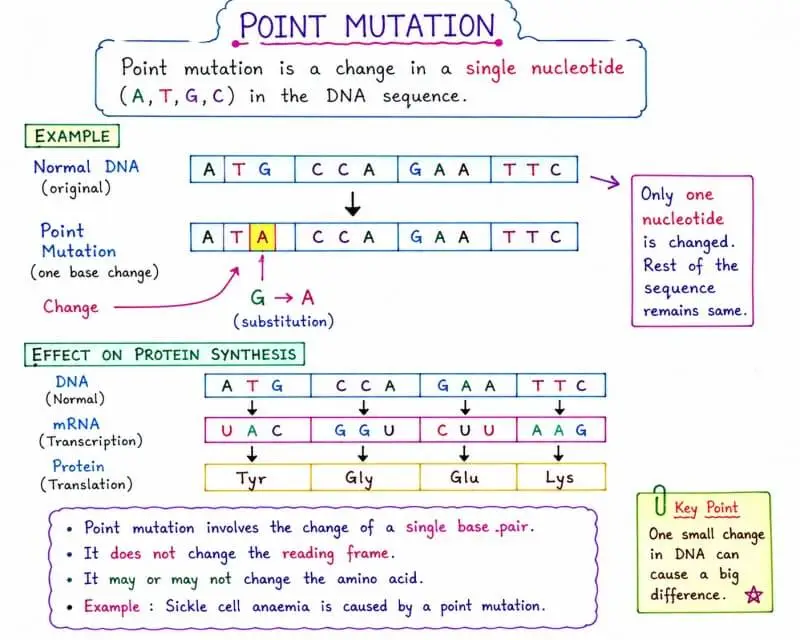
Single point mutation
- It is a change in just one nucleotide (A, T, G, C) in a DNA sequence.
- Although this change is small, it can have a major impact on the structure and function of a protein.
- One base change only. Mostly, there is a substitution type mutation.
- Effects: No effect (silent), Moderate effect (missense), Severe effect (nonsense).
An example of a point mutation
1. Sickle Cell Anaemia
- Normal DNA sequence: GAG
- Mutated DNA sequence: GTG
- This single base change causes a change in the Haemoglobin protein
- This causes the RBC (Red Blood Cells) to become sickle-shaped.
2. β-Thalassemia (Beta Thalassemia)
- Single-nucleotide change in the β-globin gene.
- Haemoglobin is not produced properly.
3. Cystic Fibrosis
- A small mutation in the DNA in the CFTR gene.
- Chloride ion transport is disturbed.
- Mucus becomes thick.
4. Tay-Sachs Disease
- Mutation in the HEXA gene.
- Enzyme production is reduced.
- Nerve cells are damaged.
5. Phenylketonuria (PKU)
- Mutation in the PAH gene.
- Phenylalanine breakdown does not occur.
- Effects on brain development.
6. Achondroplasia
- Mutation in the FGFR3 gene.
- Bone growth is reduced.
- Short stature (dwarfism) is seen.
Frameshift vs point mutation/ Defference between frameshift vs point mutation
| Feature | Point mutation | Frameshift mutation |
| Definition | Substitution of a single nucleotide. | Nucleotide insertion or deletion causes a reading frame shift. |
| Change Type | Single base change (A ↔ T / G ↔ C). | 1 or more bases are added/deleted. |
| Reading Frame | Does not change. | Changes the entire reading frame. |
| Effect on Protein | Sometimes small change / sometimes no effect. | Most of the time severe effect. |
| Types | Missense, Silent, Nonsense. | Insertion, Deletion. |
| Codon Impact | Only one codon was affected. | All subsequent codons change. |
| Severity | Low to moderate. | High (mostly harmful). |
| Example | GAG → GTG. | AUG-AAA-GGG → AGA-AAG-GG… |
| Disease Example | Sickle Cell Anaemia. | Tay-Sachs Disease. |
Conclusion
Point mutations are very small changes in DNA, but their consequences can be very large. Sometimes a change in just one nucleotide has no effect on the protein (Silent), sometimes it changes the structure of the protein (Missense) or completely stops the production of the protein (Nonsense).
This gives us an important understanding — “Even a small change in DNA can make a big difference in life.”
It creates genetic variation, which is essential for evolution. But they can also sometimes cause diseases like sickle cell anaemia and thalassemia.
Therefore, these mutations are not just “mistakes” but are an important part of life’s change, diversity, and scientific research.
Once you understand what a point mutation is, one thing becomes clear — even a small change in DNA can have a big impact on life.
Silent, Missense, and Nonsense mutations have different effects on proteins — sometimes no effect, sometimes serious diseases can occur. Therefore, point mutations are not just genetic “errors” but are a very important process for evolution, genetic variation, and medical research.
If you are a biology student, understanding this topic thoroughly will be very beneficial for your exams and concept clarity.
Explore a wide range of microbiology courses and find the right path for your career.
FAQs
1. What is a point mutation?
Answer:
It is a genetic change in which only one nucleotide (A, T, G, or C) in a DNA sequence is altered.
This change may look small, but it can affect how a gene works and how proteins are made.
A simple definition is: It is a change in a single base pair in DNA.
– Easy Example:
Original DNA: A T G C
Mutated DNA: A T A C
Here, only one base (G → A) is changed — this is a point mutation.
– Types:
a. Silent Mutation– No change in amino acid
Protein remains the same.
b. Missense Mutation – One amino acid changes
Protein function may change.
c. Nonsense Mutation– Creates a STOP codon
Protein stops forming early.
2. What is a point mutation in biology?
Answer:
A point mutation is a genetic mutation where one base pair in DNA is substituted, inserted, or deleted, potentially affecting protein synthesis.
In biology it is a change in a single nucleotide (A, T, G, or C) in the DNA sequence of a gene.
Even though only one base is altered, it can influence how a gene functions and how proteins are produced.
3. Why is a point mutation important?
Answer:
-Causes genetic variation.
-Can lead to genetic diseases (e.g., sickle cell anaemia).
-Plays a role in evolution.
4. Which is a point mutation and not a frameshift mutation?
Answer: A point mutation is a change of a single nucleotide (single base) — such as substitution (A → G, T → C). This change is not a frameshift mutation, because it does not change the reading frame.
a.Point Mutation:
-Only one base change.
-Example: GAG → GTG
-Reading frame remains the same.
-Types: Silent, Missense, Nonsense.
b.Frameshift Mutation:
-Caused by Insertion or Deletion.
-One or more bases are added/deleted.
-The entire reading frame is changed.
-The consequences are more serious.
-“A single base substitution (A↔T / G↔C) is a point mutation, while a change caused by insertion/deletion is a frameshift mutation.”
5. Which is a point mutation and not a frameshift mutation? mutagen insertion, deletion, silent
Answer: Silent mutation (Among the given options, Silent mutation is a point mutation and not a frameshift mutation.).
Brief explanation:
Silent mutation: Change in a single nucleotide (substitution). The reading frame does not change.
Insertion:➝ base is added → reading frame changes → frameshift mutation.
Deletion:➝ base is removed → reading frame changes → frameshift mutation.
Mutagen:➝ This is the agent that causes the mutation, not the type of mutation.
In short, a silent mutation is a type of point mutation, and insertion and deletion are types of Frameshift mutation.
6. Which type of mutation always produces a stop codon? missense nonsense silent point
Answer: Correct Answer: Nonsense mutation
-Brief Explanation: A nonsense mutation is a mutation in which a codon is changed to a STOP codon (UAA, UAG, UGA). This causes protein synthesis to stop midway, and the protein becomes incomplete (nonfunctional).
-Why are the other options wrong?
Missense mutation: Only the amino acid changes (STOP is not formed).
Silent mutation: No amino acid changes.
Point mutation: This is a broad term (it includes silent, missense, and nonsense mutations).
“Nonsense mutation always produces a stop codon.”
7. Can a point mutation be a frameshift mutation?
Answer: No, a point mutation is not a frameshift mutation.
“It involves single base substitution without changing the reading frame, whereas frameshift mutation involves insertion/deletion that alters the reading frame.”
Point = Replace (No shift)
Frame = Add/Delete (Shift)
Sometimes confusion happens because insertion or deletion of ONE base is also a “small change”
BUT…
-If insertion/deletion is not in multiples of 3, it shifts the frame
-Therefore, it is called a frameshift mutation, not a typical point mutation
8. What type of point mutation causes sickle cell anaemia?
Answer: Missense mutation
–“Sickle cell anaemia is caused by a missense point mutation (GAG → GTG) in the β-globin gene.”
– Sickle cell anaemia is caused by a single base substitution in the β-globin gene:
Normal codon: GAG → codes for Glutamic acid
Mutated codon: GTG → codes for Valine
-This change replaces one amino acid with another, which is exactly what a missense mutation does.
– Why it matters:
The change from glutamic acid → valine alters haemoglobin structure.
Red blood cells become sickle-shaped.
Leads to reduced oxygen transport and health problems.
9. What is a point mutation in DNA?
Answer:
-A point mutation in DNA is a change in a single nucleotide (A, T, G, or C) within a DNA sequence. Even though only one base is altered, it can influence how a gene works and how proteins are formed.
-It is a genetic change where one base pair in DNA is substituted, inserted, or deleted.
10. Is substitution a point mutation?
Answer: Yes, substitution is a type of point mutation.
“Substitution mutation is a type of point mutation in which one nucleotide is replaced by another.”
11. Is insertion a point mutation?
Answer: No, Insertion is generally not considered a point mutation.
Explanation:
– Insertion mutation: One or more nucleotides are added into the DNA sequence. This usually changes the reading frame. Therefore, it is called a frameshift mutation.
12. Is frameshift a point mutation?
Answer: No, frameshift is not a point mutation.
-Explanation:
Point mutation: Single base substitution, and the reading frame does not change.
Frameshift mutation: Caused by insertion or deletion. Shifts the entire reading frame. Changes all codons after mutation.
-“Frameshift mutation is not a point mutation because it alters the reading frame of the genetic code.”
13. What does a point mutation mean?
Answer: A point mutation means a change in a single nucleotide (A, T, G, or C) in the DNA sequence.
-Even a single base change can affect protein formation and gene function.
14. Is deletion a point mutation?
Answer:No, deletion is not considered a point mutation (in most cases).
Deletion mutation:
➝ One or more nucleotides are removed from DNA.
➝ This usually shifts the reading frame.
➝ Therefore, it is a frameshift mutation.
Important Note:
-If deletion happens in multiples of 3 bases.
-The reading frame does not shift.
-but still, it is generally not called a typical point mutation.
15. What is the difference between a point mutation and a frameshift mutation?
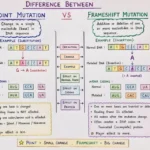
Answer:
16. What is a point mutation? Give one example.
Answer: A point mutation is a change in a single nucleotide (A, T, G, or C) in the DNA sequence.
-Example
Sickle cell anaemia (classic example):
Normal DNA codon: GAG
Mutated DNA codon: GTG
Here, A → T change causes a different amino acid (glutamic acid → valine).
This is a missense point mutation.
17. What is a point mutation? class 12
Answer: “Point mutation is a change in one base pair of DNA due to substitution, insertion, or deletion, which may affect protein synthesis.”
-Example:
Normal DNA: A T G C
Mutated DNA: A T A C
-G → A change = point mutation.
-Types (Very Important):
Silent mutation – no change in amino acid.
Missense mutation – amino acid changes.
Nonsense mutation – STOP codon forms.
18. What is a point mutation? Give one example from class 12.
Answer: “A point mutation is a change in one base pair of DNA, usually due to substitution, which may affect protein synthesis.
Example (Very Important):
Sickle Cell Anaemia:
Normal codon: GAG (codes for glutamic acid).
Mutated codon: GTG (codes for valine).
-This single-base change causes a missense point mutation.
19. What is a point mutation? Explain with an example.
Answer:“A point mutation is a change in one base pair of DNA, usually due to substitution, which may affect protein synthesis.
Example (Very Important):
Sickle Cell Anaemia:
Normal codon: GAG (codes for glutamic acid).
Mutated codon: GTG (codes for valine).
-This single-base change causes a missense point mutation.
20. What is a point mutation example?
Answer:
Sickle Cell Anaemia:
Normal codon: GAG (codes for glutamic acid)
Mutated codon: GTG (codes for valine)
-This single-base change causes a missense point mutation
21. What is a point mutation? Give one example.
Answer: “A point mutation is a change in one base pair of DNA, usually due to substitution, which may affect protein synthesis.
Example (Very Important):
Sickle Cell Anaemia:
Normal codon: GAG (codes for glutamic acid)
Mutated codon: GTG (codes for valine)
-This single-base change causes a missense point mutation
22. What do you mean by point mutation?
Answer: Point mutation means a change in a single nucleotide (A, T, G, or C) in the DNA sequence.
23. Which disease is caused by a point mutation?
Answer: The most common example is Sickle Cell Anaemia.
Explanation:
-It is caused by a point mutation (missense mutation).
-A single base change: GAG → GTG.
-This changes glutamic acid → valine in haemoglobin.
-Red blood cells become sickle-shaped.
Other Diseases Caused by Point Mutation
a.Beta Thalassemia
b.Cystic Fibrosis
c.Tay-Sachs Disease
d.Phenylketonuria (PKU)