
Introduction
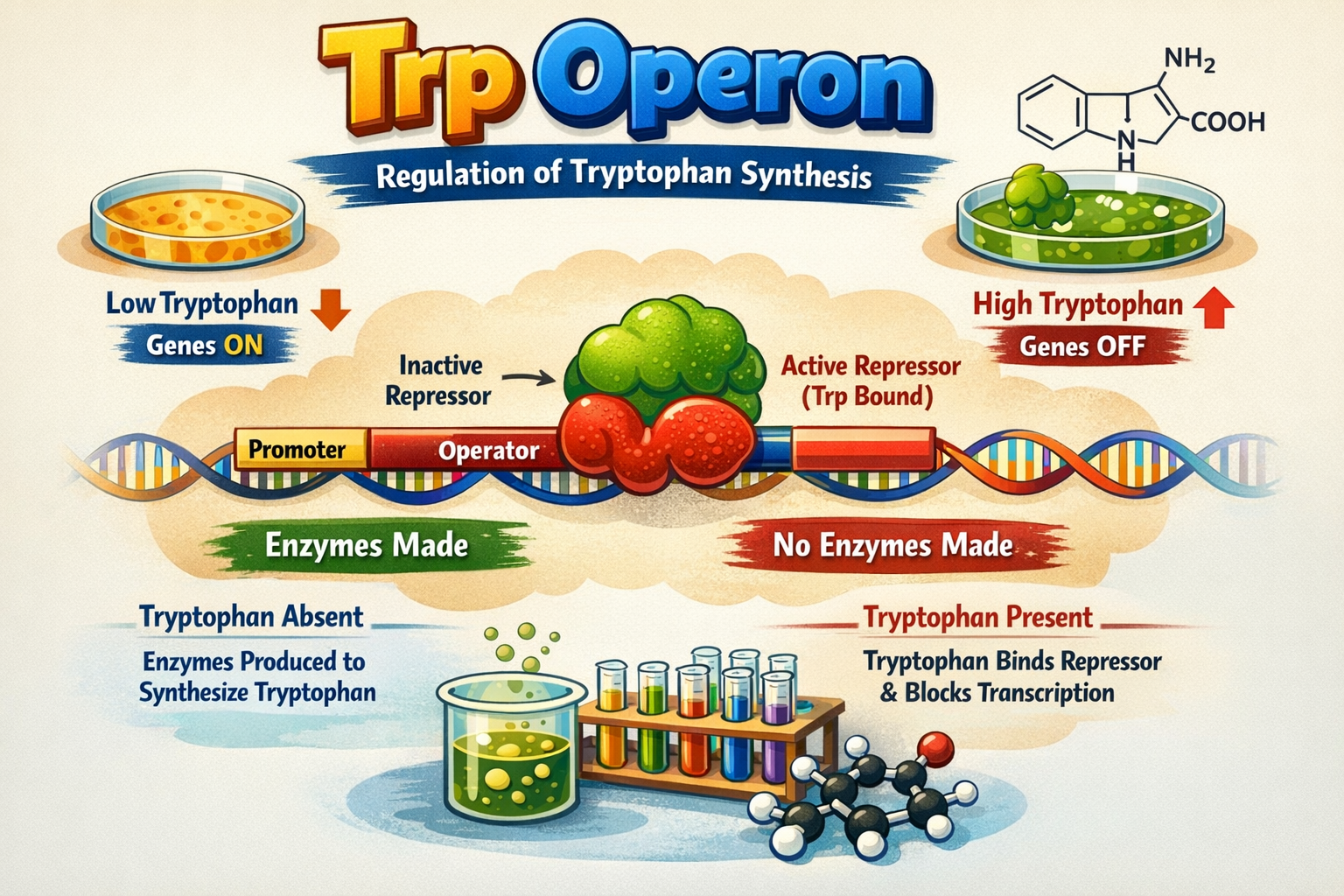
The trp operon is a repressible operon. Many of the bacteria need amino acids to survive and are able to synthesize many of them. For example, bacteria such as Escherichia coli, i.e., E. coli, can either ingest tryptophan (one such amino acid) from the environment or synthesize it using enzymes that are encoded by five genes. These five genes are next to each other; it is called the tryptophan (trp) operon.
A single mRNA strand is synthesized after the transcription of these genes, which is then translated to produce all five enzymes. E. coli does not need to synthesize tryptophan. If tryptophan is present in the environment, then the trp operon is switched off. However, when tryptophan availability is low or tryptophan is not present in the environment, the switch controlling the operon is turned on, the mRNA is transcribed, the enzyme proteins are translated, and tryptophan is synthesized.
trp operon structure
The trp operon includes three important regions:
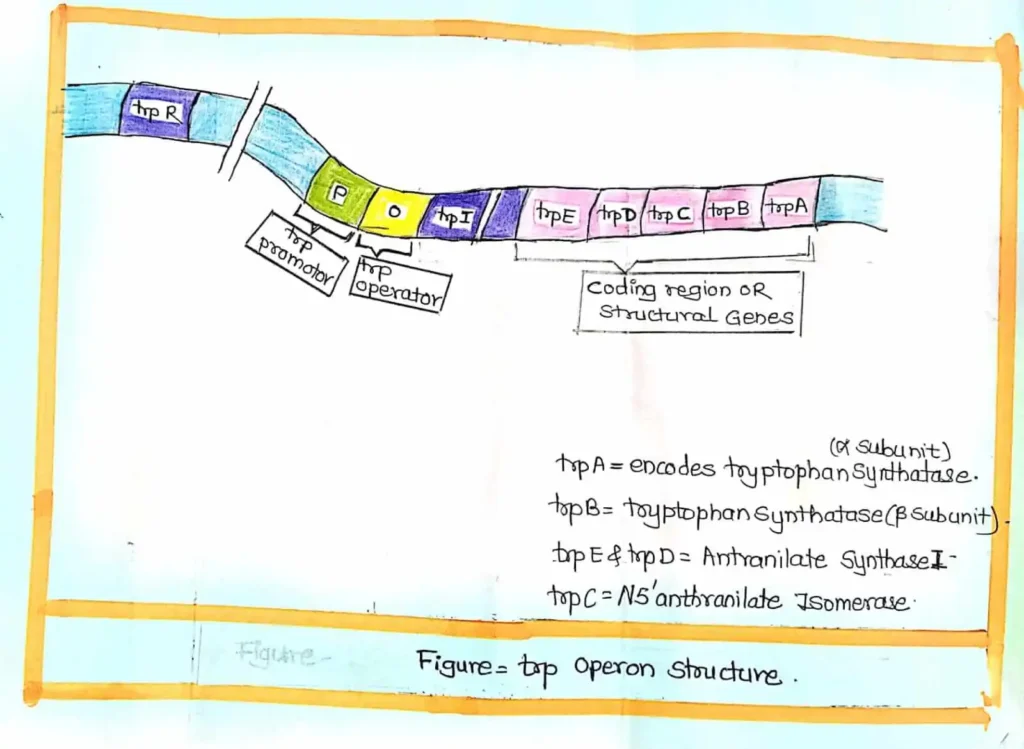
- The coding region—The coding region includes the five structural genes for the five tryptophan biosynthesis enzymes. Just before the coding region is the transcriptional start site. The tryptophan operon, i.e., the trp operon, codes for five proteins that are required for the synthesis of the amino acid tryptophan. Five structural genes include trpE, trpD, trpC, trpB, and trpA. trpA encodes tryptophan synthetase (alpha subunit). trpB, which encodes tryptophan synthetase (beta subunit). trpE and trpD code for Antranilate Synthase I. trpC codes for N5’anthranilate Isomerase (Indole 3-glycerol phosphate synthetase).
- The trp operator—Between the promoter and the transcriptional start site is the operator region. The trp operator contains the DNA code to which the trp repressor protein can bind. However, the repressor alone cannot bind to the operator.
- The trp promoter—The promoter sequence, to which RNA polymerase binds to initiate transcription, is before or “upstream” of the transcriptional start site.
When tryptophan is present in the cell, two tryptophan molecules bind to the trp repressor, which changes the shape of the repressor protein to a form that can bind to the trp operator. The tryptophan–repressor complex binding at the operator site physically prevents the RNA polymerase from binding to the promoter and transcribing the downstream genes.
Mechanism of trp operon
In E. coli, there are five trp genes that help make the amino acid tryptophan. These genes work well only when there is not enough tryptophan. A repressor controls these genes, similar to how the lac genes are controlled. However, in this case, tryptophan acts as a corepressor, meaning when tryptophan is present, it helps the repressor bind to the trp operator and stop gene activity.
When tryptophan levels are low, the repressor lets go of the operator, allowing the trp mRNA to be made. Interestingly, even when the process starts, it often does not finish, and most mRNA strands stop before including the first trp gene, unless there is a signal that tells the cell there is still not enough tryptophan.
1. When tryptophan is low or absent in the environment, refer to figure 2.
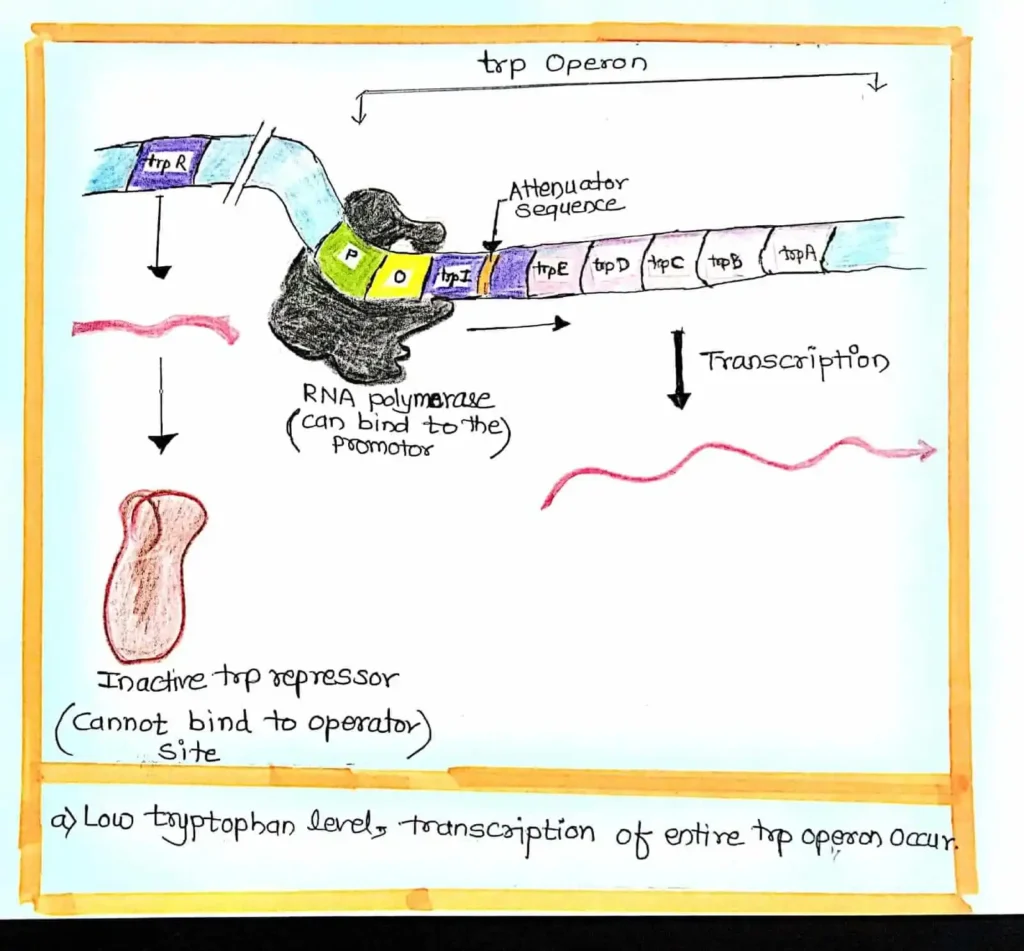
When tryptophan is not present in the cell, the repressor by itself does not bind to the operator, the polymerase can transcribe the enzyme genes, and tryptophan is synthesized. Because the repressor protein actively binds to the operator to keep the genes turned off, the trp operon is said to be negatively regulated, and the proteins that bind to the operator to silence trp expression are negative regulators.
2. When tryptophan is high or present in the environment, refer to figure 3.
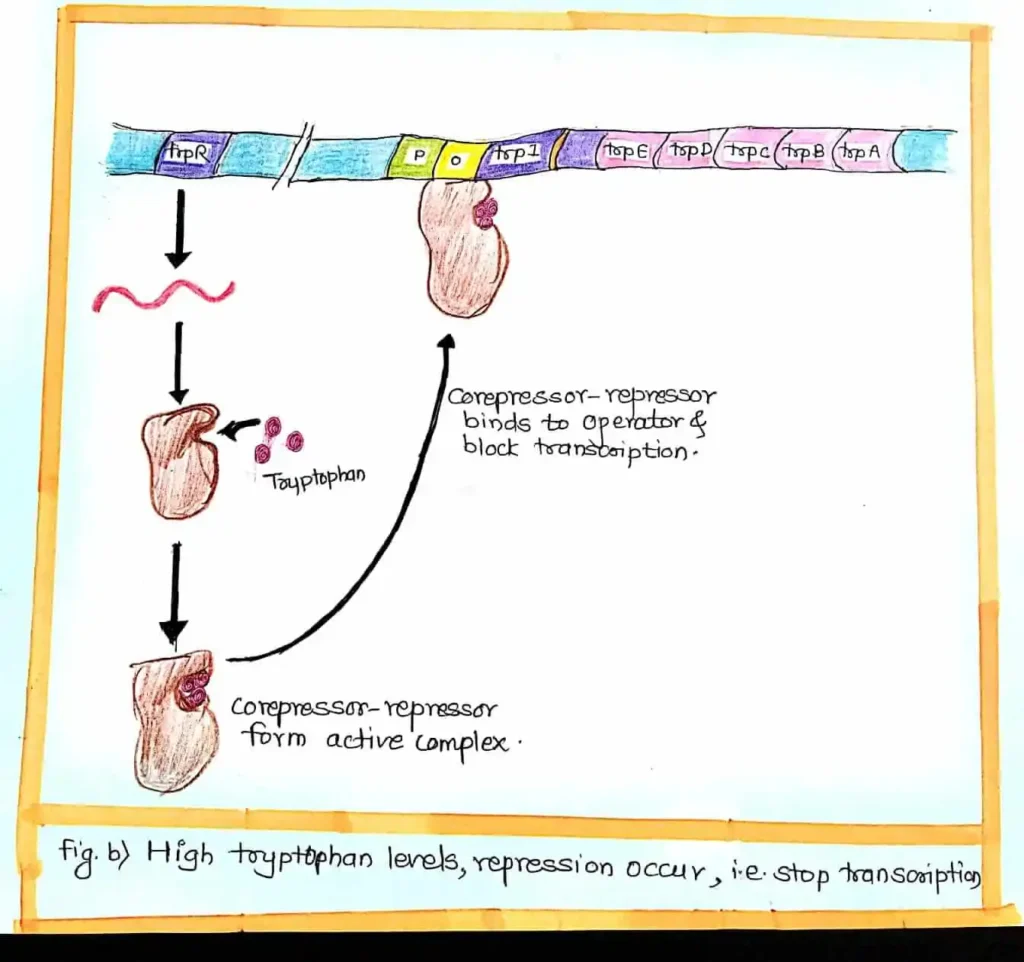
When tryptophan is present in the cell, two tryptophan molecules bind to the trp repressor, which changes the shape of the repressor protein to a form that can bind to the trp operator. The tryptophan–repressor complex binding at the operator site physically prevents the RNA polymerase from binding to the promoter and transcribing the downstream genes.
3. trp Operon Attenuation – Refer to figure 4.
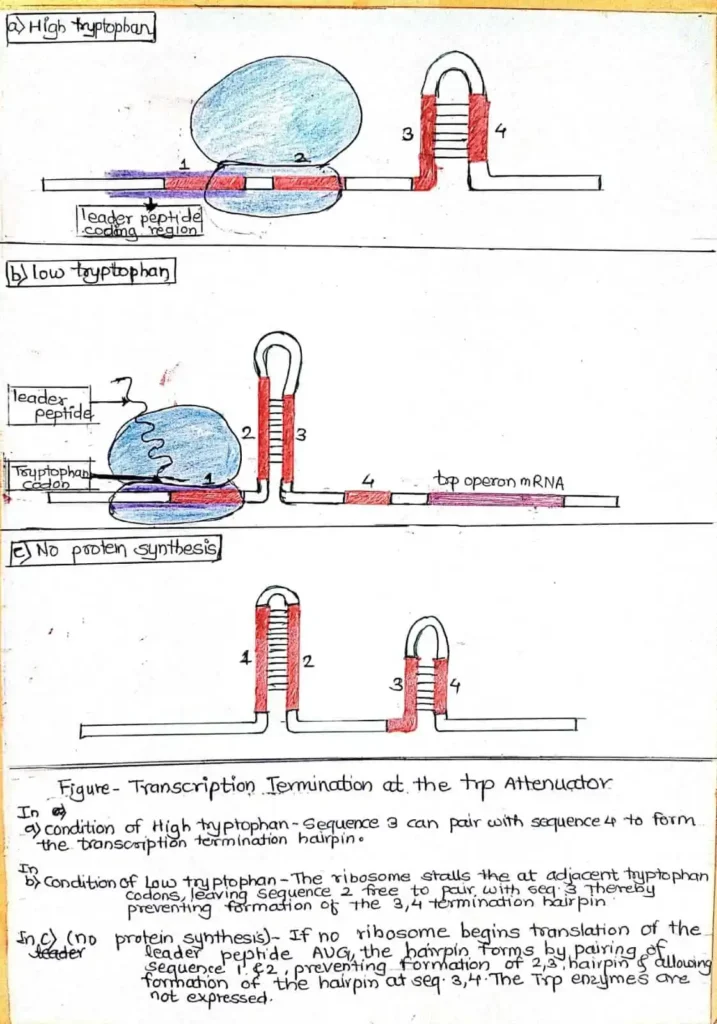
Normally, when tryptophan levels are high, RNA polymerase that started transcription pauses at a certain point and then stops before reaching TrpE, as we just explained. When there is enough tryptophan, the process doesn’t stop, and the enzyme continues to read the trp genes. The process of stopping early transcription, known as attenuation. Depends on how closely transcription (making RNA) and translation (making proteins) are connected in bacteria, as well as how RNA can form different shapes.
To understand attenuation, we looked at the start of the trp operon mRNA. This showed that 161 RNA building blocks are made from the tryptophan promoter before the enzyme reaches the first part of the trpE gene. Close to the end of this sequence, before trpE, there is a stop signal made of a hairpin loop in the RNA, followed by eight uridine building blocks. At this point, RNA production usually stops, creating a leader RNA that is 139 building blocks long.
How can mRNA for the whole operon be made? There are three features of the leader sequence that help RNA polymerase get past the attenuator when tryptophan levels are low. First, a second hairpin can form between regions 1 and 2 of the leader. Second, region 2 can pair with region 3, creating another hairpin that stops the terminator hairpin from forming. Third, the leader RNA makes a short leader peptide of 14 amino acids and has a strong ribosome binding site. This leader peptide has two tryptophan codons next to each other, which is important because similar sequences are found in leader peptides of other operons that make amino acids.
For example, the leucine operon leader peptide has four leucine codons in a row, and the histidine operon leader peptide has seven histidine codons in a row. These operons are controlled by attenuation.
The role of these codons is to stop a ribosome from making the leader peptide. When tryptophan is low, there isn’t much charged tryptophan tRNA, so the ribosome gets stuck at the tryptophan codons. This means the RNA around those codons can’t form a hairpin loop. In the diagram, a ribosome stuck at the tryptophan codons hides part of the RNA, allowing another part to pair up, which stops the hairpin from forming. This lets RNA polymerase continue and make the Trp enzyme.
If there is enough tryptophan, the ribosome can move past the codons, blocking a different part of the RNA. This allows the hairpin to form and stops transcription. The leader peptide doesn’t have a function and gets quickly broken down by the cell.
Using both repression and attenuation helps control the amount of tryptophan inside the cell. It creates a two-step response to low tryptophan, first stopping the repressor from binding, then further reducing activity as starvation increases. However, attenuation alone can also effectively regulate other amino acids like His and Leu, which don’t use repressors but rely only on attenuation.
Conclusion
The trp operon is a classic example of gene regulation in bacteria. When tryptophan is abundant in the cell, the repressor is activated and gene expression is inhibited. However, when tryptophan is lacking, repression is removed and the operon is activated, which leads to the production of tryptophan-producing enzymes. In addition, attenuation, another subtle control mechanism, is based on RNA structure and transcription-translation coupling. When tryptophan levels are low, RNA polymerase produces complete mRNA, while when levels are high, transcription is terminated early.
Two control mechanisms in the tryptophan operon, repression and attenuation, explain how gene expression is finely and precisely regulated in bacteria. When tryptophan levels are high, the cell stops producing the unnecessary enzyme, while when it is deficient, RNA polymerase is allowed to proceed and produce complete mRNA. Attenuation is a very fast and efficient response because it relies on the close relationship between transcription and translation. The consecutive tryptophan codons in the leader peptide act as sensors to detect the availability of charged tRNA in the cell. Thus, the cell recognizes the exact need for tryptophan and produces the enzyme accordingly.
This suggests that bacterial cells are very intelligent in their ability to conserve energy and resources. Notably, in some operons (such as his and leu), effective control is achieved using only attenuation. Thus, attenuation is an important and efficient mechanism in bacterial gene control. Thus, the trp operon helps the cell conserve energy and resources by recognizing the precise need for tryptophan. It is therefore considered a fundamental and important concept in understanding gene expression control in molecular biology.
Read Also:
Genetic Methylation Test – No. 1 Best information.
Frequently Asked Questions (FAQs)
1. What is the trp operon?
Answer: The trp operon is a group of genes in E. coli that controls the production of the amino acid tryptophan.
It is a classic example of a repressible operon used in gene regulation in prokaryotes.
2. Is the trp operon inducible or repressible?
Answer: The trp operon is repressible.
It is normally ON . It is turned OFF when tryptophan is present.
Because the end product (tryptophan) switches off its own synthesis, it is called a repressible operon.
3. When is the trp operon transcribed?
Answer: The trp operon is transcribed when tryptophan levels are low.
When there is little or no tryptophan in the cell:
-The repressor protein remains inactive
-It cannot bind to the operator
-RNA polymerase transcribes the structural genes
-Tryptophan is synthesized
4. How does the trp operon work?
Answer: 1. When tryptophan is LOW (Operon ON)
-Repressor is inactive.
-RNA polymerase binds to promoter.
-Genes trpE, trpD, trpC, trpB, trpA are transcribed.
-Cell produces tryptophan.
2. When Tryptophan is HIGH (Operon OFF).
-Tryptophan acts as a corepressor.
-It binds to the repressor protein.
-The activated repressor binds to the operator.
-Transcription stops.
5. What does the trp operon do?
Answer: The trp operon:
-Controls synthesis of tryptophan
-Saves energy by stopping production when tryptophan is available
-Regulates gene expression through repression and attenuation