
Missense Mutation explained in simple terms—definition, examples, diseases, and the difference between missense and nonsense mutations.
Introduction
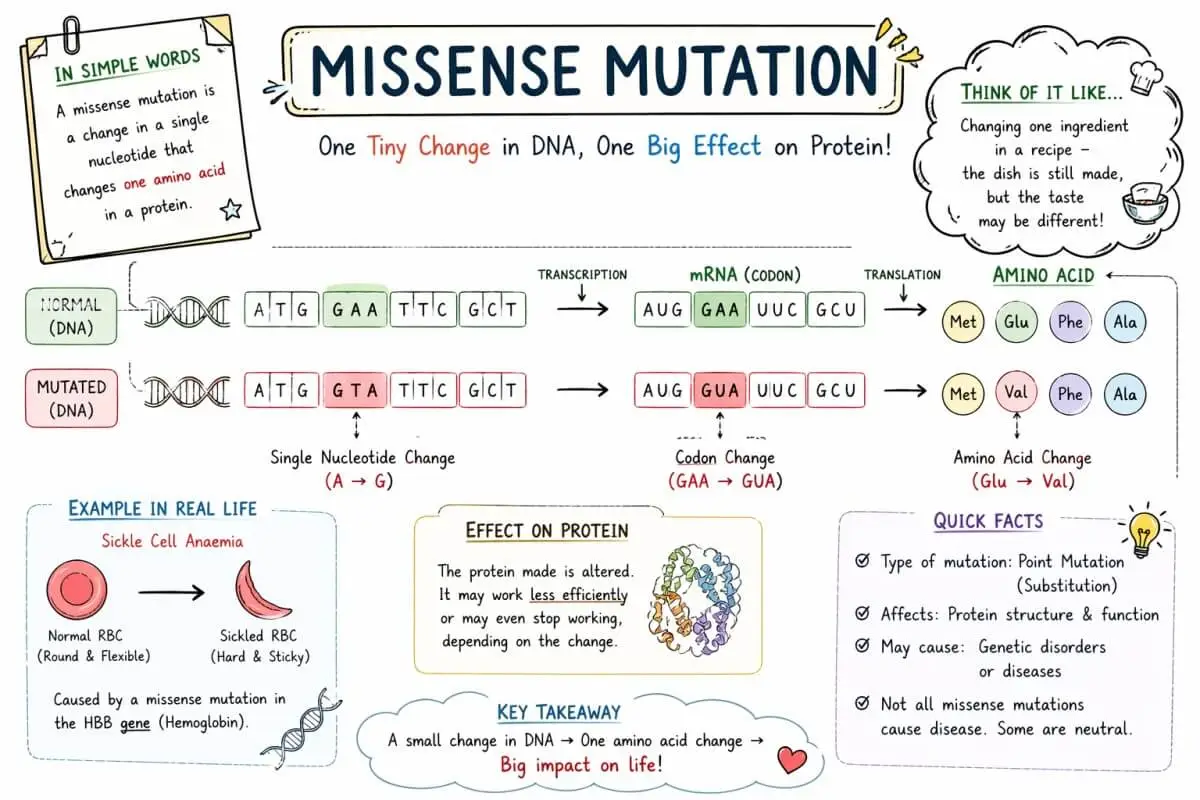
Missense mutation in simple words.
Just imagine… You are making “poha” with the perfect recipe… but suddenly you made a small mistake—you added baking soda instead of salt!
The dish is not completely spoiled… but the taste is a little “weird.” The same thing happens in our body too… It is called a missense mutation!
Our DNA has perfect instructions—like a cooking recipe, but sometimes a small spelling mistake happens…
One letter change = one amino acid change, and then the protein goes a little “off track.”
Understand in simple terms:
DNA = Recipe
Codon = Ingredient
Amino Acid = Final taste
“Missense mutation” means one ingredient changed… but the dish is still recognizable!
Funny Example:
Original: “Make a CAT”
Mutation: “Make a BAT”
Just one letter changed… But the output is totally different!
Reality Check (a bit serious but interesting):
Missense mutations cause some proteins to not work properly and some diseases to occur, like sickle cell anemia—a classic example.
A missense mutation is… a “typing mistake” in DNA, which is small… but the impact is sometimes big!
Mutation
A mutation is just a change from the normal that can be inherited. It is a change in the DNA’s nucleotide sequence or, in the case of RNA viruses, a change in the genomic RNA’s nucleotide sequence. We already know that modifications to coding regions of DNA can modify the amino acid sequences of proteins, and modifications to noncoding areas of DNA can change how genes are expressed, for instance, by changing a promoter’s strength. Naturally, a mutation can impact any physiological function that uses a DNA sequence.
To better understand how gene regulation works along with mutations, you can also explore our detailed guide on the lac operon mechanism.
The presence of mutations suggests that the DNA sequence in organisms, including viruses, is both sufficiently unstable and sufficiently stable for the majority of individuals to have the same sequence. Changes do occur and are detectable.
Although they are closely similar, the phrases “wild-type,” “mutant,” “mutation,” and “allele” need to be differentiated. A reference that is typically found in nature is called a wild-type. It may refer to an organism, a gene, a gene product, or a group of genes. Similar to a nucleotide sequence or a protein. An inheritable alteration from that reference is called a mutation. The organism carrying the mutation is called a mutant. If two mutations occur in the same gene, they are referred to as allelic. But since genes can now be examined at the nucleotide level, alleles can refer to nucleotides instead of genes.
Before the ease of DNA sequencing, mutations could only be easily recognized by their obvious impact on an organism’s shape, color, or behavior, or on the appearance of the cell. A few of the most significant changes in colony or plaque morphology were easily researched biological impacts of bacterial and viral alterations. The incapacity of cells to proliferate at low or high temperatures or without the addition of particular substances to the growth media was another readily investigated impact of mutations. These easily observable characteristics of cells make up their phenotype. The genotype is the state of the genome that results in the phenotype. For instance, the incapacity to grow on lactose is known as the Lac phenotype.
Mutations in lactose transport, the β-galactosidase enzyme, lac gene regulation, or the general regulation of classes of genes that are poorly activated when cells are cultured in the presence of glucose might cause it. Any of the following genes—lacY, lacZ, lacI, crp, or cya—would be mutated in such cells.
Missense Mutation & Missense Mutation Diagram
The altered codon in this mutation codes for different amino acids than the original. Because a mutant codon codes for a different amino acid, the protein that results from it is likewise changed. Such a protein may be entirely dormant or less active.
A protein becomes totally non-functional if its active site contains modified amino acids. A missense mutation alters the organism’s phenotype. One illness brought on by a missense mutation is sickle-cell anemia. The hemoglobin gene is the site of the mutation. A protein called hemoglobin aids in the bloodstream’s ability to deliver oxygen. Additionally, it has an impact on the shape of our red blood cells, which must be spherical in order to flow easily through our blood arteries.
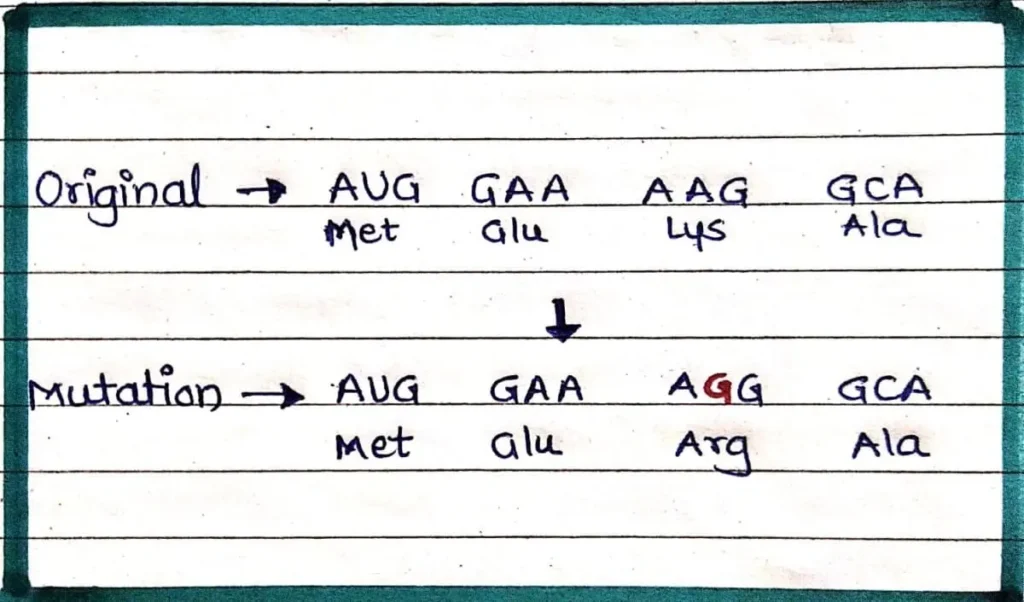
A missense mutation is a nucleotide alteration that results in the substitution of various amino acids. Consequently, the resultant protein may become nonfunctional. Diseases include sickle cell disease, SOD1-mediated ALS, and epidermolysis bullosa, which are caused by these mutations (Boillée et al., 2006). However, there may be little to no change in the protein if a missense mutation in an amino acid codon results in the use of a different but chemically identical amino acid. For instance, arginine, a molecule that is chemically identical to the desired lysine, will be encoded if AAA is changed to AGA. In the latter scenario, the mutation will be neutral since it will have little to no impact on the phenotype.
What is a Missense Mutation?
It is a type of substitution mutation. One nucleotide is swapped out for another in substitution mutations, which are frequently brought on by chemicals or problems with DNA replication. These modifications fall under the category of transitions or transversions. The most frequent transition is the one that swaps a pyrimidine for a pyrimidine (C ÷ T) or a purine for a purine (A ÷ G). Nitrous acid, base mispairing, and carcinogenic base analogues like BrdU can all produce a transition. A transversion, which switches a purine for a pyrimidine or a pyrimidine for a purine (C/T ÷ A/G), is less frequent.
A point mutation occurs when a gene’s single base pairs or other tiny base pairs are altered. A point mutation can be undone by either second-site reversion (a complementary mutation elsewhere that restores gene functionality) or by another point mutation, which returns the nucleotide to its original state (true reversion). Point mutations that take place in a gene’s protein-coding region can be categorized as either synonymous or nonsynonymous substitutions, which can then be further subdivided into missense or nonsense mutations.
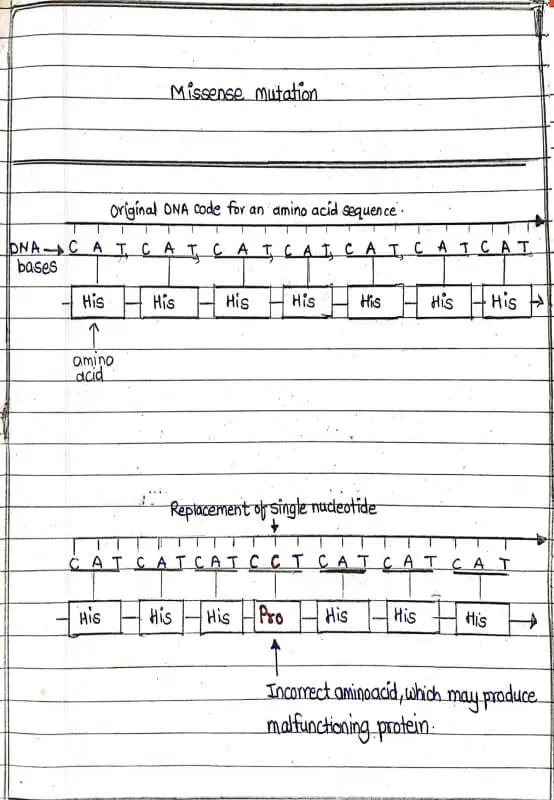
A genetic alteration in which a single base pair substitution alters the genetic code in a way that produces an amino acid that is different from the usual amino acid at that position. Some missense mutations alter the function of the protein.
For example, if a missense mutation changes a codon from AAG to AGG, the amino acid arginine will be produced instead of lysine.
Missense mutation definition/ Define “missense mutation.” Define “missense mutation” in genetics.
A missense mutation is a type of point mutation in which a single nucleotide substitution in the coding region of DNA changes the codon, and that change results in a different amino acid being incorporated into the translation process, resulting in a change in the primary structure of the protein being produced.
According to the official definition available on NCBI, a missense mutation is a type of point mutation where a single nucleotide change results in a different amino acid.
Detailed explanation at the genetic level
1. The Central Dogma of Molecular Biology is important for understanding missense mutations:
Nucleotide sequence in DNA → transcription → mRNA
Codons in mRNA → translation → amino acids → protein
When a base in DNA changes, the corresponding mRNA codon changes, and therefore a different amino acid is added according to the rules of the genetic code.
2. Codon alteration mechanism:
Although the genetic code is degenerate, each codon codes for a specific amino acid. i.e., single base substitution → amino acid replacement.
In a missense mutation:
Original codon → altered codon
Same length but different amino acid specificity.
Example—
GAG → Glutamic acid
GUG → Valine
3. Effects on protein structure and function:
The effects of a missense mutation depend on the amino acid properties:
Conservative substitution (amino acid with similar properties)—Little effect on protein function.
Non-conservative substitution (completely different properties)—Big effect on protein folding, stability, and active site.
Missense mutation definition biology/What is a missense mutation in biology?
A missense mutation is a type of point mutation in which a single nucleotide substitution in DNA changes the codon, and that change results in the incorporation of a different amino acid during protein synthesis, resulting in a change in the structure and function of the protein.
A missense mutation is a kind of genetic alteration in which a single DNA base (letter) is altered, resulting in the addition of a different amino acid during the protein-making process.
One small change in DNA → One wrong amino acid → Protein may change.
Codons, which are three-letter words, are the instructions found in DNA. Every codon represents a distinct amino acid. The codon may now code for a different amino acid when one letter is altered. Protein structure or function is altered as a result. Some missense mutations are harmless. Some can change protein function. Some may cause diseases like sickle cell anemia.
Missense mutation examples
1. Sickle Cell Anaemia
- This is the most famous example.
- Normal codon: GAG → Glutamic acid
- Mutated codon: GTG → Valine
- A single base change changes the hemoglobin in the blood. The shape of RBCs (red blood cells) becomes sickle-shaped.
Learn more about sickle cell disease.
2. Phenylketonuria (PKU)
- Normal codon: CGG → Arginine
- Mutated codon: TGG → Tryptophan
- The enzyme (phenylalanine hydroxylase) does not work properly. Phenylalanine accumulates in the body.
3. Cystic Fibrosis (Missense mutation in some cases)
- Small change in DNA → amino acid changes
- The CFTR protein (Cystic Fibrosis Transmembrane Conductance Regulator) does not work properly. As a protein that acts as an ion channel, it transports chloride and bicarbonate ions across epithelial cell membranes to balance salt and water.
- Effects on the lungs and digestive system.
4. Tay-Sachs Disease
- Normal amino acid → functional enzyme
- Mutation → different amino acid
- The enzyme (hexosaminidase A) does not work. Nervous system damage.
5. Haemophilia (In some cases)
- Amino acid changes in the clotting factor protein.
- The blood clotting process is impaired.
- Bleeding becomes more frequent.
Conservative Missense Mutation
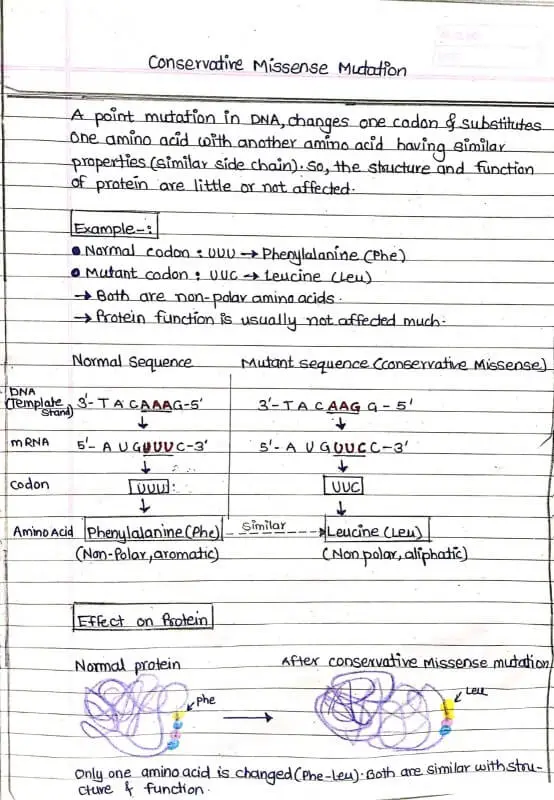
A conservative missense mutation means that a base change occurs in DNA, but the new amino acid formed is the same as the old amino acid (has similar properties).
So it doesn’t have much effect on protein.
A codon changes, but the size, charge, or nature of the new amino acid is the same as the old one, so the shape and function of the protein remain almost the same.
A conservative missense mutation mostly has a safe change.
Protein function remains roughly the same.
Disease is less likely to occur.
Simple Example
Normal: AAA → Lysine (positively charged)
Mutated: AGA → Arginine (positively charged)
Since both amino acids are similar, there is no major effect on the protein.
Nonsense vs Missense Mutation (difference between nonsense and missense mutation)
| Point | Missense Mutation | Nonsense Mutation |
| Basic meaning | A single nucleotide change replaces one amino acid with another. | A nucleotide change results in a codon → stop codon. |
| Effects on Protein | The complete protein is formed, but the structure changes. | Stops protein synthesis (incomplete protein). |
| Protein length | Normal (full length). | Reduced (truncated). |
| Effect on Function | More or less change, sometimes even normal. | Most of the time, the function is destroyed. |
| Severity | Mild to moderate. | Severe. |
| Genetic code changes | Sense codon → second sense codon. | Sense codon → stop codon. |
| Effects on Translation | Continues. | Stops suddenly. |
| Effect type | Sometimes harmful / sometimes neutral. | Most harmful. |
| Example | Sickle Cell Anemia. | Duchenne Muscular Dystrophy. |
Missense mutation vs. point mutation
| Point | Missense Mutation | Point Mutation |
| Basic meaning | A single nucleotide change replaces one amino acid with another. | Any change (substitution) in a single nucleotide in DNA. |
| Type | A type of point mutation test. | There is a large group (umbrella term) |
| Effects on Protein | The result may be different (missense/nonsense/silent). | Codon may be changed or not. |
| Scope | Specific (only amino acid changes). | Broad (includes many types). |
| Codon changes | One codon → another codon (changes the amino acid). | A codon may be changed or not. |
| Effects on Translation | continues. | May continue or stop. |
| Effect | Mild to moderate (sometimes harmful). | Effect variable (neutral to severe). |
| Importance | Direct effect on protein function. | Basic concepts to understand genetic mutation. |
| Example | Sickle Cell Anemia. | Types of point mutations: missense, nonsense, and silent. |
In short, information
- Type: Point mutation (single nucleotide substitution).
- Region: Coding sequence (exon).
- Effect: Amino acid substitution.
- Protein: Primary structure altered.
- Outcome: Variable (neutral → severe).
Conclusion
“A missense mutation is a small change in DNA… but it directly affects the quality of the protein.”
In a missense mutation, a change in one nucleotide replaces one amino acid with another. This results in a complete protein, but its structure and function may be altered. Sometimes this change is insignificant (neutral), but sometimes it has a major impact on the body’s function—for example, in sickle cell anemia, a single amino acid change changes the size of RBCs.
FAQs
What is a Missense Mutation?
A missense mutation is a genetic mutation in which a single nucleotide in DNA is changed, resulting in the replacement of one amino acid with another.
Which type of mutation always produces a stop codon? Missense, nonsense, or silent point?
Nonsense mutation.
Because,
DNA change causes a codon to become a stop codon. Protein synthesis stops early.
Missense mutation: amino acid changes (not stop).
Silent mutation: changes, but the amino acid remains the same
Point mutation: This is a broad term (missense, nonsense, and silent all come under this).
Missense, nonsense, and silent mutations are examples of which type of mutation?
Point Mutation.
-Missense, nonsense, and silent mutations are all types of point mutations.
-In a point mutation, a single nucleotide in DNA is changed (substitution).
-Missense, nonsense, and silent mutations are all types of point mutations.
-In a point mutation, a single nucleotide in DNA is changed (substitution).
What is the difference between missense and nonsense mutations?
Missense mutation → one amino acid change → protein is formed (but altered).
Nonsense mutation → stop codon is formed → protein stops (incomplete)
What does a Missense mutation do?
A missense mutation changes one nucleotide in DNA, which results in one amino acid being replaced by another in the protein.
Effect:
Protein still gets made, but its structure/function may change.
Impact can be harmless, mild, or harmful depending on where the change occurs.
Example: Sickle Cell Anemia → a single amino acid change alters the shape of red blood cells.
What does “missense mutation” mean?
A missense mutation means a change in DNA where one nucleotide is altered, causing one amino acid in a protein to be replaced by another.
What happens in a Missense mutation?
A missense mutation is a type of genetic change where one nucleotide (DNA base) is replaced by another, and this change alters a codon, causing a different amino acid to be inserted into a protein.
What actually happens step-by-step:
DNA change (point mutation)—A single base in the DNA sequence is substituted.
Example:
Original DNA → GAA
Mutated DNA → GUA
-Codon changes during translation.
-The altered DNA produces a different mRNA codon.
-Amino acid substitution.
-The new codon codes for a different amino acid.
-Protein structure may change.
-This can affect how the protein folds and functions.
Why is it called a Missense mutation?
A missense mutation gets its name from the idea that the genetic “message” is changed to mean something else.
Miss” = wrong / altered.
“Sense” = the meaning of the genetic code (codons → amino acids).
What is a missense mutation with an example?
A missense mutation is a type of gene mutation where one nucleotide (DNA base) changes, causing a different amino acid to be added to a protein.
Classic Example: Sickle Cell Anemia.
What is a conservative missense mutation?
A conservative missense mutation is a type of missense mutation where one amino acid is replaced by another with similar properties (such as size, charge, or polarity).
It is called “conservative” because the change is chemically similar, and the overall protein structure is largely preserved.
Which is worse, a missense or a nonsense mutation?
In most cases, a nonsense mutation is worse than a missense mutation.
What is a dominant negative missense mutation?
A dominant negative missense mutation is a special type of missense mutation where the mutated protein is not just defective—it actually interferes with the normal (healthy) protein.
Enlist diseases caused by a missense mutation?
1. Sickle Cell Anemia-
Cause: Mutation in the β-globin gene
Change: Glutamic acid → Valine
Effect: RBCs become sickle-shaped → anemia, pain.
2. Marfan Syndrome-
Cause: Mutation in fibrillin-1 protein.
Effect: Weak connective tissue → long limbs, heart problems.
3. Achondroplasia-
Cause: Mutation in the FGFR3 gene.
Effect: Abnormal bone growth → short stature (dwarfism).
4. Phenylketonuria (PKU)—
Cause: Mutation in the phenylalanine hydroxylase enzyme.
Effect: Toxic buildup of phenylalanine → brain damage if untreated.