What is a microbiology course?
Microbiology courses are educational programs that focus on the study of microorganisms—tiny living things that cannot be seen with the naked eye. These include bacteria, viruses, fungi, protozoa, and algae.
These microbiology courses teach the following:
1) How do microorganisms survive and grow?
2) How do they cause diseases?
3) How are they useful in medicine, industry and the environment
4) Laboratory skills are used to study them (using a microscope, culturing, testing, etc.)
Microbiology courses are available at undergraduate (UG), postgraduate (PG), diploma and post-secondary certification levels.
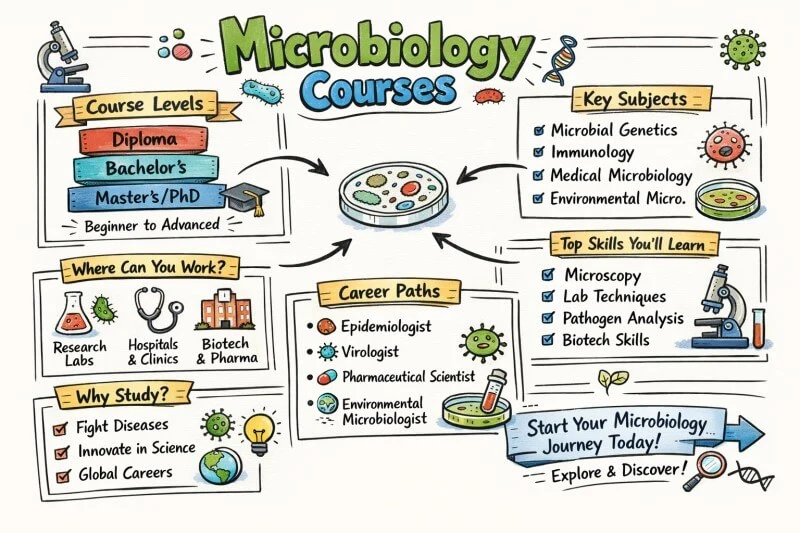
Types of microbiology courses:
Bachelor’s course (after 12th)
- B.Sc. Microbiology
- B.Sc. medical microbiology
- B.Sc. Biotechnology
- B.Sc. Clinical Laboratory Science
- B.Sc. in Industrial Microbiology
Continuing education Microbiology courses
- M.Sc. Microbiology
- M.Sc. medical microbiology
- M.Sc. industrial microbiology
- M.Sc. food microbiology
Diploma and certificate Microbiology courses
- DMLT (Diploma in Medical Laboratory Technology)
- Certificate in Food Microbiology
- Certificate in Medical Microbiology Technology
- Laboratory Quality Control Certificate
- Certificate in Microbial ecology and soil Microbiology
- Certificate in Veterinary Microbiology
- Certificate in Dairy Microbiology.
- Certificate in Aeromicrobiology
- Certificate in Exomirobiology
- Certificate in aquatic Microbiology
- Certificate in Sanitary Microbiology
- Certificate in Geochemical Microbiology
- Certificate in Petroleum Microbiology
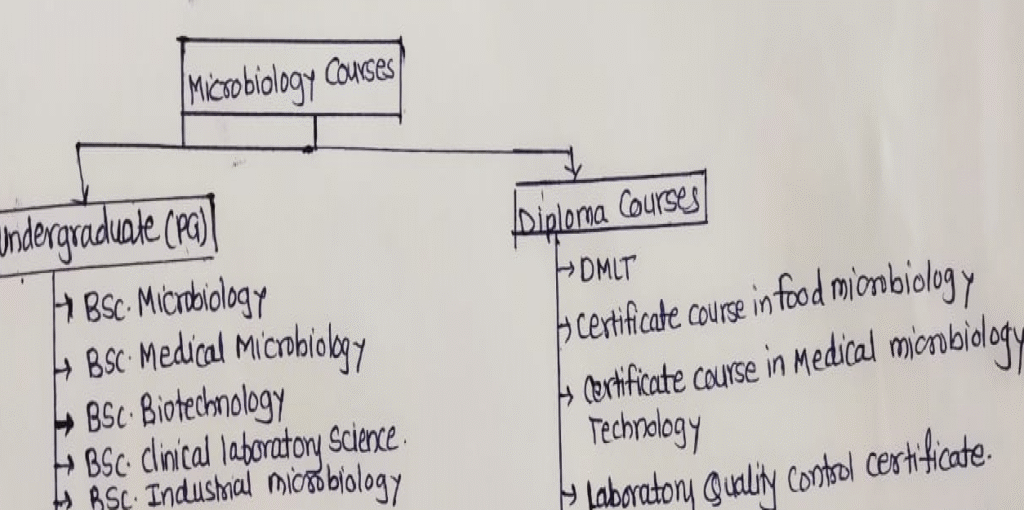
What do you study in the Microbiology course?
Students learn:
- Types of microorganisms
- Bacteria, viruses, fungi, protozoa, algae
- Infection, immunity and disease
- Antibiotics and vaccines
- Food and industrial microbiology
- Water and soil microbiology
- Clinical diagnosis
- Sterilization and disinfection
- Lab safety and lab testing techniques
- Microscopy
- Research methods
Microbiology Career Roadmap (step by step)
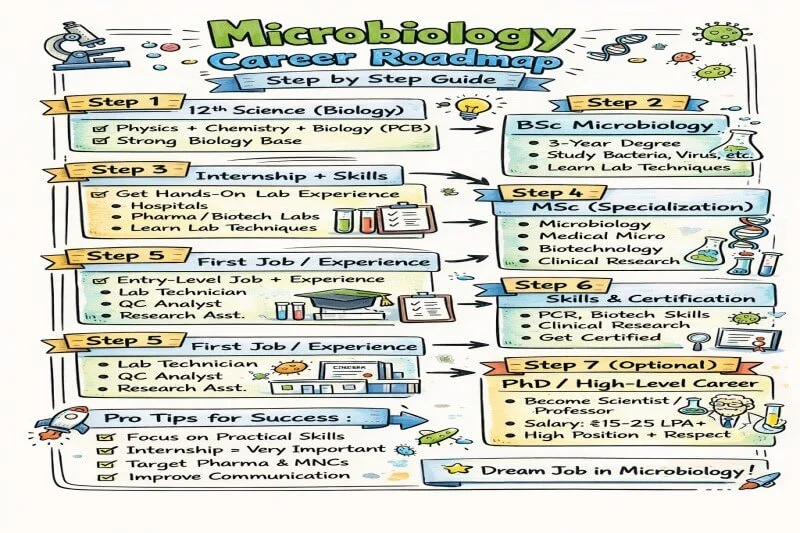
Career opportunities after a microbiology course:
- Microbiologist
- Medical Laboratory Technician
- Research Scientist
- Clinical Microbiologist
- Food Microbiologist
- Quality Control Officer
- Biotechnologist
- Pharmaceutical Industry jobs
- Hospital diagnostic labs
- Government research labs (ICMR, CSIR, DRDO)
- Water testing labs
- Forensic labs
Eligibility
- Must have completed 12th-grade science (Biology/PCB)
- Some colleges require an entrance exam
Top Colleges for Microbiology in India
- St. Xavier’s College, Mumbai.
- Fergusson College, Pune.
- University of Delhi.
- Manipal Academy of Higher Education.
- Amity University.
- Banaras Hindu University.
- Savitribai Phule Pune University.
- Loyola College, South India.
- MES’s Abasaheb Garware College, Pune.
Microbiology course fees
1. BSc Microbiology
Duration: 3 years
Fees Range:
- Government College: ₹7,000 – ₹50,000 per year.
- Private College: ₹50,000 – ₹200,000 per year.
2. MSc Microbiology
Duration: 2 years
Fees Range:
- Government College: ₹1,000 – ₹50,000 per year
- Private College: ₹50,000 – ₹150,000 per year
Why Study Microbiology? (Benefits)
- High demand in the medical and healthcare fields
- Excellent career opportunities in research
- Essential for the pharmaceutical and biotech industries
- Good salary growth
- Opportunities in both government and private sectors
- Important in modern science (vaccines, antibiotics, AI-based bio-research)
Microbiology course Post and salary
The initial salary in the microbiology field is a bit average, but with experience and higher education (MSc/PhD), your salary can increase very rapidly. With the right skills and specialization, you can easily reach ₹10–25 LPA.
| Job Profile | Average Salary in India |
|---|---|
| Microbiologist | ₹2.5 LPA–₹6 LPA (Starting) ₹10 LPA+ with experience |
| Lab Technician / Lab Assistant | ₹1.5 LPA – ₹3.5 LPA |
| Quality Control Analyst (Pharma/Food) | ₹3 LPA – ₹7 LPA |
| Research Scientist | ₹5 LPA – ₹12 LPA+ |
| Clinical Microbiologist | ₹4 LPA – ₹10 LPA |
| Food Microbiologist / Food Safety Officer | ₹3 LPA – ₹8 LPA |
| Industrial Microbiologist | ₹4 LPA – ₹9 LPA |
| Epidemiologist | ₹6 LPA – ₹20 LPA |
| Clinical Research Associate (CRA) | ₹6 LPA – ₹18 LPA |
| Pharmaceutical Microbiologist | ₹5 LPA – ₹15 LPA+ |
Future
The future of microbiology is bright. With the advent of recombinant DNA technology and genetic engineering, microbiology will expand and change even faster in the future. The need for microbiologists to work on problems in medicine, environmental protection, food production and preservation, and industrial development will undoubtedly grow. The microbiologist Rene Dubos has summarized well the excitement and promise of microbiology:-
“How extraordinary that all over the world, microbiologists are now involved in activities as different as the study of gene structure, the control of disease, and the industrial processes based on the phenomenal ability of microorganisms to decompose and synthesize complex organic molecules. Microbiology is one of the most rewarding of professions because it gives its practitioners the opportunity to be in contact with all other natural sciences and thus to contribute in many different ways to the betterment of human life.
Short Answer
Microbiology courses are programs that teach the study of microorganisms—their structure, behavior, role in diseases, and their applications in medicine, industry, and research.
Conclusion
From fighting deadly diseases to shaping the future of medicine and environmental science, microbiology stands at the heart of innovation. The courses you choose today can open doors to global opportunities tomorrow. If you’re passionate about science and discovery, now is the perfect time to dive into microbiology and build a future full of possibilities.
FAQ
1. What is a microbiology course?
Answer: The structures, functions, and purposes of microbes are all covered in microbiology courses. These classes are available at every level. In India, microbiology studies are offered by numerous government and private universities.
A BSc in Microbiology at the undergraduate level and an MSc in Microbiology at the graduate level are common choices. Immunology, molecular biology, microbial physiology, genetics, and industrial or medical microbiology are among the main fields of research.
2. After a B.Sc., which course is best in microbiology?
Answer: After a BSc in microbiology, you have many strong career options. Choosing the right course depends on your interest and career goal. If you want a safe and powerful option, then an MSc in Microbiology is considered the best choice.
3. Is B.Sc. Microbiology a good course?
Answer: Yes, BSc Microbiology is a very good and future-oriented course, but whether it is the “best” or not depends on your interests and career goals.
4. Microbiology: How many years is the course?
Answer: Microbiology is not a single course but a field available at different levels. So the duration depends on which course you choose.
BSc Microbiology—Duration: 3 years; must be done after 12th science (PCB group)
MSc Microbiology – Duration: 2 years, Must be done after BSc (specialization available, important for high-salary jobs)
5. After an MSc in microbiology, which course is best?
Answer: Your career can be very strong after completing an MSc in microbiology—but choosing the right next step is very important. Below are the best courses after MSc Microbiology, depending on your goals.
1. PhD in Microbiology
2. PG Diploma in Clinical Research.
3. MTech / MSc Biotechnology (Advanced Specialization).
4. MBA in Healthcare / Pharma Management.
5. Bioinformatics Course.
6. Postdoctoral Research (Postdoc).
After an MSc in microbiology you have many strong options, but a PhD is considered the most powerful and long-term best option. If you want a job immediately, clinical research or biotechnology are the best.
6. Is microbiology a professional course?
Answer: Microbiology is not a pure professional course, but it is a “semi-professional/career-oriented” course—and with the right specialization, it can become a full-fledged professional career.
7. Is microbiology a good course?
Answer: Microbiology is not just a course—it is the future of science, research, and innovation. If you do smart planning and continuous learning, this course can lead to a high-paying and respected career. Microbiology is not just a course—it is the future of science, research, and innovation. If you do smart planning and continuous learning, this course can lead to a high-paying and respected career.
8. Which course is better, microbiology or biotechnology?
Answer: Safe & stable career: Microbiology
High salary & future growth: Biotechnology