
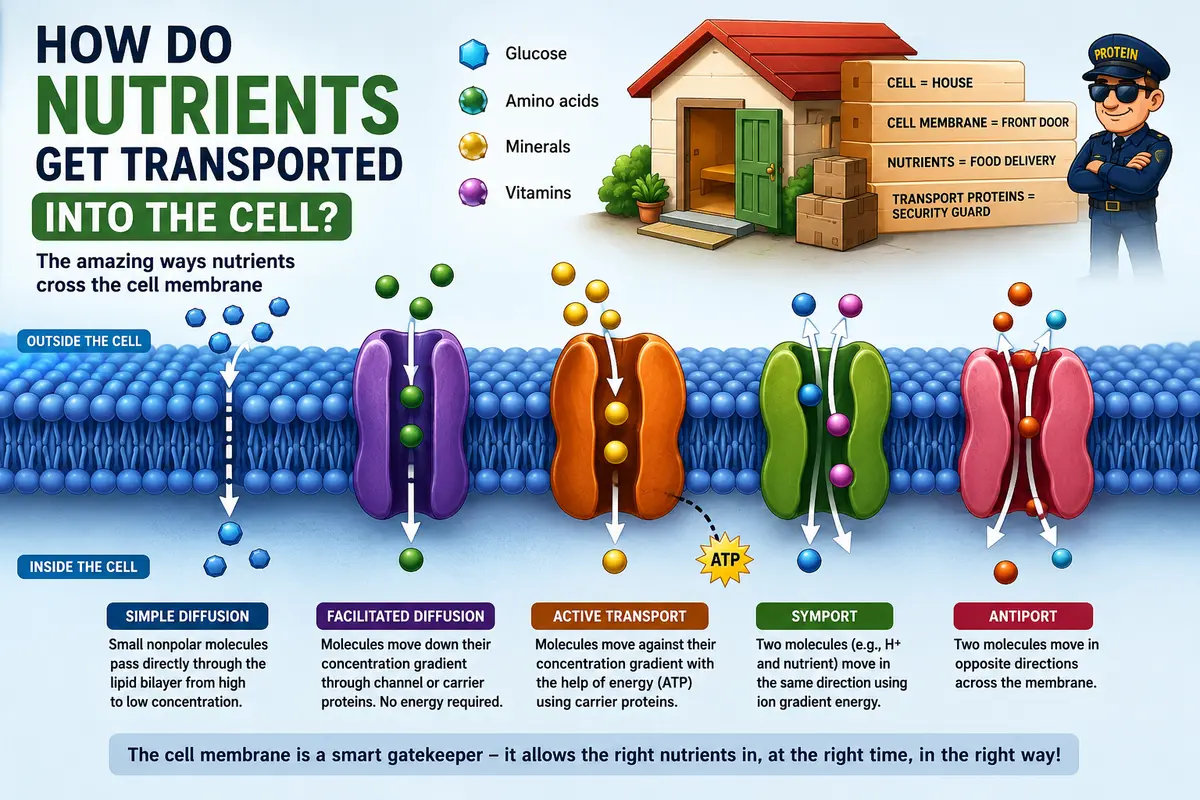
How Do Nutrients Get Transported into the Cell? Learn about diffusion, facilitated diffusion, active transport, porins, carrier proteins, and group translocation with easy examples.
Introduction
Imagine this… You order your favorite pizza. The delivery person reaches your house, but your front door is locked. Can the pizza magically appear on your dining table? Of course not! Someone has to open the door, check the order, and let the pizza inside. Now think of your cell as a tiny house.
Now think of your cell as a tiny house.
Cell = House
Cell membrane = Front door
Nutrients (glucose, amino acids, minerals) = Food delivery
Transport proteins = Security guard or doorkeeper
The cell membrane doesn’t allow everything to enter. It carefully decides who gets in, who stays out, and who needs special permission. Sometimes nutrients can simply walk through the door because they are small enough. Sometimes they need a VIP pass (transport proteins), and sometimes the cell even spends energy (ATP) to pull important nutrients inside—just like paying extra for express delivery!
Just as your body cannot survive without food, every cell cannot survive without nutrients. But first, those nutrients must cross the cell membrane. This amazing process is called transport of nutrients into the cell, and it is one of the most important functions that keeps every cell alive.
For example, imagine your college has a security gate.
Students with ID cards enter easily.
Visitors need permission from the security guard.
Heavy equipment is brought in using a special vehicle and extra effort.
Similarly, nutrients enter the cell in different ways:
Small molecules pass easily.
Some need special carrier proteins.
Others require energy (ATP) to enter.
The cell membrane works just like a smart security gate—it allows only the right substances to enter at the right time!
To understand how molecules cross the membrane, it is helpful to first learn about the structure of the cell membrane.
How do nutrients get transported into the cell?
The term “transport” describes the flow of material across a membrane in either direction. This is an important fact because if a cell allowed its intracellular levels of certain substances to become too high, it would commit apoptosis. Even while the information that follows focuses on the flow of mate into the cell, keep in mind that there is a counter mechanism for moving the same or comparable material out of the cell for every process that brings material into the cell.
Primary Transport and Secondary Transport
Ion pumps powered by chemical or photochemical reactions are referred to as fundamental transport systems in transport phenomena. Any transport system that uses energy compounds like ATP, which the cell synthesizes as a source of energy, or ion gradients created during primary transport is referred to as secondary transport.
Porins and their role
The membrane is where the transport issue for gram-negative bacteria starts. The phospholipid bilayer cannot be directly penetrated by hydrophilic molecules. The membrane has a number of distinct channels that let small molecules diffuse into the peptidoglycan while blocking larger ones. Porins are unique proteins that keep the channels in the outer membrane intact.
OmpC, OmpF, PhoE, maltoporin (LamB), and Tsx are the main porin proteins in Escherichia coli. The OmpC and OmpF pores are generic; they accept hydrophilic solutes with a preferred molecular weight of roughly 250 and reject molecules with a molecular weight greater than 650. It appears that the main function of maltoporin is to transport starch-derived unbranched polysaccharides.
Outer membrane Proteins and their role
In addition to porins, there are some outer membrane proteins that function to transport specific big molecules. Examples are BtuB, which controls uptake of vitamin B12, and the Fec family of proteins, which transport chelated iron complexes.
Explore different membrane transport mechanisms in this educational resource.
Carrier proteins and their role
Regardless of the existence or lack of an outer membrane, all cells must transfer materials across a plasma membrane. When the cell membrane is carrying out transport functions, its semipermeable characteristic becomes very significant. As is known, charged molecules cannot move across the membrane unassisted, and the passage of unaltered molecules that are much larger than water is likewise impeded unless they are lipid-soluble.
Thus, for all practical purposes, movement of material across a cell membrane is mediated by some form of carrier. Carrier proteins bridge the membrane and can bind to a substance on one side of the cell membrane and transmit it to the opposing membrane surface.
Transport Systems
For metabolically significant chemicals there are often at least two transport mechanisms. (I) One employs a carrier that has a relatively low affinity for the substance (works well when there is a high concentration of the substance outside the cell). (II) The other involves a carrier with high affinity for the same chemical, but it acts only when low outside quantities are present.
The former type of carrier protein normally is present in the cell membrane at all times, while the latter is generated only when needed.
(A) Diffusion and Facilitated diffusion
At the molecular level, any movement of a chemical across a cell membrane requires the input of energy. In a simple solution, molecules travel from an area of high concentration to an area of lower concentration. This process of diffusion results from the presence of the concentration gradient itself.
In chemical terminology, the energy of concentration, given as the chemical activity “a,” is the driving force for the motions of molecules from an area of higher concentration to an area of lower concentration.
Read this detailed explanation of facilitated diffusion and membrane transport mechanisms.
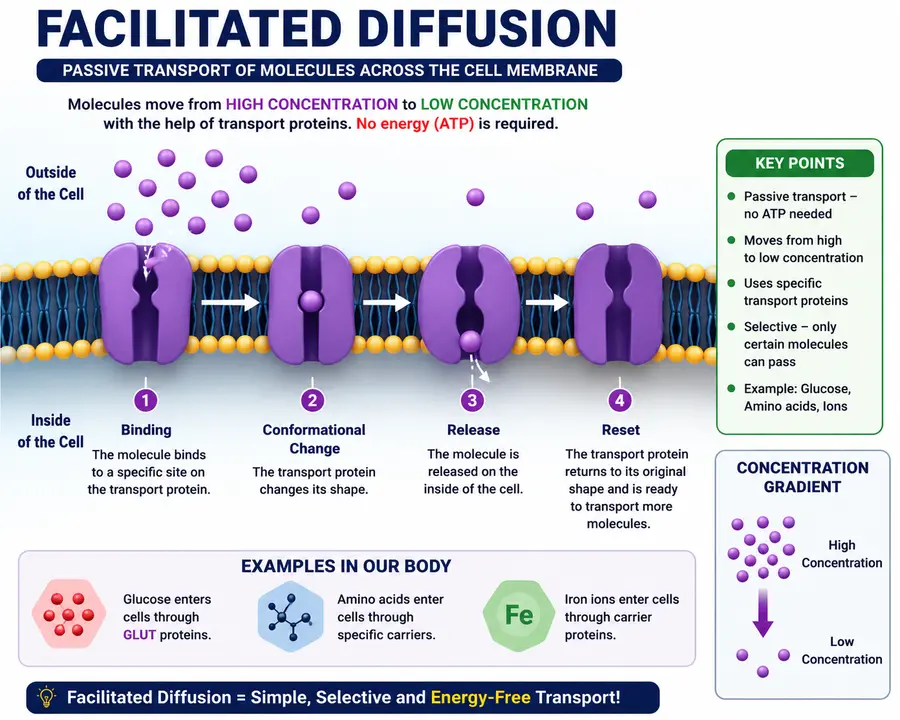
This energy also can be used by cells to drive a process termed “facilitated diffusion” (carrier-mediated diffusion) in which molecules at a higher concentration bind to a protein exposed on the membrane surface and then migrate to the other side of the membrane, where they are released.
The cell benefits from facilitated diffusion, as it doesn’t require any metabolic energy. However, because it can work in reverse to remove material as the ionic concentration outside the cell decreases, it is not as effective as some methods.
While it is uncommon in procaryotes, facilitated diffusion is ubiquitous in multicellular organisms.
(B) Active Transport
Bacterial cells require some kind of concentrative treatment mechanism in order to proliferate in regions with comparatively low nutrient concentrations (10M or less). Because the target molecule 30 is traveling against its concentration gradient, this activity is referred to as active transport and necessitates an external energy input. Proton motive force, which is equal to the total of the electric and chemical gradients across the cell membrane, is one source of energy.
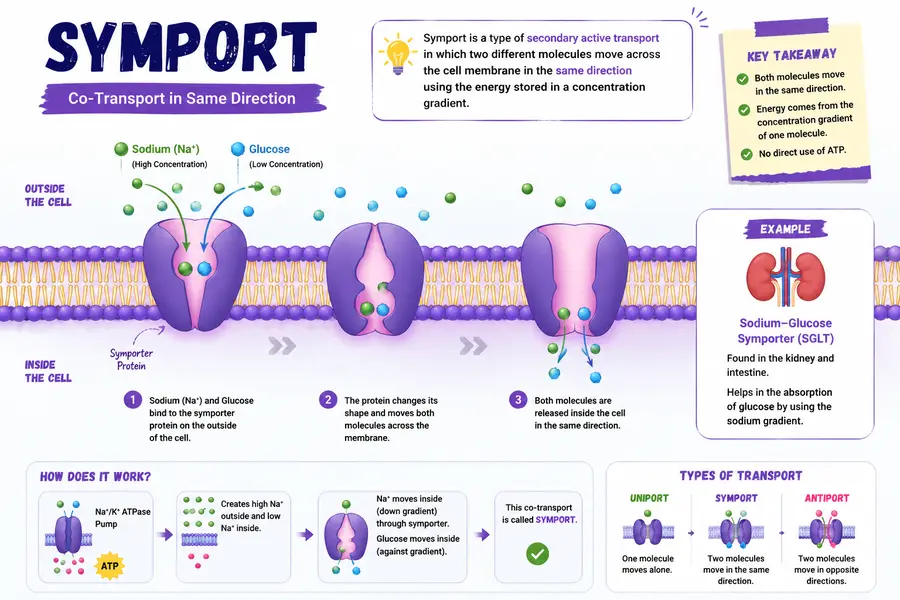
The targeted material is cotransported with a proton in systems that make use of this source. It provides the energy required to move the transported material against its concentration gradient as a proton down its electric and chemical potential gradients (from positive to negative and from higher to lower concentration, respectively).
Symport is the simultaneous transport of an ion down its concentration gradient and the transport of a desired chemical against its concentration gradient. Although H⁺ is the most common ion, other positively charged ions such as Na⁺ or K⁺ can also be utilized. H⁺, Na⁺, and K⁺ ions are then transported back to the cell’s surface by an energy-demanding antiporter pump (another type of active transport).
Binding protein-dependent transport is an additional form of active transport. To be transported across the membrane, the molecule to be moved bonds to a particular carrier, which may be a chain of carriers. Following transport, an energy input from ATP or its equivalent is required to reset the carrier (or a component in the chain).
(C) Group Translocation
Group translocation, a process in which a molecule is simultaneously chemically altered and actively transported into the cell, is frequently linked to active transport in bacteria. The transport of glucose, which is only possible in prokaryotes through the carbohydrate phosphotransferase system (PTS), is an excellent illustration of this mechanism.
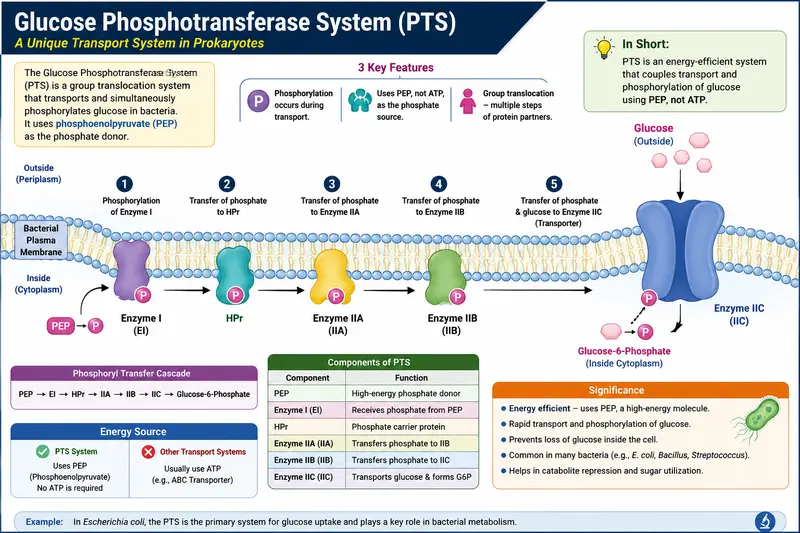
Whereas glucose outside the cell exists as free glucose, glucose inside the cell is discovered as glucose-6-phosphate. Phosphoenolpyruvate (PEP), a substance with inherent energy comparable to an ATP molecule, provides the phosphate group. After passing through a number of protein molecules, the energetic phosphate is joined to the glucose.
Because phosphorylated glucose has a net negative charge, it is less likely than an uncharged free glucose molecule to be able to pass through the cell membrane and leave the cytoplasm. On the other hand, an anion-anion antiporter system in the gram-positive bacterium Streptococcus faecalis can catalyze the exchange of an external inorganic phosphate molecule for cytoplasmic phosphorylated glucose.
In contrast to symport, an antipor reaction involves the transportation of two molecules in opposite directions. One example of a transport mechanism that can stop an excessive build-up of a material in the cytoplasm is this exchange reaction.
Four proteins are involved in the basic PTS pathway. In the cytoplasm, PEP combines with enzyme I to create a phosphorylated enzyme-1 molecule. The phosphate group is subsequently transferred to another cytoplasmic protein, Hpr (heat-stable protein), through a reaction with this phosphorylated protein.
The sugar is actually transported by enzyme II, which is found in the cell membrane. It uses the energy to transfer the sugar molecule and phosphorylate it after receiving a phosphate from either Hpr or an intermediary protein known as enzyme III. The sugar to be delivered determines where enzyme III should be employed. Certain regulatory mechanisms involve enzyme III.
Conclusion
The transport of nutrients across the cell membrane is a fundamental process that enables cells to obtain the substances required for growth, metabolism, and survival. Different transport mechanisms—including simple diffusion, facilitated diffusion, active transport, porins, carrier proteins, symport, and group translocation—allow cells to selectively regulate the movement of molecules based on their size, charge, and concentration gradient.
While passive processes such as diffusion and facilitated diffusion do not require cellular energy, active transport and group translocation utilize ATP or other energy sources to move substances against their concentration gradient. Together, these transport systems ensure efficient nutrient uptake, maintain cellular homeostasis, and support essential biological functions in both prokaryotic and eukaryotic cells. Understanding these mechanisms provides a strong foundation for studying microbiology, physiology, biotechnology, and medicine.
If you’re just starting your microbiology journey, begin with our article on the scope of microbiology to understand its applications, career opportunities, and importance in modern science.
Frequently Asked University Questions (Previous 5 Years)
Long Answer Questions (10–15 Marks)
- Explain the different mechanisms of nutrient transport across the cell membrane with suitable diagrams.
- Describe passive and active transport. Compare their characteristics with examples.
- Explain facilitated diffusion and discuss its significance in nutrient transport.
- What is active transport? Explain primary and secondary active transport with examples.
- Describe the role of carrier proteins in membrane transport.
- Explain the glucose phosphotransferase system (PTS) and its mechanism in bacteria.
- Discuss the structure and functions of porins in Gram-negative bacteria.
- Explain symport, antiport, and uniport with suitable examples.
- Describe the mechanism of group translocation and explain its importance.
- Write a detailed note on membrane transport systems in prokaryotic cells.
Short Answer Questions (5 Marks)
- Define facilitated diffusion with examples.
- Differentiate between simple diffusion and facilitated diffusion.
- Explain the role of porins.
- What are carrier proteins? State their functions.
- Write a short note on symport.
- Explain antiport with an example.
- What is group translocation?
- Write a note on the phosphotransferase system (PTS).
- Explain concentration gradient in membrane transport.
- State the importance of active transport.
Short Notes (3–4 Marks)
- Facilitated Diffusion
- Active Transport
- Simple Diffusion
- Porins
- Carrier Proteins
- Symport
- Antiport
- Uniport
- Group Translocation
- Glucose Phosphotransferase System (PTS)
- Primary Transport
- Secondary Transport
Important University Exam questions
- Facilitated Diffusion
- Active Transport
- Simple Diffusion vs Facilitated Diffusion (Comparison)
- Porins and Carrier Proteins
- Symport and Antiport
- Glucose Phosphotransferase System (PTS)
- Group Translocation
- Membrane Transport Mechanisms (Diagram-Based Question)
FAQs
1. Two nutrient solutions are maintained at the same pH. Actively respiring mitochondria are isolated and placed into each of the two solutions. Oxygen gas is bubbled into one solution. The other solution is depleted of available oxygen. Which of the following best explains why ATP production is greater in the tube with oxygen than in the tube without oxygen? responses, the rate of proton pumping across the inner mitochondrial membrane is lower in the sample without oxygen. The rate of proton pumping across the inner mitochondrial membrane is lower in the sample without oxygen. Electron transport is reduced in the absence of a plasma membrane. Electron transport is reduced in the absence of a plasma membrane. In the absence of oxygen, oxidative phosphorylation produces more ATP than does fermentation. In the absence of oxygen, oxidative phosphorylation produces more ATP than does fermentation. In the presence of oxygen, glycolysis produces more ATP than in the absence of oxygen.
Answer: The rate of proton pumping across the inner mitochondrial membrane is lower in the sample without oxygen
2. A population of bacterial cells has been placed in a very nutrient-poor environment with extremely low concentrations of sugars and amino acids. Which kind of membrane transport becomes crucial in this environment?
Answer: Active transport (high-affinity carrier-mediated transport
3. What is nutrient transport?
Answer: Nutrient transport is the process by which essential substances such as glucose, amino acids, ions, and minerals move across the cell membrane into or out of the cell. It ensures that cells receive the nutrients needed for energy, growth, repair, and normal cellular functions.
4. Why is energy required for nutrient transport?
Answer: Energy is required for nutrient transport because some nutrients must be moved against their concentration gradient (from a lower concentration to a higher concentration). This process, called active transport, uses energy in the form of ATP to transport essential nutrients into the cell.
5. What is group translocation?
Answer: Group translocation is a type of active transport found mainly in bacteria, in which a substance is chemically modified while being transported across the cell membrane. For example, glucose is phosphorylated to glucose-6-phosphate as it enters the cell using the phosphotransferase system (PTS).
References
- Prescott’s Microbiology. Willey, J. M., Sherwood, L. M., & Woolverton, C. J. (2020). Prescott’s Microbiology (11th ed.). McGraw-Hill Education.
- Brock Biology of Microorganisms. Madigan, M. T., Bender, K. S., Buckley, D. H., Sattley, W. M., & Stahl, D. A. (2021). Brock Biology of Microorganisms (16th ed.). Pearson.
- Microbiology: An Introduction. Tortora, G. J., Funke, B. R., & Case, C. L. (2019). Microbiology: An Introduction (13th ed.). Pearson.
- Jawetz, Melnick & Adelberg’s Medical Microbiology. Carroll, K. C., Butel, J. S., Morse, S. A., & Mietzner, T. A. (2019). Jawetz, Melnick & Adelberg’s Medical Microbiology (28th ed.). McGraw-Hill Education.
- Lehninger Principles of Biochemistry. Nelson, D. L., & Cox, M. M. (2021). Lehninger Principles of Biochemistry (8th ed.). W. H. Freeman.
- Molecular Biology of the Cell. Alberts, B., Johnson, A., Lewis, J., Morgan, D., Raff, M., Roberts, K., & Walter, P. (2022). Molecular Biology of the Cell (7th ed.). Garland Science.
- National Center for Biotechnology Information. NCBI Bookshelf – Free biomedical textbooks and reference resources.
- World Health Organization. World Health Organization (WHO) – Resources on microbiology, infectious diseases, and public health.