
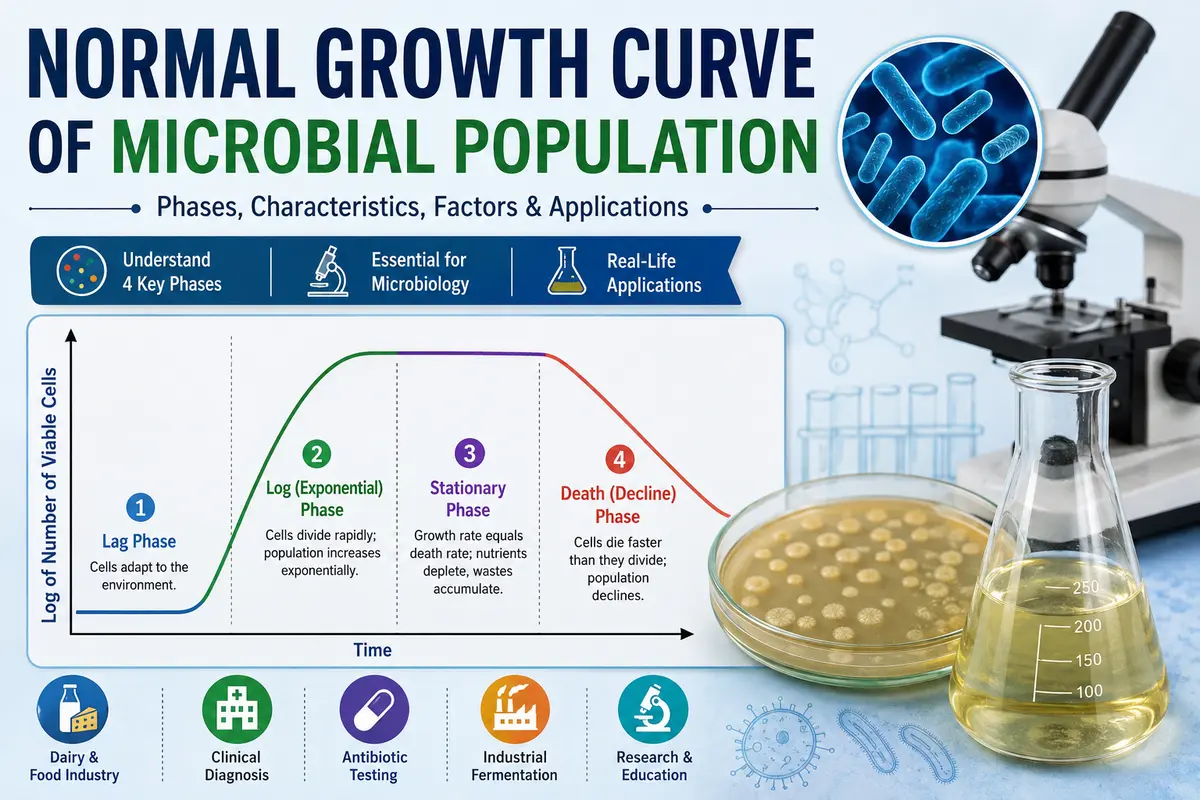
Learn about the normal growth curve of microbial populations, its four phases (lag, log, stationary, and death), factors affecting growth, and real-life examples.
Introduction
Imagine you prepare curd at home by adding a small amount of curd (starter culture) to warm milk. At first, there is no visible change because the bacteria are adapting to the new environment. After a few hours, they multiply rapidly, turning the milk into curd. Eventually, the curd becomes fully formed, and bacterial growth slows because nutrients are depleted. If left for too long, the curd becomes overly sour as many bacteria begin to die.
Similarly, microorganisms grown in a laboratory culture do not grow at a constant rate. They pass through four distinct phases—lag phase, log (exponential) phase, stationary phase, and death (decline) phase. This characteristic pattern of growth is known as the Normal Growth Curve of a Microbial Population. Understanding this growth curve is essential in microbiology because it helps scientists determine the optimal conditions for microbial growth, antibiotic testing, industrial fermentation, and disease diagnosis.
Microorganism populations don’t necessarily grow logarithmically. The pace and timing of cell division are influenced by the surroundings. The accumulation of harmful metabolic products or the depletion of available resources typically limits the growth of the bacterial population.
It is common practice to use large cell populations. The ceils are harvested after a few hours of growth following the introduction of a little inoculum of cells into a nutritional medium. Batch culture or continuous culture is used to prepare microbial populations.
To understand the basic principles of microbial growth, refer to this comprehensive educational resource
(A) Normal growth curve of microbial population in Batch culture system
Following cell inoculation into culture medium, a cell population’s growth rate varies over time.
The number of live cells is regularly counted following the inoculation of a tiny sample population of bacteria into new culture media. By comparing the total number of living bacteria in the population over time, the curve may be created.
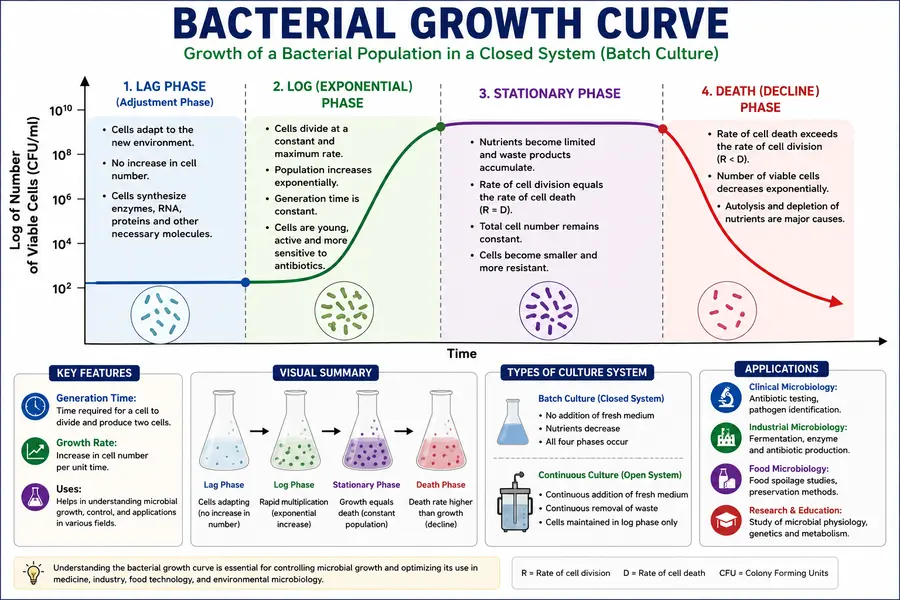
There is a transitional period between each of the four main phases of the population growth curve: (1) lag; (2) log or exponential; (3) stationary; and (4) decline or death phase. The transitional period is the amount of time needed until all cells reach the new phase (curved part).
(1) The lag stage:
Contrary to expectations, the population of living cells does not instantly double when an organism is introduced into fresh culture medium. For a considerable amount of time, the total number of live cells stays rather constant. We refer to this time as the lag phase.
The cells undergo significant environmental adaptation during this phase. Enzymes, coenzymes, and other necessary chemicals must be synthesized by cells in order for them to live. Time and effort are needed for such a synthesis process. DNA synthesis doesn’t change. The cells will proliferate if they possess genes that allow them to endure in a new environment. The microbes won’t proliferate if they don’t have the right genes.
There is no population growth during the lag phase. Even so, the lag phase is not dormant nor idle; rather, it is a time when individual cells grow larger than usual. They are producing new protoplasm and are highly active physiologically. Total protein, RNA, and cell phosphorus are all rising. Thus, it’s an adjustment phase. To put it briefly, the organisms are developing and metabolizing, but cell division is behind.
The environment and species affect how long the lag phase lasts. When cells from a culture in its log phase are used to inoculate a medium, the culture exhibits minimal lag. If a medium is injected with dormant celis from a previous culture, this lag phase is prolonged.
When the microorganisms have completed the required adjustments and start dividing at a steady pace, the lag phase ends and the log phase begins.
(2) The exponential or logarithmic (log) phase:
The curve displays a straight line, and cells in the log (logarithmic) phase exhibit most of the “typical” characteristics of the species and are continuously proliferating at an exponential rate. Protein synthesis, cellular respiration, and numerous other metabolic processes are operating at maximum efficiency.
The population is homogeneous in terms of cellular activity since it is a stage of youth when cells are actively developing and multiplying. Thus, log-phase cultures are frequently employed in microbial metabolic research. Additionally, log phase cultures are extremely susceptible to a wide range of chemical and physical antimicrobial agents.
The greatest period of activity and efficiency in industrial output occurs during the log phase, which is the time when cells are most metabolically active. Thus, fermentation industries benefit most from this stage. In order to maximize the production of beneficial products, they are using the continuous cultivation approach (chemostat/turbidostat) to preserve the log phase.
Learn more about bacterial growth and cell division from this detailed microbiology reference.
(3) The Stationary Phase
The log phase’s growth rate is discouraged or slowed by the depletion of vital nutrients and the buildup of hazardous waste products. The term “limiting factor” refers to the element that prevents microbiological proliferation. The loss of a necessary element (such as nitrogen) or a growth factor (such as a vitamin or amino acid) might result in a limiting factor.
The reproductive rate and the death rate are identical during the stagnant growth phase (R=D). The stationary phase’s duration varies widely. The stationary phase may be quite lengthy if the microbial population achieves equilibrium with the surroundings.
The chemical makeup of cells in the stationary phase differs from that of cells in the exponential phase, and they are smaller because cell division continues even after mass growth has ceased. They are more resilient to harmful chemical and physical agents.
(4) The Death Phase (Phase of decline):
The growth curve’s death phase is essentially the log phase (R<D) in reverse. Lysis kills and destroys cells at an exponential rate. The depletion of vital nutrients from the culture medium and the ever-increasing levels of acids and other hazardous wastes in the environment are the main causes of their death and lysis. The death rate may drop quickly once the majority of cells have perished.
Only a few resistant and hardy cells may survive for months or years since the dead cell substance serves as a source of energy containing chemicals, building ingredients, and growth factors for the surviving cells.
(5) Transitional periods between growth phases:
A bacterial culture moves slowly from one stage of growth to the next. We refer to these times as transitional periods. This indicates that at the end of a particular growth phase, not every cell is in the same physiological state. Some people need time to catch up with others.
(B) The microbial population growth curve’s useful uses in society include:
I) Dairy plants and at home:
Many of the environmental changes brought about by microbial activity can be explained by the population growth curve. Milk can only be stored at home for a certain amount of time before spoiling. When the bacteria that are still present in the milk after pasteurization break down the protein into unpleasant-tasting and odorous compounds, spoilage happens. Only the pathogens in milk are totally eliminated during pasteurization at the dairy plant.
The milk could be ruined by lunchtime if the lag phase is finished when breakfast is being served. The milk can be kept chilled to extend the lag phase, but once the phase is over, the result will be rapidly destroyed by exponential growth. Dairy companies are aware of this and use “expiring dates” on their product labels to help avoid the issue. The date shows when the lag phase of growth is most likely to stop and the log phase to start.
II) At the Microbiology Laboratory:
In the microbiology lab, the growth curve is also useful. Pure cultures must be cultivated in various conditions in order to identify and categorize microorganisms. The “average” microorganism’s behavior will provide details about its genetic composition. At various stages of their growth curve, microorganisms exhibit distinct physiological, morphological, and chemical traits. During the log phase, the majority of microrganisms exhibit their most distinctive genetic characteristics for their genus.
When the environment is depleted of specific nitrogenous chemicals, spore-forming bacteria like Bacillus subtilis will generate resistant endospores. Before analyzing the cells in the late stationary or early death phase, the technician must wait for the culture to grow through the lag and log phases while preparing a culture of that bacteria for endospore staining.
(III) At hospital:
Medical technologists in hospitals are in charge of accurately identifying pathogenic germs extracted from diseased patients. The kind of therapy that should be administered to aid in a patient’s recovery will depend on their exact identity. The patient’s specimens or samples are brought to the lab to be grown in pure cultures. For the microorganisms to transition from the lag phase of growth into the log phase, the culture must be incubated for a sufficient amount of time. Accurate identification is only possible at the log phase.
Learn the scope of microbiology in food microbiology and food preservation.
(IV) At the fermentation sector:
There are industrial uses for the technique of cultivating microbial cultures in the log phase. Microorganisms can be continually cultivated by maintaining cultures in the exponential (log) phase of growth, also referred to as steady-state or balanced growth. Microorganisms thriving in continuous culture create a variety of steroid chemicals, organic acids, and antibiotics.
Additional Information:
Although bacterial growth curves depict phenomena that are constantly happening in our daily lives, it is frequently difficult to become passionate about the topic. For instance, the flavor of the different acids released by the bacteria growing in the flour combination is what gives sourdough bread its name. If cooks remove some of the old material and add fresh flour (new nutrients) to the culture, they can keep their sourdough cultures going for extended periods of time. All of the bacteria will eventually perish if you purchase a commercial kit to begin your sourdough culture but neglect to feed it on a regular basis. Any attempt to make sourdough bread from this culture would fail miserably.
In a similar spirit, a bacterial growth curve and a disease epidemic in a community frequently exhibit similar general patterns. There are initially very few cases in the community, but over time, there is a logarithmic rise in the overall number of cases.
Conclusion
The normal growth curve of a microbial population is a fundamental concept in microbiology that explains how microorganisms grow and respond to changing environmental conditions. It consists of four distinct phases—lag, log (exponential), stationary, and death—each characterized by unique physiological and metabolic activities. Understanding these phases helps microbiologists determine the optimal time for microbial cultivation, identification, antibiotic susceptibility testing, industrial fermentation, and food preservation.
The growth curve also demonstrates how factors such as nutrient availability, temperature, pH, oxygen, and waste accumulation influence microbial growth. Overall, knowledge of the microbial growth curve plays a vital role in clinical microbiology, biotechnology, pharmaceutical production, environmental microbiology, and public health, making it an essential foundation for both research and practical applications.
The university repeatedly asked questions (last 5 years)
Long Answer Questions (8–10 Marks)
- Explain the normal growth curve of a microbial population with a neat, labeled diagram.
- Describe the four phases of the bacterial growth curve and mention the characteristics of each phase.
- Discuss the significance and applications of the microbial growth curve in microbiology.
- Explain the factors affecting microbial growth and their influence on the growth curve.
- Differentiate between batch culture and continuous culture with suitable diagrams.
Short Notes (3–5 Marks)
- Lag phase
- Log (Exponential) phase
- Stationary phase
- Death (Decline) phase
- Batch culture
- Continuous culture (Chemostat/Turbidostat)
- Generation time
- Growth rate
- Factors affecting bacterial growth
- Applications of the microbial growth curve
Very Short Questions (1–2 Marks)
- Define the microbial growth curve.
- Name the four phases of the bacterial growth curve.
- In which phase are bacteria most sensitive to antibiotics?
- In which phase are endospores formed?
- Which phase is most suitable for industrial fermentation?
- Define generation time.
- What is a batch culture?
- What is continuous culture?
- Why is there no increase in cell number during the lag phase?
- Why does the death phase occur?
Frequently Asked Viva Questions
- Why is the lag phase important?
- Why are antibiotics more effective during the log phase?
- Why does the stationary phase occur?
- What causes the death phase?
- Which growth phase is used for antibiotic susceptibility testing?
- How is the growth curve useful in food microbiology?
- What is the difference between growth rate and generation time?
- Why is continuous culture preferred in industries?
FAQs
1. What is the normal microbial growth curve?
Answer: The normal microbial growth curve is a graphical representation of the growth of microorganisms in a closed culture system over time. It shows how the number of viable microbial cells changes through four distinct phases: lag phase, log (exponential) phase, stationary phase, and death (decline) phase. This curve helps in understanding microbial growth patterns and their applications in microbiology, medicine, and industry.
2. What are the 4 stages of the growth curve?
Answer: The four stages of the microbial growth curve are:
Lag Phase – Cells adapt to the new environment; little or no cell division occurs.
Log (Exponential) Phase – Cells divide rapidly, and the population increases exponentially.
Stationary Phase – Cell growth equals cell death due to nutrient depletion and waste accumulation.
Death (Decline) Phase – The number of living cells decreases as cells die faster than they divide.
3. What is the ideal population growth curve?
Answer: The ideal (normal) population growth curve is a graph that shows the typical pattern of microbial growth in a closed culture system. It includes four phases: lag phase, log (exponential) phase, stationary phase, and death (decline) phase, representing the complete life cycle of a microbial population.
4. What are the three types of growth curves?
Answer: J-shaped (exponential) growth curve – Population increases rapidly under unlimited resources.
S-shaped (logistic or sigmoid) growth curve – Population grows rapidly at first and then stabilizes at the carrying capacity due to limited resources.
Normal Microbial Growth Curve – Shows the growth of microorganisms in a closed culture through four phases: lag, log, stationary, and death.
5. What are the different types of bacterial growth curves?
Answer: The main types of bacterial growth curves are:
Batch Growth Curve – Bacteria grow in a closed system and pass through lag, log, stationary, and death phases.
Continuous Growth Curve – Bacteria are maintained in the log (exponential) phase by continuously supplying fresh nutrients and removing waste products.
References
- Scott’s Microbiology. (2020). Willey, J. M., Sherwood, L. M., & Woolverton, C. J. McGraw-Hill Education. (Chapter: Microbial Growth).
- Brock Biology of Microorganisms. (2021). Madigan, M. T., Bender, K. S., Buckley, D. H., Sattley, W. M., & Stahl, D. A. Pearson. (Chapter: Microbial Growth).
- Microbiology: An Introduction. (2018). Tortora, G. J., Funke, B. R., & Case, C. L. Pearson.
- Microbiology. (2016). Pelczar, M. J., Chan, E. C. S., & Krieg, N. R. McGraw-Hill Education.
- Microbiology. (2018). P. D. Sharma. Rastogi Publications.