
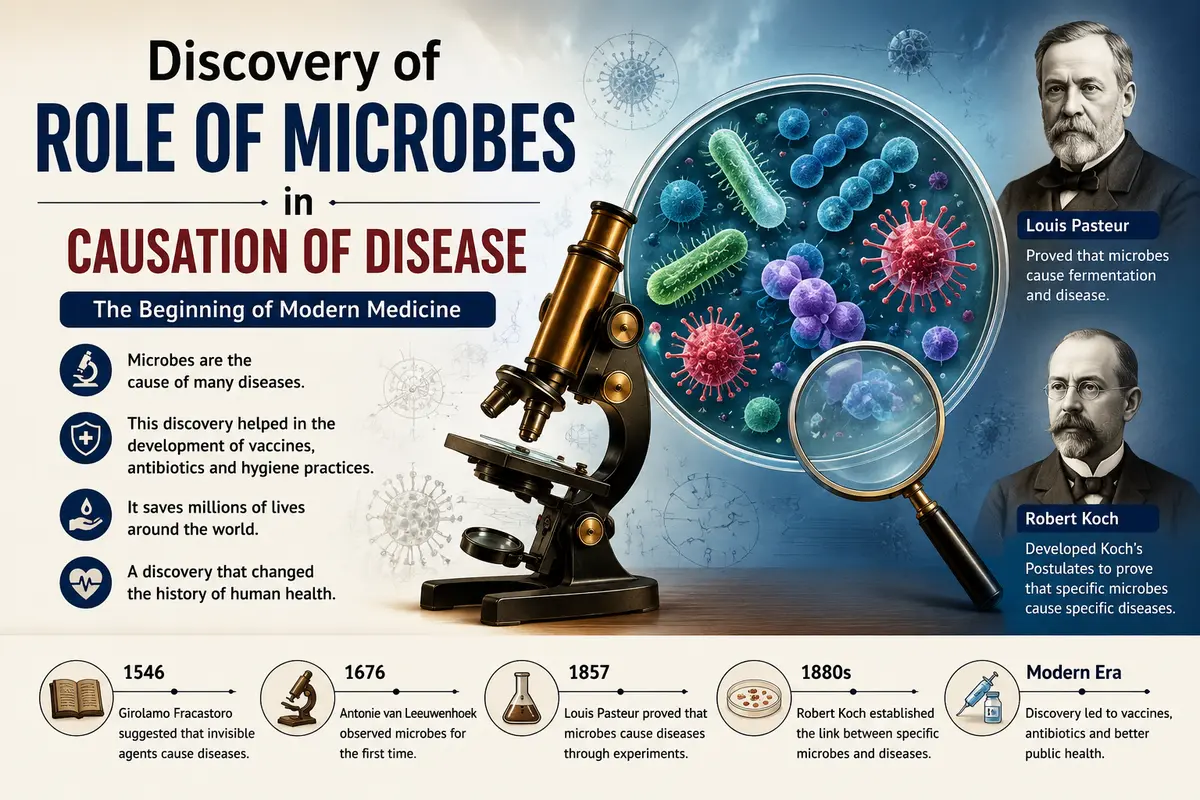
The discovery of role of microbes in causation of disease is one of the most important discoveries in microbiology. It proved that microorganisms such as bacteria, viruses, fungi, and protozoa are responsible for many infectious diseases. This discovery laid the foundation for modern medicine, vaccines, antibiotics, and disease prevention Learn about the discovery of the role of microbes in causing diseases, the germ theory of disease, key scientists, and its importance in microbiology.
Learn more about infectious diseases from the World Health Organization (WHO).
Introduction
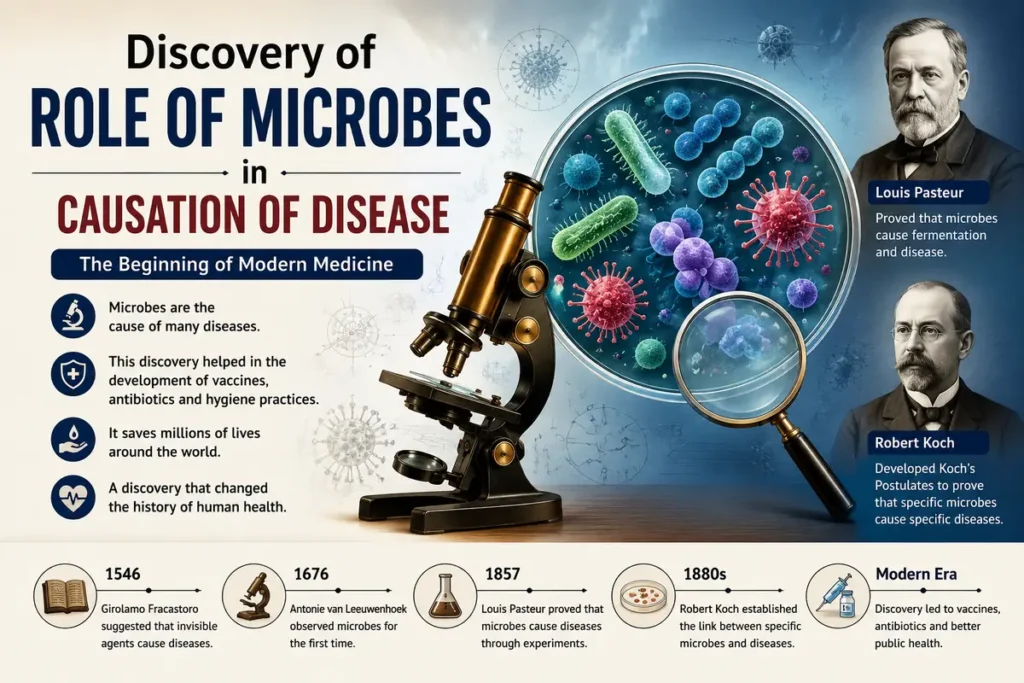
The discovery of the role of microbes in causing disease was one of the greatest breakthroughs in medical science. Scientists proved that tiny microorganisms such as bacteria, viruses, fungi, and protozoa can enter the human body and cause diseases. This discovery helped improve hygiene, develop vaccines and antibiotics, and prevent the spread of infectious diseases.
Imagine in day-to-day life you eat food with unwashed hands and later develop stomach pain or diarrhea. The illness is not caused by the food itself but by harmful microbes present on your hands or in contaminated food. This is why washing hands with soap before eating helps prevent diseases. This simple daily habit is based on the discovery that microbes are responsible for causing many diseases.
The following scientists and their discoveries are main highlights of the discovery of the role of microbes in the causation of disease:
- Germ theory of disease
- Ignaz Semmelweis and Childbirth fever
- Joseph Lister and antiseptic surgery
- Robert Koch and Etiological studies on anthrax
- The Rise of medical Microbiology
Germ theory of disease
Disease has long been associated with natural occurrences such as earthquakes and floods, mysterious and supernatural powers, and deadly “vapors” known as miasmas.
Although ancient Greek and Roman physicians speculated that many diseases were caused by unseen, minute particles, no direct evidence for this theory was discovered until the nineteenth century.
The concept of infectious disease and its propagation preceded the discovery of harmful forms of tiny life. Fungi were the first microorganisms found to be pathogenic. Agostino Bassi (1834) demonstrated the existence of fungi as the source of infection in silkworms. Johann Schonelin isolated the first fungus from human skin illness in 1839, following this finding. Similarly, the spread of infectious microorganisms in plants was seen. M.J. Berkeley (1845) demonstrated the significance of fungal infections in the disease known as late blight of potatoes. Pasteur (1865) identified the role of protozoa in pebrine sickness of silkworms in the silk business.
Although people were aware that certain diseases are contagious and can be transferred through direct or indirect contact with afflicted individuals.
Read the WHO guide on infectious diseases and disease prevention.
Ignaz Semmelweis and the childbirth fever disease
Ignaz Semmelweis (1850) was successful in preventing the spread of postpartum fever in clinics. He started using disinfectants in his medical practice. Before visiting patients, doctors should wash their hands with a calcium hypochlorite solution. This decreased the rate of infection-related death among pregnant women following childbirth. Today, all medical students follow this disinfectant application procedure in hospitals. It gave indirect proof of a contagious illness.
Joseph Lister and antiseptic surgery
The second piece of evidence comes from Lord Lister’s work on antiseptic surgery. It indirectly demonstrated the role of bacteria in infectious infection.
Joseph Lister (1867), an English surgeon, reasoned that surgical infections, such as sepsis, could be caused by bacteria. He took on the mission of preventing wound infections. He devised a method for applying phenolic solution to wounds via dressing. This has disinfecting properties and kills pathogens. In addition, he employed heat-sterilized surgical instruments during the procedure.
This surgical procedure has avoided the spread of numerous post-operative infections. (Surgical sepsis). The phrase “antiseptic surgery” was coined and first accepted by the medical community. Its application in medical science lowers the risk of surgical sepsis. It supplied an indirect source of evidence to support the germ theory of disease.
Robert Koch and Etiological studies on anthrax
Before Robert Koch’s discoveries, scientists knew that microorganisms existed, but they could not prove that a specific microbe caused a specific disease. Robert Koch changed this by establishing scientific evidence linking microbes to diseases.
His pioneering studies on anthrax led to the development of Koch’s Postulates (Etiological Studies), which became the foundation of modern medical microbiology and disease diagnosis.
Anthrax etiology research by Robert Koch in the discovery of role of microbes in causation of disease
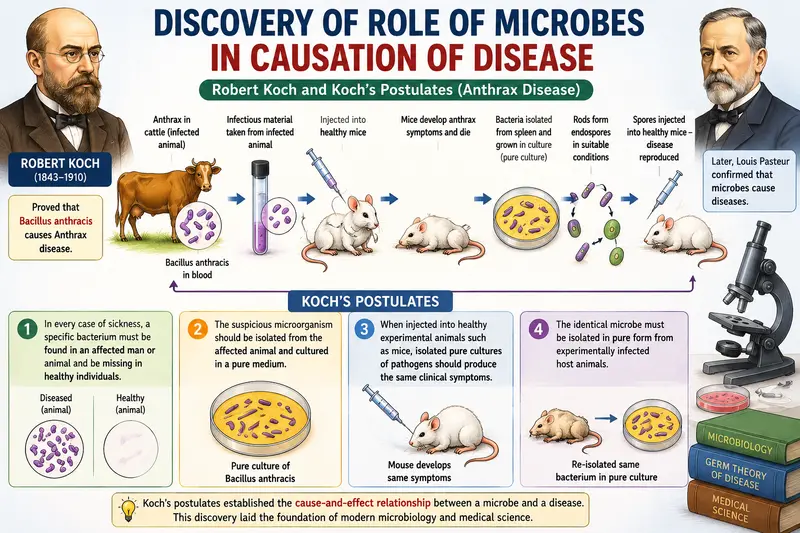
During his research into the origin of anthrax disease, Robert Koch, a German physician, provided the first direct evidence of bacteria’s role as a causal agent. Later on, Louis Pasteur confirmed it.
Although it was previously recognized that rod-shaped formations appeared in the blood and organs of sheep dying from anthrax. Cicar cut evidence that these rods were harmful and caused anthrax illness was acquired by applying four postulates. To establish the link between harmful microbes and disease, Robert Koch applied the criteria established by his former teacher Jacob Henle (1809-1885).
Robert Koch chose ill animals, such as anthrax, for his experiments. In his laboratory, he injected infectious material into her mice by lesion [flu eyes of infected bulls were utilized here] or other clinical samples. After a few days, all mice became infected. A chunk of spleen was dissected from the sick mice. In this state, it was added to beef serum to offer nutrients. The shaped bacilli found in the infected spleen developed in pure form and increased in numbers.
He discovered that after a specific amount of incubation, all rod-shaped formations transformed into circular, oval refractile forms known as endospores. These endospores did not multiply, yet they can regenerate huge rod-shaped cell germination in suitable conditions. When these bacterial formations are implanted into new healthy mice in the laboratory, they become infected. The same disease signs were created by Bacillus anthracis, which multiplies in the blood of injected animals.
Koch published four fundamental requirements known as Koch’s postulates based on results observed in laboratory inoculation animals.
Learn more about anthrax and its causes from the CDC.
The steps in Koch’s postulates are as follows:
(1) In every case of sickness, a specific bacterium must be found in an affected man or animal and be missing in healthy individuals.
(2) The suspicious microorganism should be isolated from an affected animal and cultured in a pure medium.
(3) When injected into healthy experimental animals such as mice, isolated pure cultures of pathogens should produce the same clinical symptoms. It means that it must reproduce a certain ailment in laboratory animals.
(4) The identical microbe must be isolated in pure form from experimentally infected host animals.
With relatively few exceptions, the causal association between pathogenic microorganisms and a specific disease has been demonstrated using Koch’s postulates. At the time Koch’s Postulates were developed, viral pathogens were unknown.
Etiology of T.M. Rivers in discovery of role of microbes in causation of disease
In 1937, T.M. Rivers developed a similar set of guidelines to show viruses’ causal role in disease. River’s postulates, which apply to both animal and plant viruses, are as follows.
(1) The viral agent must be identified in the host’s bodily fluids at the time of infection or in cells exhibiting specified lesions.
(2) The viral agent received from infected hosts must cause severe disease in an appropriate healthy animal or plant or provide proof of infection in the form of antiviral antibodies. It is critical that every host material utilized for inoculation be free of any bacteria or other microbes.
(3) Similar material from freshly affected animals or plants must be able to transfer the disease to additional healthy hosts.
The Rise of medical Microbiology
Meanwhile, Louis Pasteur and Jules Jourbert conducted etiological research on anthrax and independently corroborated Robert Koch’s experimental findings. They discovered that following the burial of diseased animals, anthrax spores survived and were transported to the soil surface by earthworms. Healthy predatory animals became infected with anthrax after eating green grass and digesting the spores. In another series of experiments conducted by Robert Koch, hay bacillus was put into healthy animals but did not cause anthrax. This proved the biochemical specificity of infections. It showed that an illness is caused by only one type of unique organism.
This work on anthrax ushered in the golden age of medical bacteriology. In Paris and Berlin, two new institutes were built to honor Louis Pasteur and Robert Koch, respectively. They became the world’s centers for bacteriological science.
The German school, led by Koch, focused primarily on the isolation, cultivation, and characterization of the causal agents of many infectious diseases in humans. Robert Koch investigated the pathogenesis of tuberculosis in humans and discovered the bacteria Mycobacterium tuberculosis. Several students under his supervision succeeded in dictating Koch’s postulates and establishing the causes of human illnesses such as typhoid, dysentery, and cholera.
K. Eberth, G. Gaffky, E. Klebs, F. Loeffler, and S. Kitasato were Robert Koch’s students.
One of the difficulties, similar to cultivating pathogens in pure form, is establishing Koch’s postulates to establish and validate the pathogenicity of microbes. Legionnaires’ disease, a respiratory infection, was researched in 1976 in accordance with Koch’s postulates. AIDS was first identified in 1982. It could be analyzed in accordance with River’s postulates.
The French School, led by Louis Pasteur, focused on the experimental study of how infectious diseases originate in the animal body and how recovery and immunity are achieved. He explored the causes of chicken cholera, anthrax, and rabies. Emil Roux investigated diphtheria at the Pasteur Institute and developed antidiphtheria serum. In addition, Pasteur’s Institute made a technical contribution by developing filters that could retain bacterial cells while producing bacteria-free filtrate. This breakthrough led to the discovery of filtrable, infectious disease organisms known today as viruses.
Similarly, Friedrich Loeffler (1896) demonstrated the viral nature of the infectious agent responsible for foot and mouth disease in cattle, domestic livestock, and poultry.
Conclusion
The revelation of the role of bacteria in producing diseases changed medical science by establishing that specific germs are responsible for specific infectious diseases. The germ theory of disease and Koch’s postulates have a scientific basis in the pioneering work of scientists such as Ignaz Semmelweis, Joseph Lister, Louis Pasteur, and most of all, Robert Koch. These findings revolutionized the diagnosis, prevention, sterilization, immunization, and antimicrobial therapy of disease. Today they are the foundation of contemporary microbiology and enable health care professionals to study, control, and prevent infectious diseases around the world.
Continue learning by exploring the complete history and scope of microbiology in our detailed guide.
Questions asked in question paper of most universities on the topic Discovery of Role of Microbes in Causation of Disease
The following questions are based on the pattern frequently asked in microbiology question papers of the past few years from universities like Savitribai Phule Pune University (SPPU), Mumbai University, Shivaji University, and North Maharashtra University. These questions are mostly asked on the topic “Discovery of Role of Microbes in Causation of Disease.”
Long Answer Questions (10–15 Marks)
- Explain the discovery of the role of microbes in the causation of disease. Discuss the contributions of Semmelweis, Lister, Pasteur, and Robert Koch.
- Describe Robert Koch’s etiological studies on anthrax and explain Koch’s postulates with suitable diagrams.
- Explain the germ theory of disease. Discuss the contributions of Louis Pasteur and Robert Koch in proving the theory.
- Write a detailed note on the rise of medical microbiology.
- Describe Koch’s postulates and discuss their significance and limitations.
Short Answer Questions (5 Marks)
- Explain Robert Koch’s experiments on anthrax.
- State and explain Koch’s postulates.
- Write a short note on Ignaz Semmelweis and Childbirth Fever.
- Explain Joseph Lister’s Antiseptic Surgery.
- Explain the germ theory of disease.
- Write a note on T.M. Rivers’ postulates.
- Explain the importance of medical microbiology.
Very Short Questions (2–3 Marks)
- Who proposed Koch’s postulates?
- Name the bacterium that causes anthrax.
- What is meant by “etiology”?
- Define the Germ Theory of Disease.
- Name the scientist who introduced antiseptic surgery.
- Who introduced hand washing with disinfectant to prevent childbirth fever?
- What are Endospores?
- Which scientist modified Koch’s postulates for viruses?
- Name any two students of Robert Koch.
- Which bacterium causes tuberculosis?
Frequently Repeated University Questions (Most Important)
- Explain Robert Koch’s etiological studies on anthrax.
- Explain Koch’s postulates with suitable examples.
- Discuss the discovery of the role of microbes in disease causation.
- Explain the germ theory of disease.
- Write notes on Semmelweis and Lister.
- Explain the rise of medical microbiology.
- Differentiate between Koch’s Postulates and Rivers’ Postulates.
FAQs
1. What is the role of microorganisms in the causation of disease?
Answer: Microorganisms cause disease by entering the host body, multiplying, and damaging tissues through the production of toxins or by invading cells. Disease-causing microorganisms (pathogens) include bacteria, viruses, fungi, and protozoa. Their role in causing infectious diseases was scientifically established by the germ theory of disease and Koch’s postulates.
2. Who discovered that microbes cause disease?
Answer: Louis Pasteur proposed the germ theory of disease, and Robert Koch provided experimental proof that specific microbes cause specific diseases.
3. Who established the causation of disease by microorganisms?
Answer: Robert Koch established that specific microorganisms cause specific diseases through his Koch’s postulates.
4. Who proposed the germ theory of disease?
Answer: Louis Pasteur proposed the germ theory of disease, which states that microorganisms are the cause of many infectious diseases.
5. Who gave the theory of causation?
Answer: Louis Pasteur gave the Germ Theory (Theory of Causation of Disease), stating that microorganisms are responsible for many infectious diseases.
References
- Prescott’s Microbiology. Willey, J. M., Sherwood, L. M., & Woolverton, C. J. McGraw-Hill Education.
- Brock Biology of Microorganisms. Madigan, M. T., Bender, K. S., Buckley, D. H., Sattley, W. M., & Stahl, D. A. Pearson.
- Microbiology: An Introduction. Tortora, G. J., Funke, B. R., & Case, C. L. Pearson.
- Ananthanarayan and Paniker’s Textbook of Microbiology. Universities Press.
- World Health Organization> Germ Theory and Infectious Diseases – World Health Organization
- Centers for Disease Control and Prevention> Infectious Diseases & Anthrax – CDC
- National Center for Biotechnology Information—Historical articles on Koch’s Postulates and medical microbiology. NCBI Bookshelf
- Elementary Microbiology by Dr. H.A. Modi.