
Master the lac operon with this complete guide covering mechanism, mutations, and comparison of concepts. Learn how gene regulation works in bacteria with simple explanations, diagrams, and exam-focused insights—perfect for microbiology students and competitive exams.
Introduction
Ohhh, lunch is lactose! Since lactose is the primary sugar in milk and you definitely don’t want to eat it plain, that may not seem good to us, but lactose can be a great diet for E. coli bacteria. But they will only consume lactose in the absence of other, superior carbohydrates, such as glucose.
In light of this, what precisely is the lac operon? An operon, a collection of genes with a single promoter (transcribed as a single mRNA), is what the lac operon is. The operon’s genes produce proteins that enable the bacteria to consume lactose as a source of energy.
Every human cell has all the genetic material needed for human growth and development. A few of these genes will require constant expression. These genes are engaged in essential biological functions, including breathing. The expression of other genes is not constant. They can be turned on and off as needed. A collection of genes that are transcribed simultaneously is called an operon. Typically, they regulate a significant biological process.
Only prokaryotes contain them. An operon is an operating unit which can be defined as a cluster of genes located together on the chromosomes & transcribed together. All the genes of an operon are coordinately controlled by a mechanism first described in 1961 by Francois Jacob & Jacques Monod of the Pasteur Institute of Paris. It is a group of closely linked structure genes & associated control genes which regulate the metabolic activity.
What makes the lac operon turn on?
Although lactose can be broken down by E. coli bacteria, it is not their preferred fuel. They would much rather use glucose if it were available. Compared to lactose, glucose requires fewer steps and less energy to break down. On the other hand, E. coli will use lactose as an energy source if it is the only sugar available.
The lac operon genes, which encode essential enzymes for lactose uptake and processing, must be expressed by the bacteria in order for them to utilise lactose. E. coli should only express the lac operon when two requirements are satisfied in order to maximise efficiency: There is lactose accessible, but not glucose.
How are lactose and glucose levels measured, and how do variations in levels impact the transcription of the lac operon?
There are two regulatory proteins at play:
- One serves as a lactose sensor and is called the lac repressor.
- The other functions as a glucose sensor and is called catabolite activator protein (CAP).
These proteins attach to the lac operon’s DNA and control its transcription in response to glucose and lactose levels. Let’s examine how this operates.
lac operon
In bacteria like E. coli, the lac operon is a genetic regulatory system that governs lactose transport and metabolism. It is made up of a group of genes that, when lactose is present, are expressed and create enzymes; when lactose is not present or when a more advantageous energy source, such as glucose, is present, these genes remain dormant. The lactose operon is referred to as the lac operon.
The lac operon is responsible for coding enzymes that facilitate the breakdown of lactose. Lactose is a disaccharide composed of glucose and galactose. It is categorized as an inducible operon because the presence of lactose activates the operon.
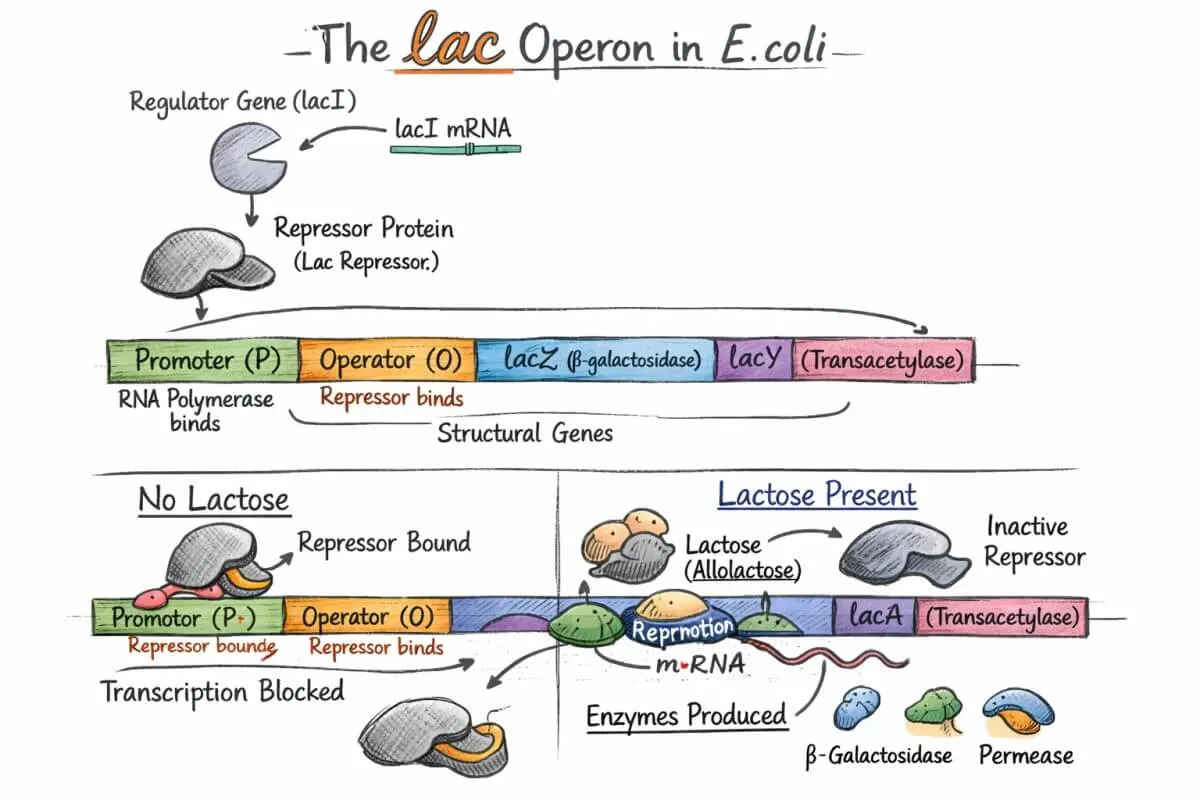
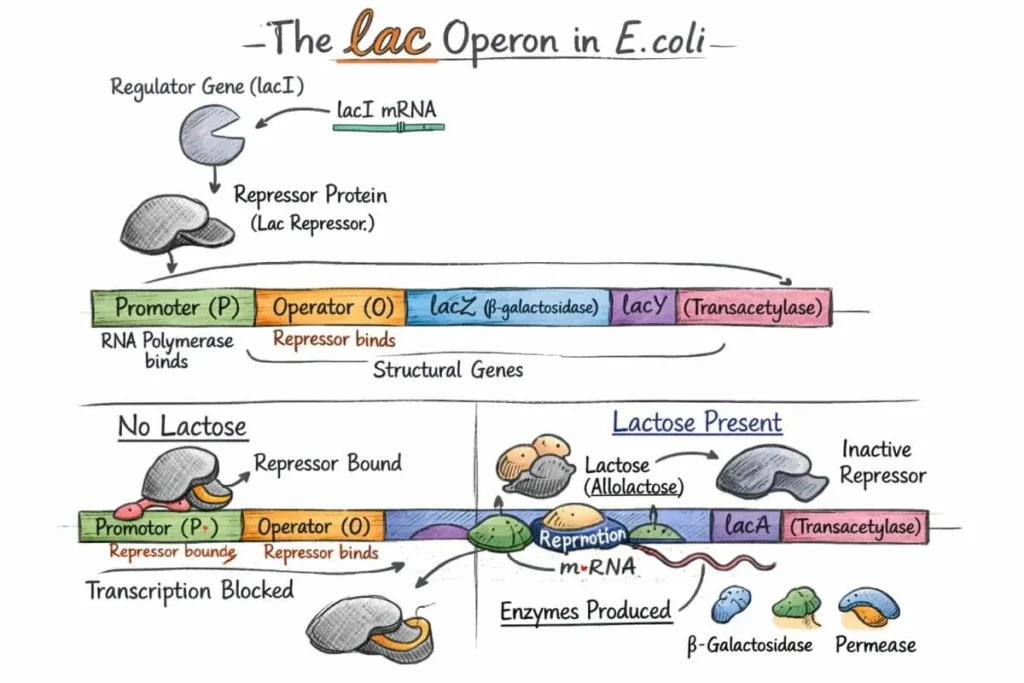
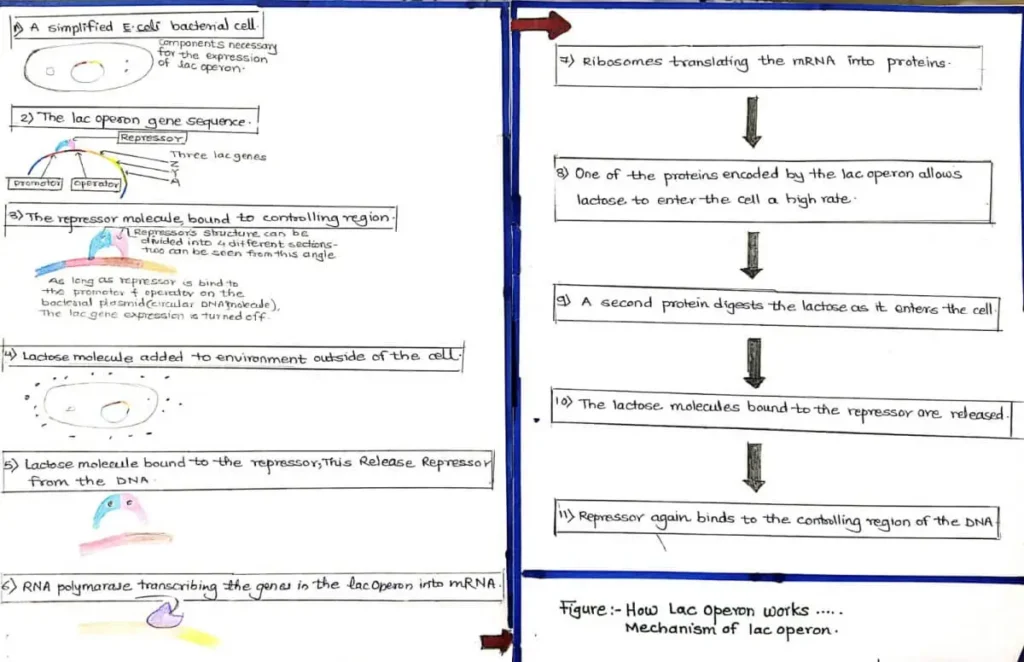
The function of the lac operon is, in the absence of lactose (inducer), the regulator gene produces a repressor protein that binds to the operator site & prevents the transcription; as a result, the structural genes do not produce mRNA & the proteins are not formed.
When lactose (inducer) is introduced in the medium, it binds to the repressor, and the repressor now fails to bind to the operator. Therefore, the operator is made free & induces the RNA polymerase to bind to the initiation site on the promoter, which results in the synthesis of lac mRNA. This mRNA codes for three enzymes necessary for lactose catabolism.
What is the lac operon?
An operon consists of a cluster of genes (called structural genes) that encode proteins (enzymes) to facilitate a common metabolic pathway. The lac operon consists of three structural genes needed for the transport and metabolism of lactose in E. coli.
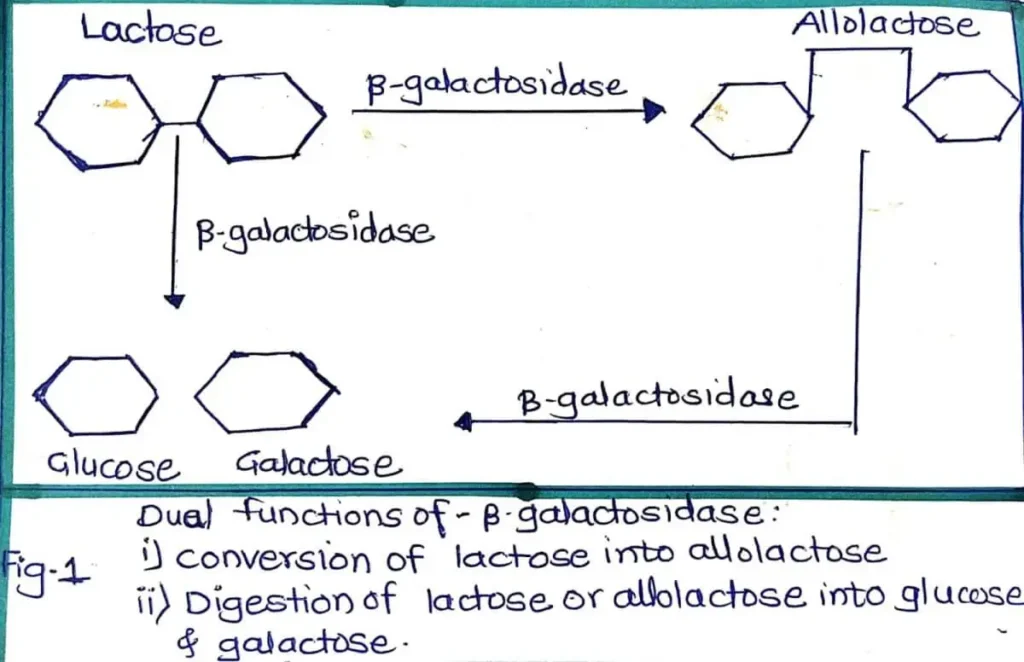
These structural genes are lacZ, lacY, and lacA, which encode β-galactosidase, lactose permease, and thiogalactoside transacetylase, respectively. ȕ-galactosidase has two functions. One is to convert lactose into allolactose.
Allolactose is an isomer of lactose that serves as an inducer by complexing and inactivating the repressor, a product of the nearby regulatory gene lacI. Its other function is to break down the disaccharide lactose (as well as free allolactose) into two monosaccharides, glucose and galactose. Glucose serves as the primary source of energy.
It should be noted that when the operon is turned on, the three structural genes, Z, Y, and A, are transcribed, yielding a single mRNA. Since the mRNA is the product of more than one gene, it is polycistronic. The polycistronic RNA, in turn, is translated into the three individual enzymes described above.
All three structural genes are under the control of a promoter P, which contains an upstream activator binding site (ABS) along with another control element called the operator O. Binding of an activator to the activator binding site enhances the binding of RNA polymerase to the promoter for transcription. On the other hand, binding of a repressor protein (product of the regulatory or repressor gene I+) to the operator blocks the binding of RNA polymerase to the promoter, preventing transcription.
Thus, the lac operon is controlled not only by the lac promoter and the lac operator, but also by the separate regulatory gene lacI, which itself requires a promoter for expressing its product, the repressor. The general structure of the lac operon is shown in Figure 4. Unless otherwise indicated, all genes and control elements are assumed to be in the wild-type (+) form.
Like all living organisms, bacterial cells use glucose as their primary energy source. However, glucose is not always available in the natural environment. If glucose is not present or is used up, lactose, when present, can be digested by β-galactosidase to provide an alternative way for generating glucose for the bacteria.
Therefore, there is a selective advantage for bacteria, such as E. coli, to have two systems for controlling the lac operon: 1) a positive system to turn on the lac operon when lactose is present (and glucose is absent) 2) a negative system to turn off the lac operon when lactose is absent (or glucose is present).
lac operon consist of
Structural genes of lac operon
The lac operon consists of three structural genes: lacZ, lacY, and lacA. These genes are transcribed together as a single polycistronic mRNA from a common promoter.
1. lacZ: This gene codes for the tetramer enzyme β-galactosidase, which has a molecular weight of about 500 kD. β-galactosidase is essential for the metabolism of lactose because it breaks down β-galactosides, including lactose, into its monosaccharide components. For instance, lactose hydrolyses into galactose and glucose, which can be further processed by glycolysis.
2. lacY: This gene produces the membrane-bound protein β-galactoside permease, which has a molecular weight of roughly 30 kD. Lactose and other β-galactosides are transported into bacterial cells with the help of β-galactoside permease. It is in charge of absorbing lactose from the surroundings.
3. lacA: Although its exact function within the lac operon is unclear, this gene codes for β-galactoside transacetylase. An acetyl group is transferred from acetyl-CoA to β-galactosides by β-galactoside transacetylase. Its precise role in lactose metabolism is still unknown, though.
Within the lac operon, these three structural genes—lacZ, lacY, and lacA—are situated next to one another. An operon is a functional unit made up of the promoter, operator, and regulatory elements. In bacteria such as E. coli, the lac operon supplies the genes and enzymes required for the uptake and metabolism of lactose and other β-galactosides.
| Designation of gene | Codes for enzyme | Function of the enzyme |
| lacZ | β-galactosidase | Breaks down lactose into glucose & galactose. |
| lacY | β-galactoside permease | This protein, found in the E.coli cytoplasmic membrane, actively transports lactose into the cells. |
| lacA | β-galactoside transacetylase | The function of this enzyme is not known. It is coded for by the gene lacA. |
Regulatory genes of lac operon
The lac operon consists of several regulatory genes that control its activity:
- Promoter: RNA polymerase, the enzyme that starts transcription, binds to the promoter region. It is situated upstream of the lac operon and aids in RNA polymerase binding, which starts the structural genes’ transcription.
- Operator: Located between the promoter and the structural genes, the operator region is a negative regulatory locus. The promoter region and it overlap. By attaching itself to the operator, the lac repressor protein stops RNA polymerase from transcribing the structural genes. By acting as a switch, the operator decides whether or not transcription should take place.
- Lac I (Repressor) Gene: The lac operon repressor protein is encoded by the Lac I gene. It has its own promoter and terminator and is situated next to the lac operon’s promoter region. The repressor protein has a molecular weight of 38 kD and is a tetramer made up of identical subunits. Since the repressor’s gene is always being produced and transcribed at all times. By preventing RNA polymerase interaction, the repressor protein can attach to the operator and repress (switch off) the lac operon.
- Catabolite Activator Protein (CAP) Binding Site: Located immediately upstream of the lac operon promoter, the CAP binding site is a positive regulatory site. This location is bound by the catabolite activator protein (CAP). DNA and cAMP (cyclic adenosine monophosphate) can be bound by the dimeric protein CAP. cAMP’s affinity for DNA rises as it binds to CAP. By strengthening RNA polymerase’s affinity to the promoter region, CAP bound to DNA stimulates transcription and increases lac operon gene expression.
Together, these regulatory genes—the promoter, operator, LacI repressor gene, and CAP binding site—control the lac operon’s activity, enabling the cell to react to lactose and other regulatory cues.
| Element | Purpose |
| Operator (lacO) | Binding site for repressor |
| Promoter (lacP) | Binding site for RNA Polymerase |
| Repressor | Gene encoding the lac repressor protein. Binds to DNA at the operator & blocks binding of RNA polymerase at the promoter. |
| lacI | Controls production of the repressor protein. |
lac operon diagram or lac operon model
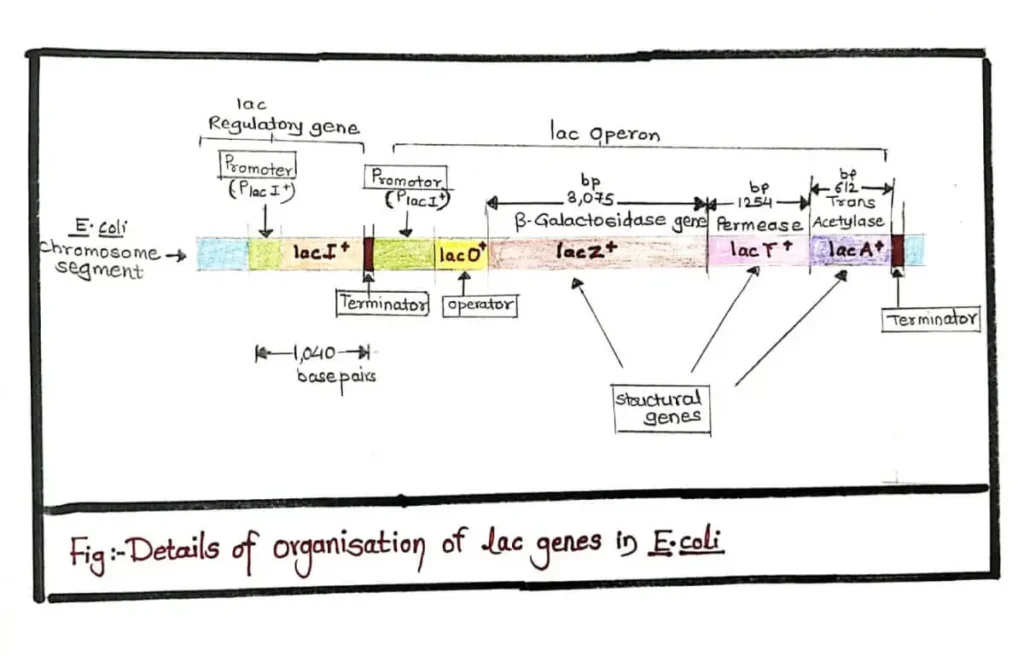
Regulation of the lac operon
In prokaryotes, the lac-operon system is controlled in two ways:
1. Positive control
2. Negative control
1. Positive Control of Lac-Operon
The positive regulation of the lac operon involves a mechanism that promotes gene expression under specific circumstances. In the situation of the lac operon, the introduction of an inducer like lactose initiates this positive regulation.
Here are the steps involved in the positive control of the lac operon:
- Expression of the Repressor Protein: The lac repressor protein is expressed by the lac operon’s regulatory gene. The repressor protein is constantly produced and found in the cell.
- Repressor Protein Production: Repressor proteins are produced when the regulatory gene is expressed.
- Inducer Binding: Both the operator and the inducer (lactose) have binding sites on the repressor protein. Lactose binds to the repressor protein and functions as an inducer when it is present in the cellular environment.
- Creation of the R+I Complex: The repressor protein and the inducer (lactose) combine to create the R+I complex. The repressor protein’s structure is changed by this combination.
- Preventing Repressor Binding: The operator area is no longer bound by the R+I complex. Consequently, it no longer
- prevents RNA polymerase from attaching to the lac operon’s promoter region.
- Transcription and mRNA Production: RNA polymerase can attach to the promoter area and start transcription once the repressor protein has stopped obstructing the operator. As a result, the lac operon genes produce mRNA.
The lac operon’s positive control permits the activation of gene expression when an inducer, such as lactose, is present. By preventing the repressor protein from attaching to the operator, the inducer allows RNA polymerase to transcribe the lac operon’s genes and create the enzymes required for lactose digestion.
2. Negative Control of the Lac Operon
The regulatory mechanism that prevents gene expression in the absence of an inducer, such as lactose, is known as the negative control of the lac operon. The lac repressor protein plays a role in it. The stages involved in the lac operon’s negative control are as follows:
- Expression of the Repressor Protein: The lac repressor protein is expressed by the lac operon’s regulatory gene. The repressor protein is constantly produced and found in the cell.
- Repressor Protein Production: Repressor proteins are produced when the regulatory gene is expressed.
- Repressor-Operator Binding: The repressor protein attaches itself directly to the lac operon’s operator region when neither lactose nor an inducer is present. RNA polymerase is physically prevented from moving and from attaching to the promoter region by this interaction.
- Transcription Blockage: The transcription of the lac operon genes is essentially stopped when the repressor protein binds to the operator. The mRNA cannot be transcribed by RNA polymerase.
- Turning Off the Operon: The lac operon stays turned off in the absence of an inducer. The repressor protein can stay attached to the operator and prevent gene expression when lactose is not present as an inducer.
In general, the lac operon’s negative regulation prevents the transcription of genes related to lactose metabolism when there is no lactose. The repressor protein is essential for preventing RNA polymerase from moving, hence turning off the lac operon. Gene expression is activated when an inducer, such as lactose, binds to the repressor protein and releases its inhibitory function.
| Regulatory protein is present. | Example of regulatory protein. | Mutate regulatory gene to lose function. | |
| Positive control | Operon ON | Activator | Operon OFF |
| Negative control | Operon OFF | Repressor | Operon ON |
How does the lac operon work?
lac operon works in 4 scenarios –
1. When Lactose is Absent
- There is constant manufacture of a repressor protein. It is situated on a DNA sequence just in front of the operator site, or lac operon.
- RNA polymerase can begin transcription; the repressor protein inhibits the promoter site.
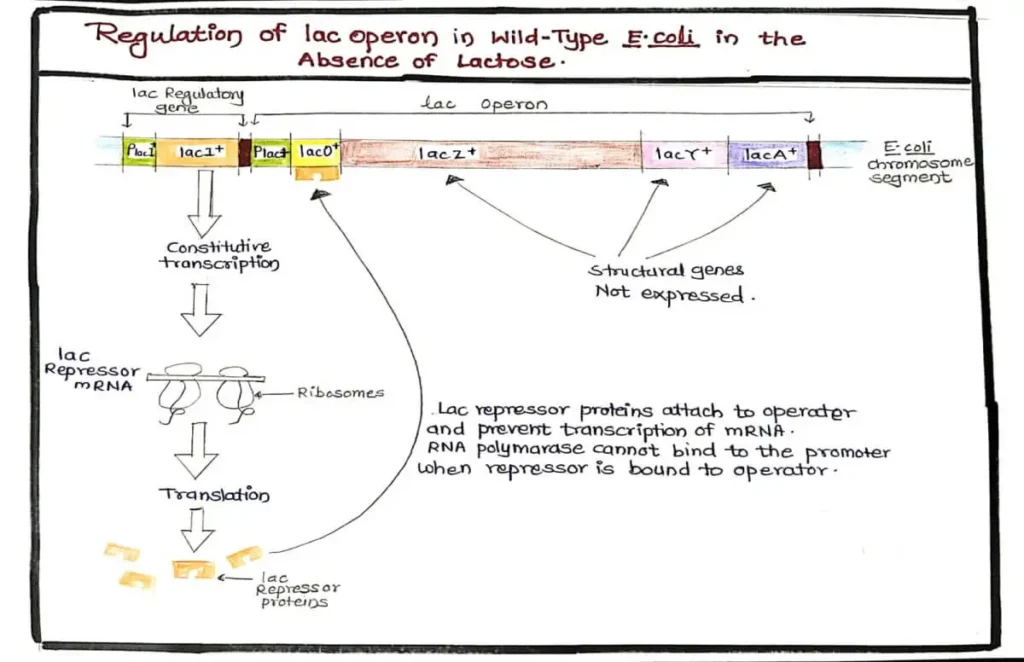
2. When Lactose is Present
- The bacterial cell produces a tiny quantity of the sugar allolactose. This attaches to a different active site on the repressor protein (allosteric site).
- As a result, the repressor protein undergoes a conformational shift. It is no longer able to remain on the operator site. Now, RNA polymerase may access its promoter location.
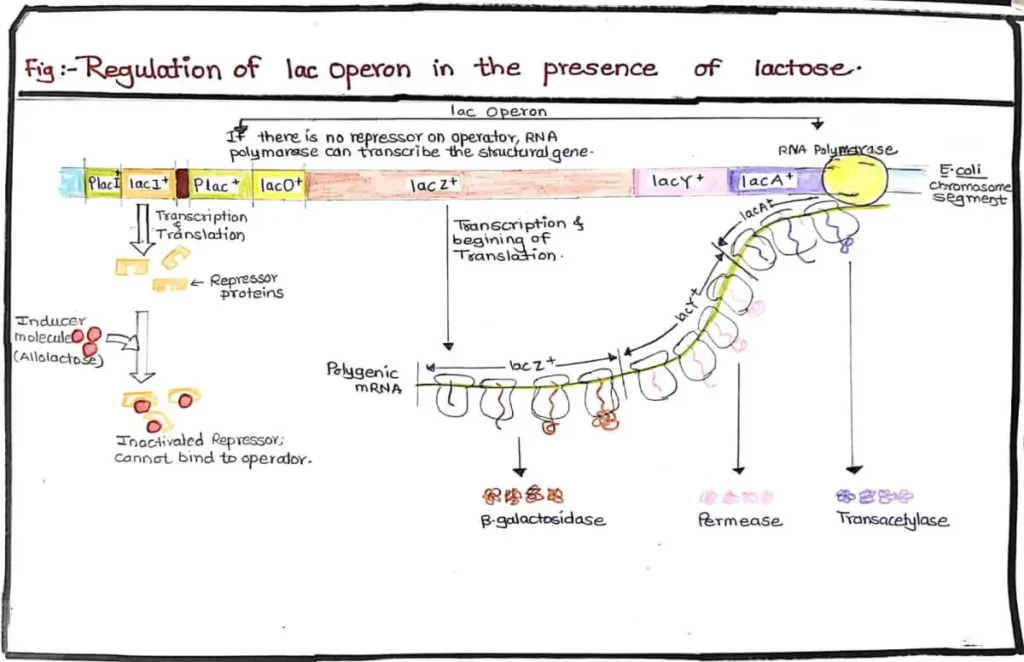
3. When both glucose and lactose are present [Lactose (+) and glucose (+)]
- RNA polymerase can sit on the promoter site when lactose and glucose are present, but it is unstable and continually coming off.
4. When glucose is absent and lactose is present [Lactose (+) and glucose (-)]
- An activator protein is required. RNA polymerase is stabilised as a result.
- Only in the absence of glucose does the activator protein function.
- In this manner, E. coli only produces the enzymes needed to break down other carbohydrates when glucose is not present.
| Carbohydrates | Activator protein | Repressor protein | RNA polymerase | lac Operon |
| Lactose (+) and glucose (+) | Not bound to DNA | Lifted off operator site | Keeps falling off the promoter site. | No transcription |
| Lactose (-) and glucose (+) | Not bound to DNA | Bound to operator site | Blocked by the repressor. | No transcription |
| Lactose (-) and glucose (-) | Bound to DNA | Bound to operator site | Blocked by the repressor. | No transcription |
| Lactose (+) and glucose (-) | Bound to DNA | Lifted off operator site | Sits on the promoter site. | Transcription |
LAC MUTATIONS
- By examining mutations that impact lactose metabolism, Jacob and Monod determine the structure and function of the lac operon.
- They employ the partial diploid stain of E. coli to assist identify the roles of the various operon components.
- They identify areas of the lac operon that are transacting while others are cis-acting.
STRUCTURAL-GENE MUTATION
- Initially, Jacob and Monod found certain mutant strains that were unable to produce either permease or β-galactosidase.
- The amino acid sequences of the proteins encoded by the lacZ and LacY structural genes were changed by the mutation.
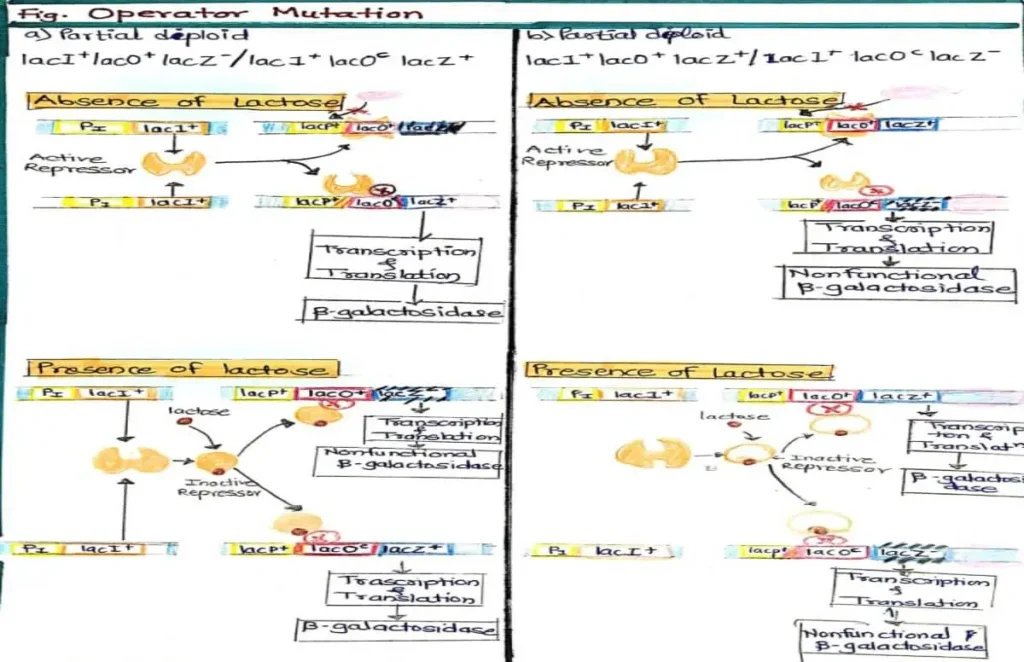
a) The lacOc operon generates nonfunctional permease molecules from the lacY gene with missense mutation and functional β-galactosidase from the lacZ⁺ gene, while the lacO⁺ operon is inactive in the absence of inducer.
b) The lacOc operon produces faulty permease and functioning β-galactosidase in the presence of an inducer, while the lacO⁺ operon produces functional permease from the lacY⁺ gene and nonfunctional β-galactosidase from the lacZ⁻ gene.
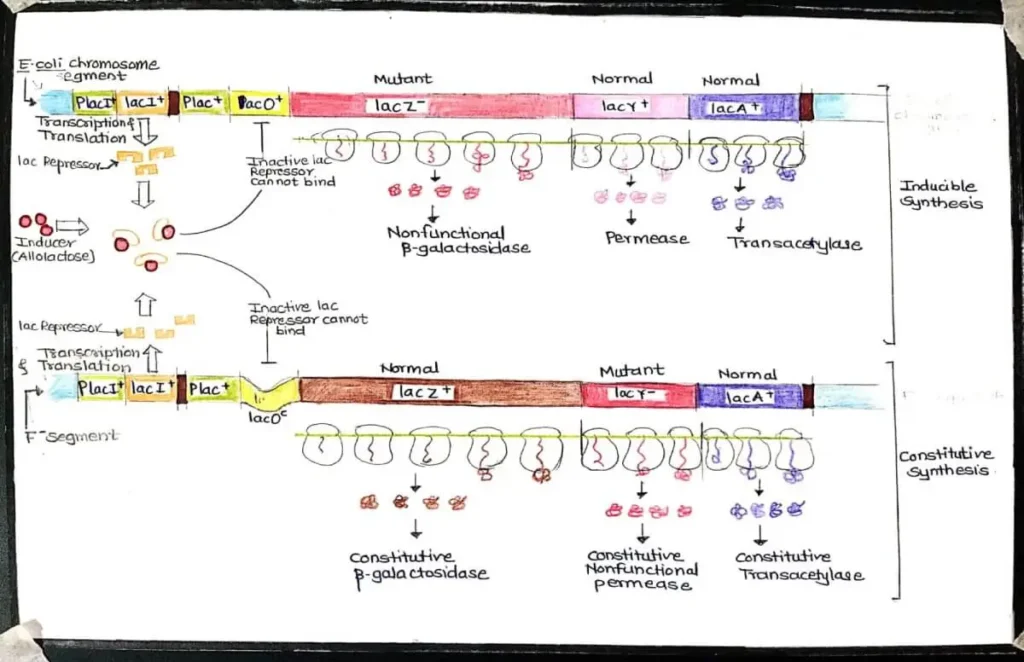
OPERATOR MUTATIONS
- Jacob and Monod discover other constitutive mutants at a location next to lacZ.
- These mutations, known as lacOc, happened at the operator region.
- The lacOC mutations changed the operator’s DNA sequence, making it impossible for the repressor protein to bind.
- Constitutive production of β-galactosidase was seen in a partial diploid with genotype lacI⁺ lacOc lacz⁺ /lacI⁺ lacO⁺ lacz⁺, suggesting that lacOc is dominant over lacO⁺.
PROMOTER MUTATION
- Lactose metabolism-related mutations have also been identified at the promoter site; these mutations, known as lacP-, prevent RNA polymerase from attaching to the promoter.
- The structural gene’s transcription depends on this binding.
- Whether lactose is present or not, an E. coli strain with the lac P mutation does not generate lac proteins.
- Mutations in lacP are cis-acting.
The lac operon vs trp operon
| Point | Lac Operon | trp operon |
| Type | Inducible operon | Repressible operon |
| Default status | OFF | ON |
| Activator/Control | Lactose (inducer) | Tryptophan (corepressor) |
| Without substance | remains OFF | remains ON |
| Presence Of Substance | turns ON | turns OFF |
| Function | Lactose breakdown | Tryptophan synthesis |
| Energy use | Enzymes are produced only when needed. | Stops synthesis when not needed. |
| Example organisms | E. coli | E. coli |
Conclusion
“The lac operon is the cell’s ‘smart energy manager’ – it turns genes ON only where needed, making life efficient!” The lac operon is a classic example of gene regulation, which helps bacteria conserve energy.
In this, the promoter, operator, and structural genes work together to control lactose metabolism. When lactose is present, the repressor becomes inactive, and the genes are turned ON, thus producing enzymes. In the presence of glucose, the operon remains off due to catabolite repression—meaning the cell always uses the easiest energy source first. Lac mutations can disrupt this control system, causing genes to remain either ON or OFF.
In the lac operon vs the trp operon, lac is inducible (ON by need) while trp is repressible (OFF by excess).
This article explains the structure and function of the lac operon in a simple and student-friendly way.”
References
Books:
- Genetics by Benjamin Pierce
- iGenetics by Peter J.Russell
FAQs
1. What is the lac operon?
Answer: The lac operon is a group of genes and the mechanism that controls them to produce enzymes necessary for the digestion of lactose in bacteria.
2. Is the lac operon inducible or repressible?
Answer: The lac operon is an inducible operon.
An inducible operon is an operon which is normally OFF and turns ON when a specific substance (inducer) is present.
In the lac operon, lactose (allolactose) is the inducer. It inactivates the repressor; therefore, the genes are turned on.
3. How does the lac operon work?
Answer: The lac operon is a classic example of gene regulation, which controls genes for lactose utilization in E. coli.
In the absence of lactose (operon OFF), the repressor protein binds to the operator. RNA polymerase cannot proceed from the promoter. Transcription does not occur. Enzymes are not produced. Gene expression is OFF.
When lactose is present (operon ON), lactose enters the cell and is converted to allolactose. Allolactose binds to the repressor. Repressor becomes inactive (operator is released). RNA polymerase starts transcription. lacZ, lacY, lac Genes are expressed. Enzymes are produced, and lactose breakdown occurs.
4. What does the lac operon do?
Answer: The lac operon is an important part of gene regulation, found in bacteria such as E. coli.
The main function of the lac operon is to produce the enzymes needed to utilize lactose (milk sugar).
When lactose is available, the lac operon turns on genes. Enzymes are produced. Lactose is broken down.
When lactose is not available, genes are turned off. Enzymes are not produced.)
5. Lac operon diagram
Answer: