
Introduction
Imagine…
You are sitting in front of a microscope, and an “Invisible Party” is going on in front of you!
Bacteria are so small that they are not visible to the naked eye… but their “color-changing” drama is huge!
This is where Gram staining comes in!
Gram staining is a unique technique for creating a “color ID card” of bacteria.
Just as we can recognize ourselves by wearing new clothes at a festival, bacteria also appear in two groups after this process:
- Some become purple (Gram Positive )
- Some become pink (Gram-negative)
That is…
“Invisible bacteria become colorful stars under the microscope!”
This process is so fun that it feels like a “makeover show” of bacteria is going on!
When you add one chemical, the color changes; when you add another, some of the color stays, and some of the color goes away… just like a reality show!
Therefore, Gram Staining is not just a laboratory process…
It is a colorful, exciting journey into the world of bacteria!
If you are interested in microbiology concepts like Gram staining, you can also explore career opportunities in this field through our detailed guide on 15+ Important Scope of Microbiology – Best Jobs After Microbiology.
Staining concept in Microbiology
Staining is a fundamental technique used in microbiology to visualize microorganisms and their structures under a microscope. It involves the application of a colored dye to a sample to make it more visible and aid in the identification and classification of microorganisms. Staining is important in microbiology because many microorganisms are too small to be seen with the naked eye, and the use of stains enhances contrast and allows for the visualization of cellular morphology and structure.
Staining is based on the differential affinity of dyes for different components of microbial cells. Some dyes have an affinity for the cell wall of bacteria, while others preferentially stain the cell membrane or the cytoplasmic structures. Staining techniques are often used in conjunction with other microbiological methods, such as culturing and biochemical testing, to obtain a more accurate identification of microorganisms.
There are many types of stains used in microbiology, including simple stains, differential stains, and special stains. Simple stains use a single dye to color microorganisms, while differential stains use multiple dyes to differentiate between different types of microorganisms or cellular structures. Special stains are used to identify specific components of microbial cells, such as spores, flagella, or capsules.
Overall, staining is a crucial technique in microbiology that allows for the identification and characterization of microorganisms and plays a significant role in research, diagnostics, and medical treatments.
What is the purpose of staining in microbiology?
The purpose of staining in microbiology is to enhance the contrast between the microorganisms and their surroundings, making it easier to visualize and study them under a microscope. Staining can help microbiologists to identify the morphology (shape), size, and arrangement of bacteria, fungi, and other microorganisms, which can provide important clues about their classification and behavior.
There are several types of staining techniques used in microbiology, including Gram staining, acid-fast staining, endospore staining, and capsule staining. Gram staining is the most commonly used technique and involves applying crystal violet, iodine, and a decolorizing agent to the bacterial cells.
This process distinguishes bacteria into two categories, Gram-positive and Gram-negative, based on the differences in the structure of their cell walls. Acid-fast staining is used to identify mycobacteria, such as Mycobacterium tuberculosis, which have a waxy outer layer that is resistant to staining with most dyes.
Overall, staining is a crucial tool in microbiology that allows scientists to visualize and study microorganisms at a microscopic level, which is important for diagnosing infections, developing treatments, and understanding the diversity and ecology of microbial communities.
What is Gram staining?
It is the type of differential staining. Differential staining is a technique used in microbiology and histology to distinguish between different types of cells or structures within a sample. It involves using different dyes or staining methods to selectively stain specific parts of the sample, making them visible under a microscope.
Gram staining is one of the most important and widely used differential staining techniques in microbiology. Christian Gram, in 1883, while working on the etiology of respiratory disease in the municipal hospital in Berlin, discovered this technique.
Gram staining is a differential staining technique by which bacteria are classified as “Gram positive” or “Gram negative” depending upon whether they retain or lose the primary stain crystal violet when subjected to treatment with a decolorizing agent such as alcohol. Bacteria are classified as “Gram positive” or “Gram negative” according to their response to the Gram staining procedure. Gram staining is based on the physicochemical nature of the cell wall of bacteria.
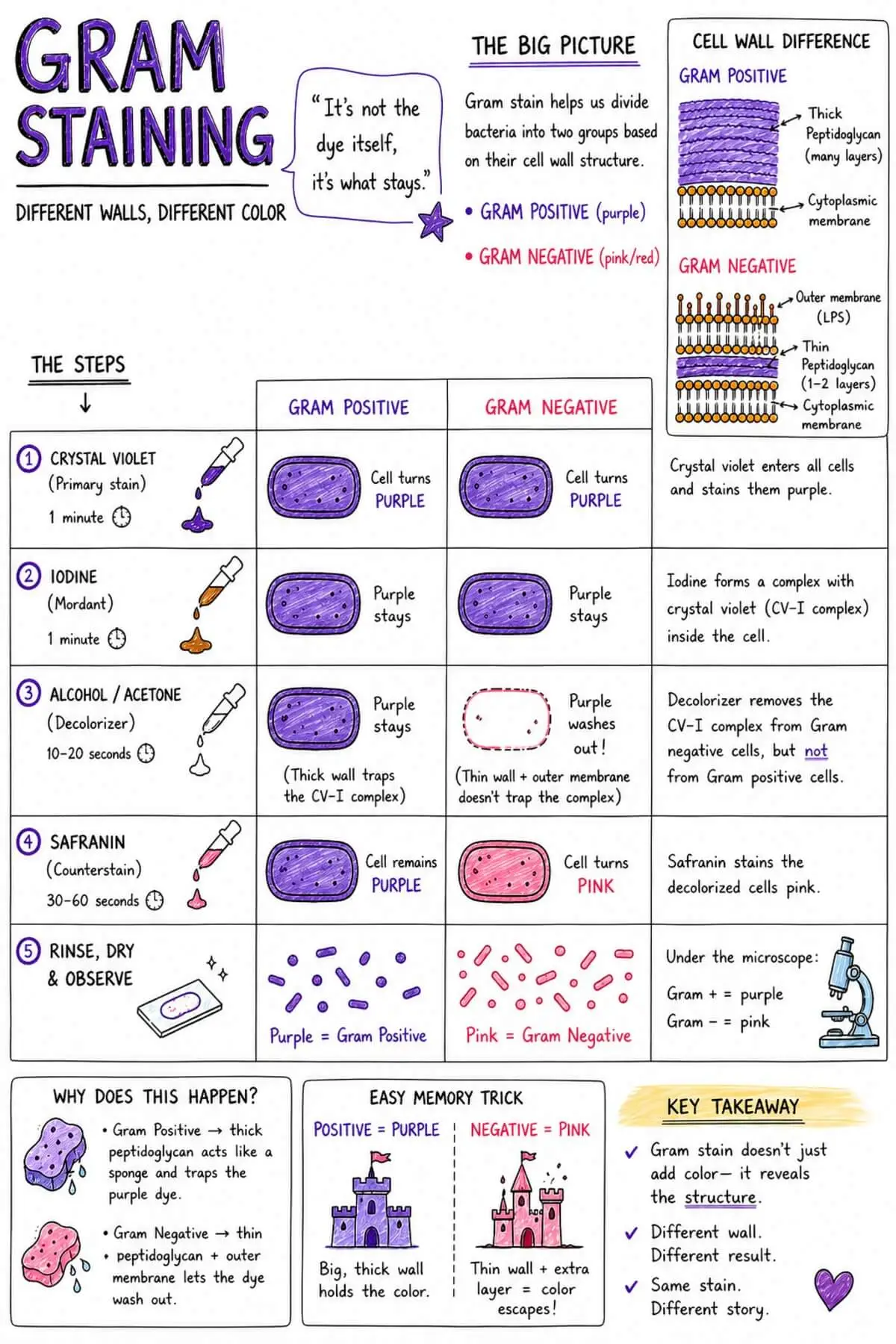
In this technique, the heat-fixed bacterial smear is subjected to the following staining reagents in the order listed: crystal violet (primary stain), Gram’s iodine (mordant), alcohol (decolorizer), and safranin (counterstain or secondary stain).
Gram-positive bacteria retain the crystal violet and appear deep violet in color, whereas Gram-negative bacteria lose the crystal violet on application of decolorizer and are counterstained by the safranin, hence appearing red in color.
Gram staining is one of the common examples of differential staining, which is used to differentiate between two broad types of bacteria based on their cell wall structure. Gram-positive bacteria have a thick layer of peptidoglycan in their cell walls, which retains the crystal violet stain used in the staining process and appears purple under the microscope.
In contrast, Gram-negative bacteria have a thinner layer of peptidoglycan and an outer membrane that can be penetrated by alcohol during the staining process, causing the crystal violet to be washed out and the counterstain safranin to appear red or pink.
Gram staining is one of the most widely used staining techniques in microbiology. It involves the use of crystal violet, iodine, alcohol, and safranin to differentiate between different types of bacteria based on their cell wall composition. Gram-positive bacteria retain the crystal violet stain and appear purple under the microscope, while gram-negative bacteria lose the stain and appear pink or red.
Purpose of Gram staining
A. Classifying Bacteria:
- With the help of Gram staining, bacteria are divided into two groups:
- Gram Positive (appears purple)
- Gram-negative (appears pink)
- This classification is based on the structure of their cell wall.
B. Rapid Identification:
- This method is quick and easy, so initial identification can be done immediately in the laboratory.
- Helps doctors start treatment immediately.
C. Appropriate Antibiotic Selection:
- Gram-positive and Gram-negative bacteria respond differently to different antibiotics.
- Therefore, Gram staining is very useful in selecting the appropriate drug.
D. Diagnosis of Infection:
- Used to find out what bacteria are present in samples such as blood, urine, and sputum.
- Helps to understand the cause of the infection.
E. Research & Study:
- Gram staining is essential in the study and research of microbiology to understand the structure of bacteria.
Principle of Gram staining
Gram staining is a fundamental staining technique in microbiology used to differentiate bacteria based on the structure of their cell walls. The difference between Gram-positive and Gram-negative bacteria has been shown to reside in their cell walls. Although the chemical composition of Gram-positive and Gram-negative walls is now fairly well known, the reason Gram-positive walls block the dye-extraction step is still unclear.
The basic mechanism of the Gram reaction is still not completely understood. Several theories have been proposed by various scientists to explain the mechanism of the Gram reaction. The most plausible and accepted hypothesis for this phenomenon is based on the difference in structure and composition of cell walls of Gram-positive and Gram-negative bacteria, proposed by M.R.J. Salton. The cell wall of Gram-negative bacteria possesses a higher percentage of lipids (10-20%) as compared to that in the cell wall of Gram-positive bacteria (1-2%).
The primary stain [crystal violet (CV)] forms a complex with the mordant Gram’s iodine (CVI complex) in the cell. When bacterial cells are treated with a decolourising agent, bacteria are extracted, resulting in increased porosity or permeability to propen alcohol, lipids from the cell wall of Gram-negative bacteria.
Therefore, the CV-1 complex escapes the cells, and thus Gram-negative organisms are decolorized. In the subsequent step, to render the colorless Gram-negative bacteria visible, counterstain safranin is applied. These cells take up the color of safranin, a basic dye.
In contrast to this, the cells of Gram-positive bacteria, because of their low lipid content, become dehydrated during treatment with alcohol. The cells shrank in size, which decreases pore size and permeability, and the CV-I complex cannot be extracted, but it is retained in the cell. Therefore, Gram-positive cells appear purple-violet in color.
Another hypothesis is also based on permeability differences between Gram-positive and Gram-negative bacteria. In Gram-positive bacteria, the CVI complex is trapped in the cellwall following alcohol treatment which causes a diminution in the diameter of the pores in the cell wall peptidoglycan. The cell walls of Gram-negative bacteria have a much smaller amount of peptidoglycan (5-10% of the dry weight of the cell wall) as compared to the cell walls of Gram-positive bacteria (40-90% of the dry weight of the cell wall).
In Gram-negative bacteria, there appear to be only one sheet of peptidoglycan, whereas as in Gram-positive bacteria there are as many as 40 sheets of peptidoglycan. The peptidoglycan in the cell wall of Gram-negative bacteria is less extensively cross-linked and rather thin than that in cell wall of Gram-positive bacteria. The pores in the peptidoglycan of Gram-negative bacteria remain sufficiently large even after alcohol treatment to allow the CV-I complex to be extracted.
These two hypotheses are not mutually exclusive, and both likely provide an explanation of the mechanism of the Gram reaction.
Gram staining is of great taxonomic importance and is often the first step in the identification of an unknown prokaryotic microorganism. For eukaryotic cells, this reaction is not significant since most of them are Gram-negative, except eukaryotic microorganisms such as yeasts and a few molds, which are Gram-positive. In general, Gram negativity is more widespread than Gram positivity in the microbial world.
Gram staining kit
Gram staining kits are very important diagnostic and practical tools in microbiology. It is used to accurately identify the two main groups of bacteria—Gram-positive and Gram-negative. This kit is used in laboratories, hospitals, and education (practicals/exams).
What is in a gram staining kit?
1. Crystal Violet (Primary Stain)
- Function: Gives initial purple color.
- All bacteria initially appear purple.
- Penetrates the cell wall.
2. Gram’s Iodine (Mordant)
- Function: Forms CV-I complex with crystal violet
- Keeps the dye “fixed” in the cell.
- Important role in maintaining the dye in Gram-positive bacteria.
- In short: Iodine = Fixer.
3. Decolorizer (95% Ethanol / Acetone)
- Function: Removes primary stain from Gram-negative bacteria.
- This step is the most critical.
- Incorrect use → incorrect result.
4. Safranin (Counterstain)
- Function: Gives Gram-negative bacteria a pink/red color.
- Final differentiation is seen here.
5. Additional Components (some are in kits)
- Glass slides.
- Inoculating loop.
- Staining rack/tray.
- Wash bottle.
- Dropper bottles.
- Microscope oil (oil immersion).
Mordant in Gram staining
In microbiology, a mordant is an important component in the staining process, which fixes the dye by forming a strong chemical bond between the dye and the microbial cell. A fixative is a chemical that binds a stain (dye) to a cell and increases its intensity. This makes the staining more vivid and durable. Cells are more clearly visible under microscopy
Function of Gram’s Iodine (Function of Mordant):
- Preparation of CV-I Complex:
Crystal violet + iodine = crystal violet–iodine complex (CV-I).
This complex is large and heavy.
So it does not easily exit the cell. - Dye Fixation:
Mordant fixes the dye strongly in the cell wall.
This dye sticks tightly to Gram-positive bacteria. - Preparation for Differentiation:
In the absence of a mordant, the staining process remains incomplete.
The CV-I complex makes differentiation possible in the next step.
mechanism:
Iodine reacts with crystal violet to form an insoluble complex
During alcohol treatment:
Gram-positive → pores shrink → complex retained.
Gram-negative → pores large → complex escape.
Therefore, mordant is a key factor in the Gram reaction.
Gram staining procedure/Process (steps of Gram staining)
- Prepare a smear from the given bacterial culture on a clean, sterile glass slide and allow it to air dry, and fix it by heat treatment.
- Cover the smear with violet staining solution for 2 minutes.
- Pour off the stain and wash the slide in running tap water.
- Cover the film with Gram’s iodine solution for 30 – 60 seconds.
- Rinse the slide in running tap water.
- Apply 95% ethanol or an acetone-alcohol mixture in a dropwise manner until the excess violet color ceases to come out and only faint violet color remains in the solvent. During decolorization, the slide is held in an inclined position.
- Rinse the slide briefly in tap water.
- Apply counterstain safranin and allow it to react for 5-7 minutes.
- Pour off the stain and wash the slide in tap water, drain, blot, and air dry.
- Examine the stained smear under an oil-immersion (100X) objective lens.
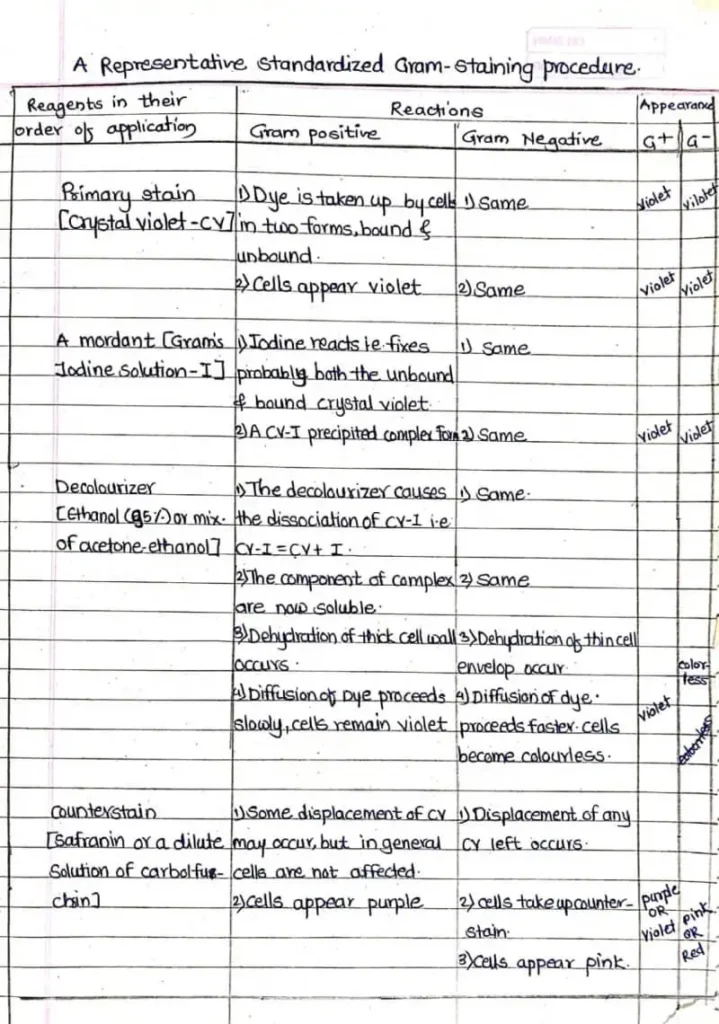
Gram staining procedure diagram/ Gram staining steps diagram

Gram staining results
Gram-positive bacteria are stained violet in color, while Gram-negative bacteria are stained pink in color.
- Gram Positive- Violet
- Gram Negative – Pink
Modification of techniques
- Method of Hucker and Conn.
- The method of Preston and Morell is an example of modifications of the original Gram staining procedure.
Gram variability
(Variations of the Gram reaction)
Variations in the results of Gram staining may have their origins in problems of technique or in changes in the biological substratum of the reaction. The former problem can be largely controlled by strict attention to the details of procedure and by acting on an intelligent understanding of the conditions affecting the accomplishment of the basic objectives of each of the steps in staining.
For example, we should not be surprised to find that the reaction varies if no attempt is made to maintain the pH at an alkaline value during application of the primary dye. Nor is it desirable to wash a smear between the application of dye and the mordant. There is a danger of washing out the primary dye from the cell wall, particularly if the wash solution is acidic.
The most critical step in staining is decolorization. The knowledge that water in the organic solvent seriously changes the solubility of the dye iodine lake warns against the promising application of decolorizer to wet smears and requires information on the water content of the decolorizer.
The gram reaction may vary in numerous ways, depending upon changes in the biological substrate. In many species, the Gram reaction changes with the age of the culture. The resistance of Gram-stained organisms to decolorization decreases as the culture ages. However, in some species of aerobic spore-forming bacilli (Bacillus subtilis, Bacillus vulgatus), the germinating spore yields a Gram-negative vegetative cell or a cell with only granules taking the stain. The organisms may not become positive until several generations after the spore has germinated.
Inasmuch as the cell wall plays a critical role, any factor that adversely affects the synthesis of this structure will tend to give gram-negative organisms. The organisms grown in magnesium-deficient media are gram-negative. The inadvertent inclusion of substances in the media or the production by the organism of enzymes capable of attacking the cell wall might also be expected to destroy the Gram-positive character. Similarly, treatment of cells for any reason by chemical or other means that destroy or modify the nature of the cell wall also results in loss of the Gram reaction. Bacterial protoplasts are always Gram-negative.
In order that particular cases of variation in the Gram reaction may be traced to changes in the magnesium ribonucleoprotein carbohydrate material or another postulated Gram reaction substrate, there is a need for the study of the conditions of growth and storage that affect the production and the stability of these materials. From these studies, one might also expect to learn precisely how the Gram-variable group of bacteria differs from those species consistently giving a definite Gram reaction.
Application
1. Diagnosis of Infectious Diseases:
- Helps detect bacteria in clinical samples like blood, urine, sputum, and pus.
- Provides rapid preliminary diagnosis.
- Useful in infections like pneumonia, UTI, and wound infections
2. Selection of Appropriate Antibiotics:
- Differentiates Gram-positive and Gram-negative bacteria
- Helps doctors choose effective initial treatment (empirical therapy)
- Reduces misuse of antibiotics.
3. Identification of Bacterial Morphology:
- Determines shape (cocci, bacilli, spirilla).
- Shows arrangement (chains, clusters, pairs).
- Helps in the preliminary identification of bacteria.
4. Microbiology Research and Education:
- Basic technique in laboratory studies and practicals.
- Helps students understand bacterial classification and structure.
- Used in research for studying microorganisms.
5. Food and Water Quality Testing:
- Detects contamination by harmful bacteria.
- Ensures the safety of food and drinking water.
- Used in quality control labs.
6. Pharmaceutical and Industrial Use:
- Checks the sterility of drugs and products
- Maintains hygiene standards in manufacturing
- Ensures products are free from microbial contamination
7. Monitoring Infection and Treatment:
- Helps track the progress of infection
- Used to evaluate whether treatment is working
Conclusion
Gram staining is not just a laboratory procedure in microbiology; it is the scientific foundation for the structure, identification, and classification of bacteria. This technique provides a clear, colorful, and easy-to-understand identification of invisible microorganisms—making the study of microorganisms more effective and precise.
Decolorization—The reagents used in this process, crystal violet, iodine, alcohol, and safranin, not only provide color but also reveal differences in the structure of the bacterial cell walls. Gram-positive bacteria retain their purple color due to their thick peptidoglycan layer, while Gram-negative bacteria appear pink/red after decolorization—the scientific reason for this is the structural and chemical differences in their cell walls.
Gram staining is of great importance in the medical field. With its help, doctors can quickly diagnose infections, select the right antibiotic, and determine the direction of treatment for the patient. Therefore, this method plays an essential role not only in education but also in actual healthcare.
Also, in terms of research, Gram staining is the first and most important step, providing preliminary identification of unknown bacteria. It forms a strong foundation for the technology to study the diversity and behavior of microorganisms.
In short, Gram staining is a colorful, scientific, and effective tool for understanding the invisible world of microorganisms—one that doesn’t just change color but reveals the true identity of bacteria.
To build strong practical skills in microbiology, explore our detailed list of 20+ Trending Microbiology Courses with Amazing Career Opportunities and choose the best course for your career growth.
FAQs
1. What is the purpose of Gram staining?
Answer: Gram staining is used to identify, classify, and study bacteria by dividing them into two main groups based on their cell wall structure:
–Gram-positive (purple)
–Gram-negative (pink/red
Main Purposes of Gram Staining
1. Bacterial Classification
2. Rapid Identification
3. Antibiotic Selection
4. Diagnosis of Infections
5. Study of Bacterial Morphology
2. How does Gram staining work? Or what is the Gram-staining procedure?
Answer: Gram staining works on a simple but powerful idea: bacteria have different cell wall structures, and these differences decide whether they keep or lose a stain during the process.
Step-by-Step Working Mechanism:
1. Crystal Violet (Primary Stain):
-All bacteria are stained purple
-Dye enters the cell wall
2. Iodine (Mordant):
-Iodine combines with crystal violet
-Forms CV-I complex (large molecule)
-This helps trap the stain inside cells
3. Alcohol / Acetone (Decolorizer) – Critical Step:
-Removes stain from some bacteria
-This step creates the main difference
4. Safranin (Counterstain):
-Adds pink/red colour to decolored cells
-Final differentiation becomes visible
3. What does iodine do in Gram staining?
Answer: In Gram staining, iodine (Gram’s iodine) acts as a mordant, meaning it helps the primary stain stick firmly inside the bacterial cell.
1. Forms CV-I Complex
-Iodine reacts with crystal violet
-Forms a Crystal Violet–Iodine (CV-I) complex
-This complex is large and insoluble
2. Fixes the Stain (Mordant Action)
-Iodine helps lock the dye inside the cell
-Makes staining more stable and strong
3. Helps in Differentiation
-This step is essential before alcohol treatment
-Without iodine, differentiation between bacteria is not possible
4. What does safranin do in Gram staining?
Answer: Safranin is the counterstain used in the final step of Gram staining. Its main job is to color the bacteria that lost the primary stain, making them visible under the microscope.
Main Function of Safranin:
1. Stains Decolorized Cells
-After alcohol treatment, some bacteria become colorless.
-Safranin stains these cells pink/red
2. Acts as Counterstain:
-It provides a contrast to the primary stain (crystal violet)
-Helps clearly differentiate between two groups of bacteria
3. Makes Gram-Negative Bacteria Visible:
-Gram-negative bacteria lose the purple stain
-Safranin gives them a pink/red color.
5. Gram staining is done to determine
Answer: The type of bacteria is based on their cell wall structure, specifically whether they are
Gram-positive (purple)
Gram-negative (pink/red)
What exactly does it determine?
1. Bacterial Classification:
-Divides bacteria into Gram-positive and Gram-negative.
2. Cell Wall Structure:
-Thick peptidoglycan → Gram-positive.
-Thin layer + lipid membrane → Gram-negative.
3. Staining Reaction (Gram Reaction):
-Whether bacteria retain or lose the crystal violet stain.
4. Initial Identification:
-Helps in the early identification of microorganisms.
5. Clinical Decision Support:
-Assists in selecting appropriate antibiotics.
6. What is Gram staining?
Answer: Gram staining is a differential staining technique used in microbiology to classify bacteria into two groups—Gram-positive and Gram-negative—based on their cell wall structure.
Simple Understanding: It works like a “color test” for bacteria.
After staining:
Gram-positive bacteria → Purple (retain stain)
Gram-negative bacteria → Pink/Red (lose stain and take counterstain)
-Based on differences in the bacterial cell wall
-Uses four main reagents: Crystal violet (primary stain)
Iodine (mordant)
Alcohol (decolorizer)
Safranin (counterstain)
-Definition:
Gram staining is a differential staining method used to distinguish bacteria into Gram-positive and Gram-negative groups based on their ability to retain the crystal violet stain.
7. Who discovered Gram staining? Who invented Gram staining? /Who developed Gram staining?
Answer:
-Hans Christian Gram was a Danish scientist and bacteriologist.
-He developed this technique while studying bacteria in infected tissues.
-His goal was to make bacteria clearly visible under the microscope.
8. How to do Gram staining? Or what is the Gram staining technique? Or how to perform Gram staining?
Answer: Gram staining is a systematic laboratory procedure. Accurate results are obtained only if the correct sequence and timing are followed.
Step 1: Smear Preparation.
-Prepare a bacterial smear on a clean glass slide.
-Air dry and heat fix.
Step 2: Crystal Violet (Primary Stain) – 1–2 min.
-Apply crystal violet to the slide.
-All bacteria turn purple.
-Wash gently with water.
Step 3: Gram’s Iodine (Mordant)—30–60 sec
-Apply iodine.
-CV-I complex is formed (stain is fixed).
-Wash again.
Step 4: Decolorization (Alcohol/Acetone) – A few seconds
-Apply alcohol dropwise.
-Until the excess purple color disappears.
-This is the most critical step.
-Rinse immediately with water.
Step 5: Safranin (Counterstain) – 1–2 min
-Apply safranin.
-Gram-negative bacteria turn pink/red.
-Wash and dry the slide.
Step 6: Observation
-Observe using a microscope (oil immersion, 100X)
Final Results:
-Gram-positive bacteria → Purple
-Gram-negative bacteria → Pink/Red
9. What is Gram staining used for?
Answer: Gram staining is a fundamental technique in microbiology used to classify bacteria into two main groups: Gram-positive and Gram-negative, based on their cell wall structure.
a. Identifying Types of Bacteria.
b. Diagnosing Infections.
10. Why is Gram staining important?
Answer: Gram staining isn’t just a basic lab test—it’s one of the fastest and most useful tools for understanding bacteria and starting the right treatment.
Gram staining is important for
a. Quick Identification of Bacteria.
b. Helps in Early Diagnosis.
c. Guides Antibiotic Selection.
d. Reveals bacterial structure.
e. Essential for Lab & Research Work.
f. Cost-Effective and Simple.
11. What is a mordant in Gram staining?
Answer: In Gram staining, a mordant is a substance that fixes the primary stain (dye) onto the bacterial cells, making the color more stable and intense. A mordant acts like a “binding agent” or “glue” that helps the stain stick firmly to bacteria.
During the staining process:
a. Crystal violet (primary stain) colors all bacteria purple.
b. The mordant (iodine) is added.
c. Iodine forms a crystal violet–iodine complex (CV-I complex).
d. This complex gets trapped inside Gram-positive bacteria.
12. Why is Gram staining done?
Answer: Gram staining is performed to quickly detect, classify, and understand bacteria in a sample so that doctors and microbiologists can make fast, informed decisions.
a. To Classify Bacteria (Gram-positive vs Gram-negative)
b. To Detect Infection Quickly
c. To Start the Right Treatment
d. To Study Bacterial Shape & Arrangement
e. To Support Laboratory & Research Work
13. What does Gram staining tell us?
Answer: Gram staining gives quick, essential information about bacteria in a sample—helping identify what kind of organism is present and how to treat it.
a. Type of Bacteria (Gram-positive or Gram-negative).
b. Shape and Arrangement of Bacteria.
c. Presence of Infection.
d. Clues for Antibiotic Treatment.
e. Overall Insight into Bacterial Nature.
14. What does crystal violet do in Gram staining? Why do we use crystal violet in Gram staining?
Answer: Crystal violet is the primary stain used in Gram staining. Its main job is to color all bacterial cells purple at the start of the procedure.
Role of Crystal Violet:
-It is the first dye applied to the bacterial smear.
-It penetrates the cell wall of all bacteria.
-After this step, both Gram-positive and Gram-negative bacteria appear purple.
Crystal violet is important because
-Provides the initial color to all bacteria.
-Essential for differentiating bacteria later in the process.
-Helps highlight bacterial cells under the microscope.
15. What is the purpose of safranin in Gram staining? Why is safranin used in Gram staining?
Answer: Safranin is the counterstain used in Gram staining. Its purpose is to color Gram-negative bacteria pink/red after the decolorization step, making them visible under the microscope.
Role of Safranin:
After the alcohol wash:
-Gram-positive bacteria → remain purple (they retain crystal violet).
-Gram-negative bacteria → become colorless.
When safranin is applied:
-Gram-negative bacteria take up the dye and turn pink/red.
-Gram-positive bacteria stay purple (the darker color masks safranin).
Why Safranin is Important:
-Provides contrast between Gram-positive and Gram-negative bacteria.
-Makes Gram-negative bacteria visible.
-Completes the differentiation process.
16. What is the purpose of iodine in Gram staining?
Answer: Iodine (Gram’s iodine) acts as a mordant in Gram staining. Its main purpose is to fix and strengthen the primary stain (crystal violet) inside bacterial cells.
Role of Iodine (Mordant):
-Iodine combines with crystal violet to form a crystal violet–iodine (CV-I) complex
-This complex becomes larger and more stable inside the cell
-In Gram-positive bacteria, the thick cell wall traps this complex firmly
Why This Step is Crucial:
-Fixes the dye so it doesn’t wash out easily.
-Enables proper differentiation during the alcohol (decolorization) step.
-Helps Gram-positive bacteria retain the purple color.
What Happens Without Iodine?
-The primary stain would be weak and easily removed.
-Both types of bacteria might lose colour → unclear results
17. What is the purpose of crystal violet in Gram staining? Or why is crystal violet used in Gram staining?
Answer: Crystal violet serves as the primary stain in Gram staining. Its purpose is to initially color all bacterial cells purple, allowing them to be clearly seen under the microscope and setting up the later differentiation step.
18. What is the primary stain in Gram staining?
Answer: Crystal violet serves as the primary stain in Gram staining.
19. What is a mordant in Gram staining?
Answer: Iodine.
20. What does Gram staining do?
Answer: Quickly detect, classify, and understand bacteria.
21. Why is iodine used in Gram staining?
Answer: As a mordant. Its main purpose is to fix and strengthen the primary stain (crystal violet) inside bacterial cells.
22. What is Gram staining in microbiology?
Answer: To quickly detect, classify, and understand bacteria.
23. Why do we do Gram staining?
Answer: To quickly detect, classify, and understand bacteria.
24. Which stain is used in Gram staining?
Answer:
Primary Stain: Crystal Violet
-Color all bacteria purple initially
-First step of staining
Counterstain: Safranin
-Colors Gram-negative bacteria pink/red
-Gram-positive remain purple
25. What is the principle of Gram staining?
Answer: The principle of Gram staining is based on the difference in cell wall structure of bacteria, which determines their ability to retain or lose the primary stain (crystal violet) during decolorization.