
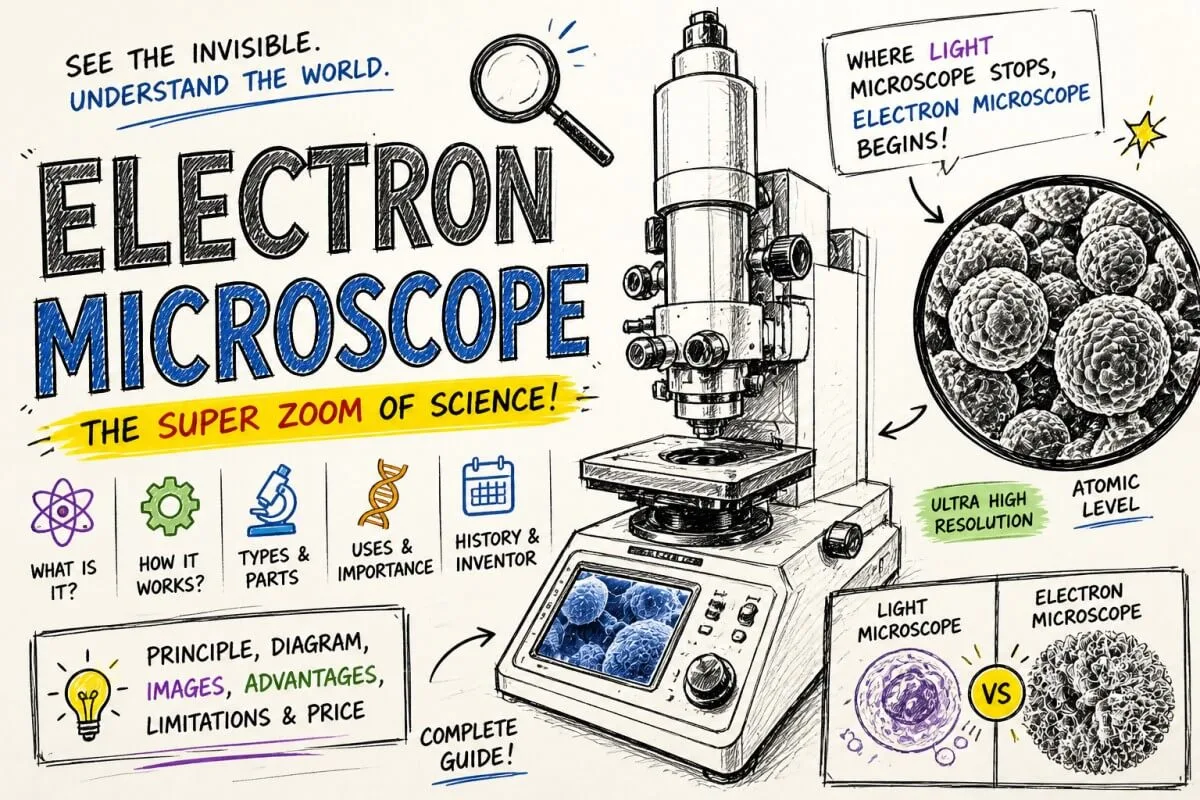
Discover what an electron microscope is, how it works, its types, parts, uses, advantages, limitations, invention history, and price explained in simple words with examples and diagrams.
Introduction
Let’s look at a fun example.
Imagine you are taking a photo of the moon using your mobile camera—the photo comes out, but it’s not very clear.
But if you use a professional DSLR camera with a zoom, even the small spots on the moon start to appear!
Exactly:
Light microscope = simple mobile camera
An electron microscope is a super-zoom DSLR camera
An electron microscope is a “super zoom camera” that looks so closely that even tiny things that are invisible to the naked eye are clearly visible.
In simple terms:
“Where the mobile camera gives up, the electron microscope begins its game!”
Electron Microscope
Definition
Electron microscopy is a technique used in scientific research and industry to examine the internal structure of objects and materials on a microscopic scale. Electron microscopes are incredibly powerful tools that allow us to see and study things that are invisible to the naked eye, making them an essential tool for a wide range of applications, from biological research to materials science.
Electron microscopy is a technique that uses a beam of electrons to create an image of an object or material. Unlike traditional light microscopes, electron microscopes don’t use light to create images. Instead, they use electrons, which have a much shorter wavelength than light, allowing us to see details that are impossible to see with light.
There are two main types of electron microscopes: transmission electron microscopes (TEMs) and scanning electron microscopes (SEMs). TEMs work by passing a beam of electrons through an object and then collecting the electrons that make it through on the other side to create an image. SEMs work by scanning a focused beam of electrons over the surface of an object and detecting the electrons that are reflected to create an image.
Learn more about the official definition of electron microscopy from Britannica.
Why is it important in modern science?
Electron microscopes play a major role in microbiology research and modern laboratory careers.
1. Helps Us See the “Invisible World”: Electron microscopes can see things smaller than what light microscopes can detect, even up to the atomic level.
2. Essential in Medical & Biological Research: It is widely used to study cells, tissues, and diseases in detail.
3. Backbone of Nanotechnology & Material Science: Electron microscopes are used to analyze nanoparticles, metals & crystals, and semiconductor chips.
4. Ultra-High Resolution = More Accurate Science: Electron microscopes provide 1000× better resolution than light microscopes. (More accurate observations, better scientific conclusions, fewer experimental errors).
5. Used in Almost Every Scientific Field: Electron microscopy is now used in biology, chemistry, physics, and environmental science.
6. Diagnostic and research applications.
7. Integration with modern techniques.
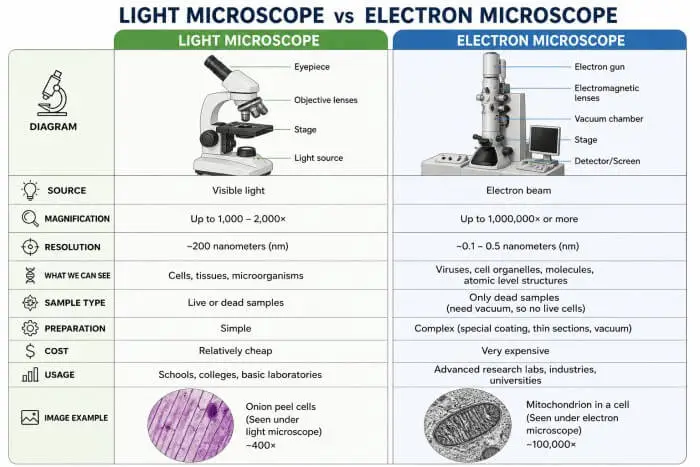
Difference from the light microscope.
History of the Electron Microscope/Electron Microscope Discovered By.
Inventor
The wave theory to describe the nature of electrons by de Broglie in 1924 laid the foundation of electron optics required for the development of the electron microscope. In 1931, Ernst Ruska, then 24 years old, invented the electron microscope, for which he was a co-recipient of the Nobel Prize in Physics. Ernst Ruska invented the electron microscope in 1931. He created the first transmission electron microscope (TEM) with the help of his colleague Max Knoll. This invention changed the way we see the microscopic world.
Key Milestones
- 1931: First electron microscope created (Ruska & Knoll).
- 1933: Achieved higher resolution than the light microscope.
- 1937–1938: Production of commercial electron microscopes begins.
- 1950s: Widespread use in biological research.
- 1960s–present: Development of TEM, SEM, and advanced microscopy technologies.
Nobel Prize (Nobel Prize Relevance)
- Ernst Ruska was awarded the Nobel Prize in Physics in 1986.
- Reason: The development of the electron microscope revolutionized the scientific field.
- Gerd Binnig and Heinrich Rohrer also received the Nobel Prize in the same year for the scanning tunneling microscope (STM), which further advanced microscopic observation technology.
Read the official Nobel Prize history of Ernst Ruska and the invention of the electron microscope.
Basic Principle of the Electron Microscope
The advent of the electron microscope marked a significant improvement over the light microscope for microorganisms because electron microscopy allows better resolution and higher useful magnification than the light microscope.
Basic Principle of the Electron Microscope
1. Electron beam instead of light:
- A simple microscope uses light, but an electron microscope uses a beam of electrons.
- These electrons travel very fast and collide with the object to provide very detailed information about it.
2. Wave nature of electrons:
- Electrons are not just particles; they also behave like waves.
- The wavelength of these waves is very short, thousands of times shorter than that of light.
3. Higher Resolution Explained Simply:
- Resolution is the ability to distinguish between two very close objects.
- Light microscope → low resolution
- Electron microscope → very high resolution
- Because the wavelength of electrons is very short, they can clearly show very small details (down to the atomic level).
Electron microscope diagram
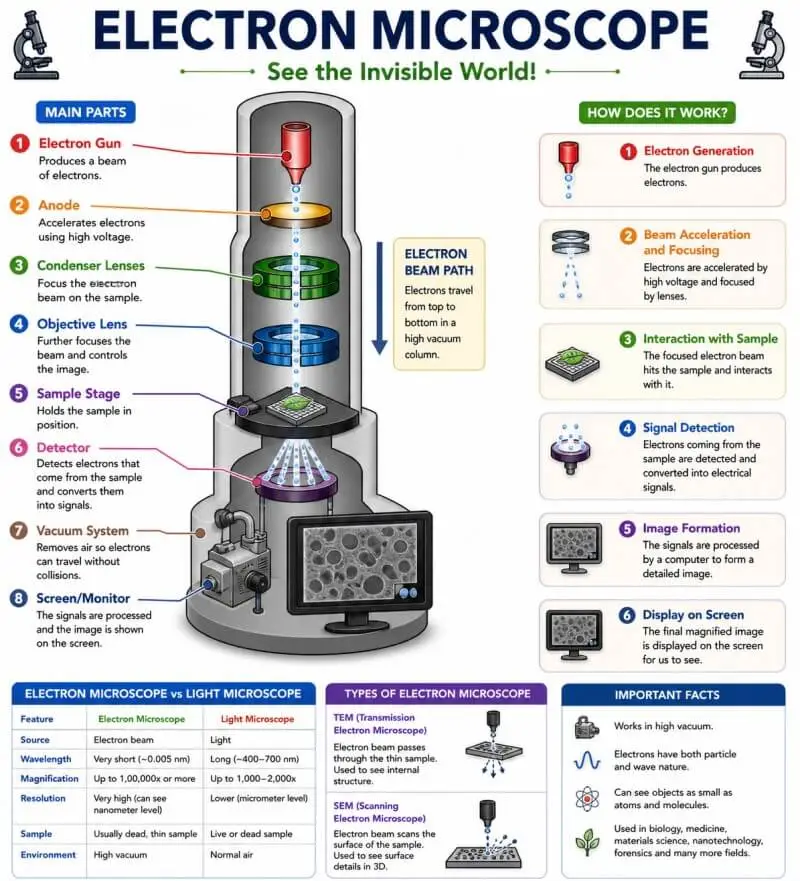
Electron microscope images
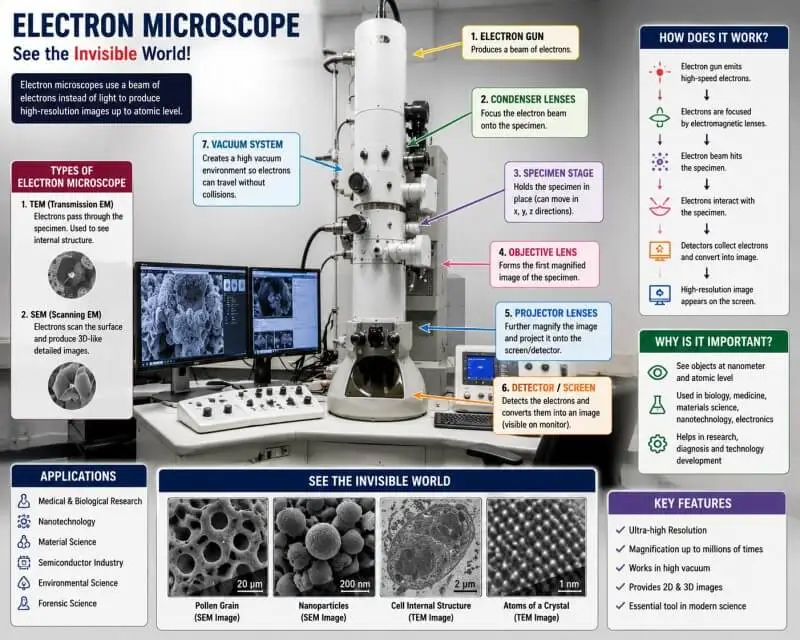
Main Parts of an Electron Microscope
The electron source, electromagnetic lenses, and one or more electron detectors are the main parts of a contemporary electron microscope. A concentrated electron beam is first produced by the source of the microscope and directed toward the sample by the lenses. If the sample is sufficiently thin, the electrons in the beam will either reflect or pass through it after interacting with it. The detector is set up to catch these transmitted or reflected electrons, which, as a result of their interaction, contain different information about the sample.
A) Electron gun/electron source
Electron sources come in a variety of forms and can be broadly classified as either thermionic or field emission sources. Thermionic sources use an applied current to heat a filament or crystal until there is sufficient energy to release electrons. When a sharp metal (tungsten) tip is exposed to a high electrostatic field from field emission sources, electrons are ejected due to the concentration of energy at the tip edge. Cost and required image quality play a major role in the decision between thermionic and field emission sources.
B) Electromagnetic Lenses
Electromagnetic lenses regulate electron movement through the microscope, much like glass lenses focus and direct light in an optical microscope. A set of parallel electric coils that generate a magnetic field forms an electromagnetic lens. These are attached to hollow metal cylinders called pole pieces, which concentrate the magnetic field close to the electron beam. The field subsequently pulls the electrons through the pole piece’s center.
C) Vacuum Chamber
The vacuum chamber is a very important part of an electron microscope. A vacuum chamber used in an electron microscope is a sealed space from which air is completely removed (creating a vacuum). Powerful vacuum pumps are used in a vacuum chamber. Air is removed to create a high-vacuum environment. The entire system is completely sealed. See how vacuum systems improve electron microscope imaging quality
Why is a vacuum chamber necessary?
1. To keep the path of electrons clear:
In an electron microscope, an electron beam is used instead of light. If there is air, the electrons will collide with air particles and change direction. This will not give a clear image.
2. To obtain high resolution: Because of the vacuum, the electrons travel in a straight path. This allows very fine (nano-level) details to be seen.
3. To keep the specimen safe: Oxygen or moisture in the air can affect the specimen. The specimen remains safe in a vacuum.
4. To preserve electron energy: Electrons do not lose energy due to the absence of air. This makes imaging more effective.
D) Specimen Holder
The specimen holder in an electron microscope is a part that securely holds the sample placed for observation and keeps it in place.
The main function of the specimen holder:
1. Keeping the sample stable: Holds the sample tightly so that it does not move during observation. A clear image is obtained only if there is stability.
2. Keeping it in the right position: The sample is placed in front of the electron beam at the right angle. Some holders have tilt and rotation facilities
3. Fine adjustment: Can be moved in x, y, and z directions. This allows you to zoom in on a specific part of the sample.
4. Suitable for working in a vacuum: This holder is designed to be used in a vacuum chamber. The sealing is done properly to prevent air from entering
Types of Specimen Holder:
1. TEM (Transmission Electron Microscope) Holder: To hold a very thin sample (ultra-thin section). The sample is placed on a grid.
2. SEM (Scanning Electron Microscope) Holder: The sample is placed on a small metal stub. Used to observe surface structure.
E) Detector / Screen
Over the course of the development of electron microscopes, detectors have undergone substantial change. In the beginning, electrons were found by directly interacting with camera film, which reacts to photons and electrons in a similar way. These days, the majority of electron microscopes employ a digital camera, either with a direct electron detector or a light-emitting scintillator. With some detectors reaching 4k × 4k physical pixels (or 16 million pixels overall), resolution is interpreted per pixel of the detector.
How Does an Electron Microscope Work? (Step-by-Step)
An electron microscope is an advanced instrument used to view very small (nano-level) structures using a high-energy electron beam instead of light. It provides very high resolution due to the wave nature and short wavelength of electrons.
Step 1: Electron generation.
- Electron gun used for creating electrons.
- The electron gun on top of the machine creates electrons.
- These electrons are released downwards with high energy.
- Electrons are generated in an electron microscope using an electron gun (usually a tungsten filament or field emission gun).
- This process is based on the principles of thermionic emission or field emission.
- When a high voltage (kV range) is applied, electrons are emitted and form a directed beam.
Step 2: Beam focusing
- The generated electron beam is focused with the help of electromagnetic lenses (condenser lens and objective lens).
- These lenses work like optical lenses, but they control the path of the electrons using a magnetic field.
- This makes the beam very fine and controllable.
Step 3: Interaction with the sample
- The focused electron beam falls on the sample and interacts with it.
- This interaction produces various signals: secondary electrons, backscattered electrons, and X-rays.
- Based on these signals, the surface structure, composition, and morphology of the sample are understood.
Step 4: Image formation
- The signals obtained from the electron-sample interaction are captured by the detector.
- The detector converts these signals into electrical signals.
- A detailed image is created by processing these signals.
Step 5: Display on screen
- The processed signal is displayed on the computer.
- The final image is very high-resolution and magnified (down to the nanometer scale).
- This allows microscopic objects like cells, viruses, and nanoparticles to be clearly seen.
An electron microscope uses electrons to observe a sample very closely.
Every step, from electron generation to image display, works in a very precise and scientific manner, which makes it of immense importance in modern science.
Advantages of the Electron Microscope
- Extremely high resolution
- Detailed internal structure
- Scientific research importance
Limitations of the Electron Microscope (Problems of Electron Microscopy)
(A) Limitations
Despite the great advantage of high resolution and magnification, there are some limitations to electron microscopy mentioned as follows:
(1) The specimen being examined is in a chamber that is under a very high vacuum. Thus, cells cannot be examined in a living state.
(2) The drying process may alter some morphological characteristics.
(3) The low penetration power of the electron beam necessitates the use of thin sections to reveal the internal structures of the cell.
(B) Problems:
Formation of artifacts:
There is great potential for creating artifacts that could be mistakenly viewed as real structures in electron micrographs. An artifact is the appearance of something in an image or micrograph that is due to causes within the optical system or the preparation of the specimen and is not a true representation of the features of the specimen on view. This is a problem common to all microscopes but is particularly troublesome in electron microscopy because of the high magnifications that are used, the need to dehydrate the specimen, and the fact that the specimen must be placed in a high-vacuum chamber. Improper adjustment of the electron beam, excessive magnification, and improper sample preparation can all cause the formation of artifacts.
Applications of the Electron Microscope
- Medical research
- Nanotechnology
- Material science
- Forensic science
Electron microscope price
Approx.
Basic / Educational “Electron-type” Digital Microscopes: From ₹1,000 to ₹20,000.
Tabletop / Entry-level Electron Microscopes: In India, around ₹10 lakh to ₹2 crore+
Advanced SEM (Scanning Electron Microscope): ₹30 lakh to ₹5 crore+.
TEM (Transmission Electron Microscope – High-end): ₹2 crore to ₹10 crore+.
Explore advanced electron microscopy solutions from Olympus Life Science.
Conclusion
An electron microscope is a sophisticated analysis technology system that uses high-energy electron beams, short wavelengths, and electromagnetic control to reveal the microscopic (nanoscopic to atomic) structure of materials with extreme precision. From electron generation to signal detection and image reconstruction, each step in the electron microscope is based on highly controlled physical principles, ensuring high resolution, high magnification, and reliability of structural analysis. This device is therefore indispensable for fundamental research in areas such as modern nanotechnology, biomedical research, and materials science. This device is therefore indispensable for fundamental research in areas such as modern nanotechnology, biomedical research, and materials science.
Frequently Asked Questions (FAQs)
1. How does an electron microscope work in simple words?
Answer:
a. Electrons are created: A part of the machine (electron gun) creates electrons.
b. The beam is created and focused: These electrons are sent to the sample in a thin beam.
c. They hit the sample: The electrons hit the sample, and information (signals) is obtained from it.
d. The image is created: The machine creates a detailed image from those signals.
e. It appears on the screen: Finally, the image appears on the computer—very zoomed in.
2. Why is a vacuum required in an electron microscope?
Answer: Creating a vacuum in an electron microscope is a very important condition because the travel, energy, and image quality of the electron beam all depend directly on the vacuum.
a. Straight and stable travel of the electron beam:
-If the electron beam travels in air, it collides with air molecules (O₂, N₂).
-This causes scattering and changes the direction of the beam.
-In a vacuum, electrons travel in a straight path without any obstacles → high precision imaging is possible.
b. Required to achieve high resolution:
-The main feature of an electron microscope is ultra-high resolution.
-If electrons collide continuously, the image becomes blurry.
-Due to the vacuum, the beam remains stable and nano-level details are clearly visible.
c. Protection of Electron Energy:
-Electrons lose energy when they collide with air molecules.
-Energy loss weakens the signal and reduces image quality.
-In a vacuum, the energy of electrons is maintained → a strong signal and a clear image are obtained.
d. Protection of Specimen (Sample):
-Oxygen, moisture, or contaminants can degrade the sample.
-Especially in biological samples, oxidation or contamination can occur.
-Vacuum environment keeps the sample safe → accurate analysis is obtained.
e. Stable Instrument Operation:
-The components (electron gun, lenses) in an electron microscope are designed for vacuum conditions.
-Without a vacuum, the instrument cannot function properly.
-High vacuum pumps stabilize the system.
3. Who invented the electron microscope?
Answer: The electron microscope was invented by Ernst Ruska in 1931.
He was assisted in this work by his colleague, Max Knoll.
4. What are the main uses of electron microscopes?
Answer:
An electron microscope is not just for “looking at small objects” but is a very important research tool in modern science. Below are its major uses explained from a scientific point of view:
a. Biomedical Research:
-An electron microscope is used to study the ultrastructure of cells, tissues, viruses, and organelles (such as mitochondria and nuclei).
-This helps in understanding the causes of diseases, cellular damage, and infection mechanisms.
-It has a great contribution, especially in virology and cancer research.
b. Nanotechnology and Nanomaterial Analysis:
-In nanotechnology, an electron microscope is used to study the shape, size, morphology, and arrangement of nanoparticles, nanowires, and nanostructures.
-Observations can be made up to the atomic level, which is essential for nanotech development.
c. Material Science:
-Used to detect internal structure and defects (cracks, dislocations) of metals, alloys, ceramics, and polymers.
-This can improve the strength, durability, and performance of materials.
-This is a very important application in industrial R&D.
d. Semiconductor and Electronics Industry:
-Electron microscopes are used to observe microchips, transistors, and integrated circuits at the nanoscale.
-Essential for circuit defects, fabrication errors, and quality control.
-Modern electronics manufacturing is impossible without it.
e. Forensic Science:
-Electron microscopy is used to analyze gunshot residues, fibers, paint particles, and trace evidence.
-Helps in forensic investigations by finding very small evidence (micro-evidence).
f. Environmental Science:
-Used to study air pollution particles, soil samples, and water contaminants.
-Important for environmental monitoring and pollution control.
g. Microbiology: g. Microbiology:
-Electron microscopy is very useful for the detailed study of bacteria, viruses, and other microorganisms.
-Helps in discovering new pathogens and understanding their structure.
5. How much does an electron microscope cost?
Answer:
Basic / Educational “Electron-type” Digital Microscopes: From ₹1,000 to ₹20,000.
Tabletop / Entry-level Electron Microscopes: In India, around ₹10 lakh to ₹2 crore+
Advanced SEM (Scanning Electron Microscope): ₹30 lakh to ₹5 crore+.
TEM (Transmission Electron Microscope – High-end): ₹2 crore to ₹10 crore+.
6. When was the electron microscope invented?
Answer: The electron microscope was invented in 1931. This revolutionary invention was developed by Ernst Ruska with the help of his colleague Max Knoll.