
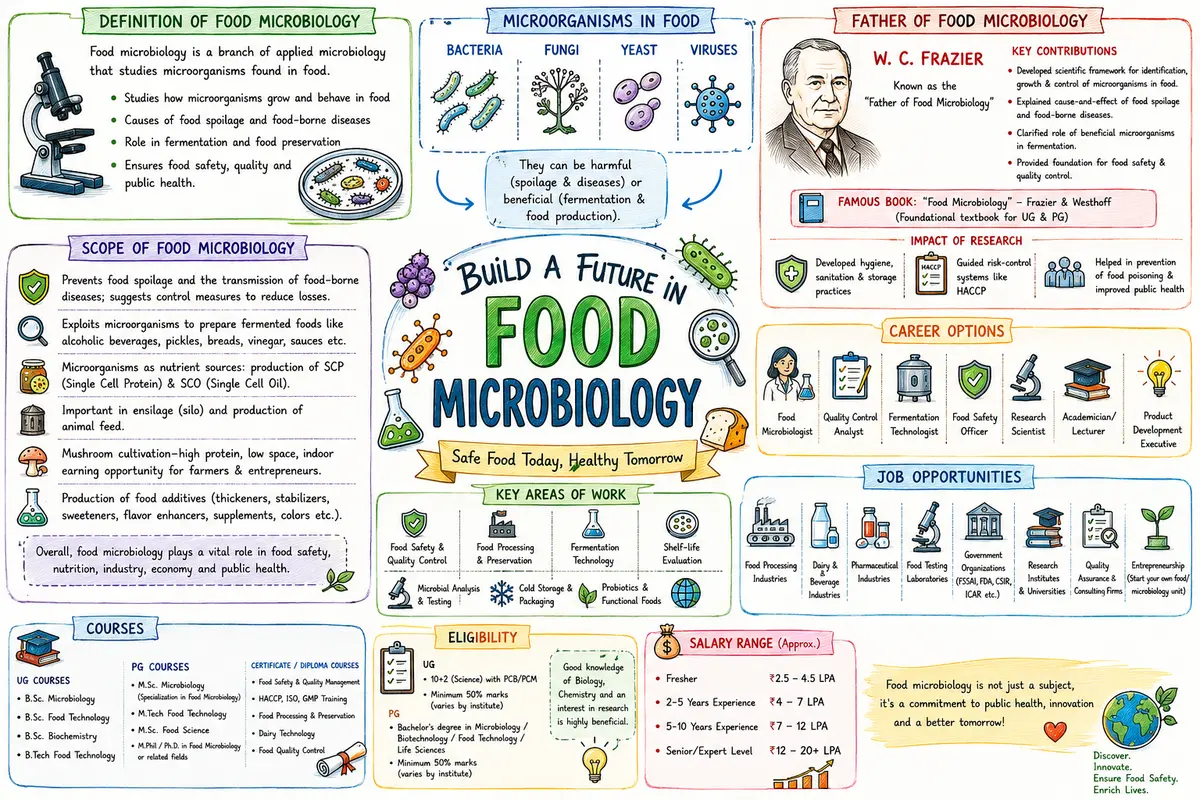
Do you want to build a future in food microbiology? Read complete information in English about future scope, career options, courses, eligibility, salary, and job opportunities.
Food microbiology is a branch of applied microbiology that studies microorganisms found in food. It focuses on how these microorganisms behave, how they cause food spoilage and food-borne diseases, and how they are useful in fermentation and food preservation processes.
Definition of Food microbiology
Food microbiology is a branch of microbiology that studies microorganisms found in food, such as bacteria, fungi, yeast, and viruses. It focuses on how these microorganisms grow and act in food, how they cause food spoilage and food-borne diseases, and how they affect food safety. It also studies the role of microorganisms in fermentation processes. OR
Food microbiology is a branch of applied microbiology that involves the in-depth study of the biological, chemical, and physiological behavior of microorganisms present in food, as well as their role in food spoilage, food-borne diseases, fermentation, and food preservation processes.
Food microbiology deals with the study of microorganisms associated with foods, including their role in food spoilage, food-borne diseases, and food processing. -by W. C. Frazier & D. C. Westhoff.
Food microbiology is the study of microorganisms that inhabit, create, or contaminate food and their impact on food safety, quality, and preservation. -by Jay, Loessner & Golden (Modern Food Microbiology).
Food microbiology focuses on microorganisms in food, their growth and survival, and their importance in food spoilage, food poisoning, and fermentation. – by Adams & Moss.
Food microbiology is concerned with the study of microorganisms found in food and their influence on food quality, safety, and public health. -by Prescott, Harley & Klein.
Food microbiology involves the study of microorganisms in food and food products, including their biological activities and their role in food deterioration and food-borne illnesses. -by Pelczar, Chan & Krieg.
Father of Food Microbiology
W. C. Frazier is known as the Father of Food Microbiology.
Key contribution:
- Developed a scientific framework for the identification, growth, and control of microorganisms in food.
- Explained the cause-and-effect relationship of food spoilage and food-borne diseases.
- Provided a scientific foundation for food safety and quality control.
- Clarified the role of beneficial microorganisms in fermentation processes.
Famous Book:-
- “Food Microbiology” – Frazier & Westhoff
This book is considered a foundational textbook in food microbiology and is widely used in UG and PG courses.
Impact of Research
- Helped in the development of hygiene, sanitation, and storage practices in the food industry.
- Provided direction for risk-control systems such as HACCP.
- Contributed significantly to the prevention of food poisoning from a public health perspective.
Scope of Food Microbiology
Food microbiologists working in food microbiology try to prevent microbial spoilage of food and the transmission of food-borne diseases (salmonellosis) or food intoxications (botulism). They identify the causes for spoilage and suggest or apply measures to prevent the economic losses caused due to the attack of microbes on foods (unprocessed as well as processed), cereals, fruits, vegetables, etc. So, the role of a food microbiologist is very crucial; otherwise, food spoilage may become one of the causes for hunger in the community.
Food microbiologists exploit the use of microorganisms to prepare delicious fermented foods like alcoholic beverages, pickles, breads, vinegar, sauces, etc.
Nowadays, fermented foods have captured a very big market, and so many big food-processing plants have been established all over the world. The students of microbiology can find jobs as fermentation technologists in the food industry.
One more area has been developed because of microorganisms themselves becoming nutrient sources for human beings and livestock. Technology involved in the development of single-cell protein (SCP) and single-cell oil (SCO) has opened the doors for new industries. Organisms like bacteria (Methylophilus methylotrophs), yeast (Saccharomyces cerevisiae), molds (Fusarium or Trichoderma), and algae (Chlorella) have been successfully commercialized for the production of SCP and have solved the problems of protein shortages.
Ensilage (silo) is one of the important animal feeds prepared by fermenting plant wastes. Similarly, the industrial units for other types of animal feed have been started by co-operatives as well as private units.
So, the students of microbiology have nice opportunities to work in the units manufacturing feed for livestock and also in SCP plants.
Today popularizing mushrooms as part and parcel of everyday food is of paramount importance because nutritionally they are very rich. Secondly, they grow very fast, do not require sunlight or fertile soil, grow only on discardable agro-waste, and require very little space as compared to big farms. Modern mushroom culture technology produces more protein per unit area of land than any other kind of agriculture and technology.
Mushroom cultivation is an indoor earning job that can help the landless, small, and marginal farmers to supplement their income and diversify economic activity and can create gainful employment, especially for unemployed or underemployed youths, weaker sections of the society, and women folk. A microbiologist can start his own unit for making a “spawn” culture of edible mushrooms and can provide it to needy farmers.
Nowadays, industries for making various food additives (thickeners, stabilizers, low-calorie sweeteners, flavor enhancers, food supplements, and coloring agents) have been started as their demand has increased in the food industry due to liberalization of policies all over the world.
“Students can also explore the complete scope of microbiology for wider career opportunities.”
Food Microbiology Courses
Below is a clear and easy-to-understand list of food microbiology-related courses and colleges in Maharashtra.
This list mainly includes government and government-recognized colleges, along with courses in microbiology, food science, food technology, and related subjects, where food microbiology is taught as part of the syllabus.
1) Relevant Courses (Maharashtra)
i) B.Sc. in Microbiology (UG – 3 years)/Bachelor’s Degree Related to Food/Microbiology
- Foundational course that includes microbes, applied microbiology, and often food microbiology/industrial microbiology topics.
Offered by many Maharashtra colleges. - B.Sc. Microbiology—foundational course, includes basics of microbial contamination and food safety principles.
- B.Tech / B.Sc. Dairy Technology – includes microbiology of dairy, fermentation science, and food quality.
ii) M.Sc. in Microbiology (PG – 2 years)/M.Sc. Food Microbiology / Food & Industrial Microbiology
- Advanced program covering microbial physiology, food microbiology, applied microbiology, research skills, etc.
- Some universities offer specialized Food Microbiology or Food & Industrial Microbiology courses (e.g., M.Sc. Food & Industrial Microbiology).
iii) Food Science / Nutrition (Food Microbiology Related)
• Courses like M.Sc. Food Science & Nutrition include microbiological aspects of food quality and safety.
iv) Short-Term / Certificate Training (Skill-Based)
- Food Microbiology Analyst Course — practical training approved by FICSI/NSDC (Maharashtra-based).
- Practical training programs on food microbiology techniques (hands-on) available in Pune (vocational).
2) Government/Public Colleges Offering Microbiology Programs (Food Microbiology-Relevant)
Mumbai Region
- University of Mumbai—M.Sc. Microbiology (Government University)—covers food microbiology concepts.
- K. J. Somaiya College of Science & Commerce, Mumbai — B.Sc. and M.Sc. Microbiology (food microbiology included in the syllabus).
- St. Xavier’s College, Mumbai — B.Sc. / M.Sc. Microbiology.
- Mithibai College of Arts, Science & Commerce, Mumbai — B.Sc. / M.Sc. Microbiology.
- Kishinchand Chellaram (KC) College, Mumbai — Microbiology programs.
Pune Region
- SPPU Savitribai Phule Pune University
- M.E.S. Abasaheb Garware College, Pune — B.Sc. / M.Sc. Microbiology with applied areas including food microbiology topics.
- Modern College of Arts, Science & Commerce, Pune — B.Sc. Microbiology.
- Dr. D. Y. Patil Arts, Commerce & Science College, Pune — Microbiology courses available.
Other Cities in Maharashtra
- Dnyanopasak College, Parbhani—B.Sc. & M.Sc. Microbiology.
- R.C. Patel Arts, Science & Commerce College (Shirpur/Dhule region)—Microbiology department (UG/PG).
3) Food Science / Nutrition Courses (Related to Food Microbiology)
- M.Sc. Food Science & Nutrition – SNDT Women’s University, Juhu (Mumbai)
- Includes food quality, safety, nutrition, and microbiological aspects.
4) Key Points for Admission
Eligibility:
- B.Sc. Microbiology: 10+2 (Science — PCB) with qualifying marks.
- M.Sc. Microbiology: B.Sc. degree with a microbiology / life sciences subject.
- Entrance requirements vary by university/college (e.g., MH-CET, University-Level Tests).
5) Why These Courses Are Useful for Food Microbiology Careers
These programs provide knowledge in-
- Microbial growth & food safety
- Foodborne pathogens and detection techniques
- Industrial and applied microbiology
- Quality control and food testing methods.
Interested students can explore these 20 Trending Microbiology Courses to discover more specialization options and career opportunities in microbiology.
Job Opportunities After Food Microbiology
- Food Safety Officer
- Microbiologist in Food Testing Labs
- Quality Assurance/Control Analyst in Food Industry
- Research and Development (Food & Dairy)
- Higher Studies (Ph.D. / Research).
1) Food microbiology companies and labs in Pune
These labs often hire microbiologists, lab technicians, quality analysts, and interns for food testing, microbial analysis, quality checks, and laboratory work.
- OXYFOOD LABORATORY OPC PVT LTD – NABL-accredited food testing lab
- SP Aqua Food Testing Laboratory – Food & water testing lab
- FHHL PRIVATE LIMITED (Food Hygiene And Health Laboratory)—Food hygiene and health lab
- Kiaan Labs Pvt. Ltd. – Food, water, and environmental testing
- Sigo food and water testing laboratory—Food & beverage testing
- National Agriculture & Food Analysis & Research Institute (NAFARI) – Food and agriculture analysis lab
- Envirocare Labs Pune – Testing lab covering food, water, etc.
- SSAS Laboratory – NABL-accredited food/water testing
- Lotus Water Food Testing & Research Laboratory – Research & testing lab
- MITCON NABL Accredited Laboratory—Food, milk & environmental testing
- Anushka Food And Water Testing Laboratories – Local food & water testing
- Biotech lab with microbiology work
2) Companies Hiring Microbiology/Quality Jobs in Pune
Actual job listings show that a variety of companies post positions like microbiologist, quality control, QA executive, lab technician, or food quality intern in and around Pune:
- Life Scanners – Laboratory technician roles reported.
- Vasaya Foods Pvt Ltd – Food quality and microbiology-related roles like production and intern positions.
- Oriental Yeast India Pvt. Ltd. – Application Specialist with microbiology skills (e.g., yeast/fermentation and quality testing).
- P9 Farms Private Limited – Dairy microbiology roles testing dairy products.
- Dr. Lal Pathlabs Ltd. – Lab technician roles involving microbiology.
- SKP Corp Pvt Ltd – Microbiologist positions.
3) Research & Advanced Microbiology Institutes (Useful for Career Growth)
These are not direct food testing companies but excellent places for research experience, networking, or advanced microbiology roles, which may include food/industrial microbiology projects:
- National Collection of Industrial Microorganisms (NCIM) – Government culture repository based in Pune offering research support and microbial strains.
- Agharkar Research Institute (ARI)—Government research institute with a strong microbial sciences focus.
- Biotech and diagnostic companies like Serum Institute of India and Mylab Discovery Solutions also operate in Pune — great for broader microbiology careers (even though not strictly food).
How to Find Food Microbiology Jobs in Pune
Here are some practical search tips:
- Search job portals (e.g., Indeed, Shine, LinkedIn) with terms: Food microbiology, QA/QC microbiologist, Lab Technician, Food testing, Dairy microbiologist, indeed.
- Visit or contact local testing labs listed above — many hire interns and fresh graduates.
- Network with alumni or professors from local colleges (e.g., Savitribai Phule Pune University) for referrals.
Conclusion
Food Microbiology (From Courses to Jobs)
Food microbiology is one of the most practical and career-oriented branches of life science, directly connected to public health, food safety, and industry needs. From undergraduate courses like B.Sc. Microbiology/Food Science to postgraduate programs such as M.Sc. Microbiology or Food Microbiology, this field builds strong theoretical knowledge and hands-on laboratory skills.
With growing awareness of food safety laws, quality standards (FSSAI, HACCP, and ISO), and increasing demand from food industries, testing laboratories, and dairy and beverage sectors, food microbiology offers stable job opportunities in both government and private sectors. Graduates can work as food microbiologists, QC/QA analysts, lab technicians, or research assistants or prepare for government roles like food safety officer.
Overall, food microbiology is an excellent long-term career choice for students who enjoy laboratory work and want to contribute to safe, hygienic, and quality food production. With experience and specialization, it provides professional growth, job security, and social importance, making it one of the best career paths in applied microbiological sciences.
Also Read:
15+ Important Scope of Microbiology – Best Jobs After Microbiology
Frequently Asked Question
1. What is Food Microbiology?
Answer: Food microbiology is the branch of science that studies microorganisms present in food, including beneficial microbes, spoilage organisms, and disease-causing pathogens. It focuses on how these microorganisms affect food safety, quality, preservation, fermentation, and shelf life.
2. What is the scope of food microbiology?
Answer: The scope of food microbiology is very wide and growing, because safe food is a basic human need. It includes:
Food safety and quality control
Detection of foodborne pathogens
Food testing laboratories
Food and beverage industries
Dairy, bakery, meat, and processing industries
Government roles (Food Safety Officer, public health labs)
Research, teaching, and higher studies (Ph.D.)
3. What do food microbiologists do?
Answer: Food microbiologists:
Test food samples for bacteria, yeast, and molds
Detect pathogens like Salmonella and E. coli
Monitor food hygiene and safety standards
Help in quality control (QC) and quality assurance (QA)
Study food spoilage and improve shelf life
Support food industries in meeting FSSAI, HACCP, ISO standards
4. What is food microbiology?
Answer: Food microbiology is a branch of science that deals with the study of microorganisms present in food. It includes the study of beneficial microorganisms, food-spoilage microorganisms, and disease-causing microorganisms transmitted through food. This field plays a very important role in ensuring food safety, food quality, proper storage, and shelf life of food products.
5. What is the scope of food microbiology?
Answer: It is essential for food safety and quality control
Provides job opportunities in food testing laboratories
Plays a key role in the food and beverage industry
Has applications in dairy, bakery, and processed food sectors
Offers government job opportunities such as Food Safety Officer
Provides scope for research, teaching, and Ph.D. programs