
Understand what is the resolution or resolving power of a microscope is with easy examples, a formula, factors affecting resolution, and exam notes for students.
Introduction
Have you ever tried to read a road sign from far away? At first, the letters look blurry, but as you move closer, they become clear, and you can easily read them. The road sign didn’t change—your ability to see the details improved.
The same idea applies to a microscope. When scientists or students observe tiny objects like bacteria, cells, or tissues, simply making the image bigger is not enough. The microscope must also be able to show fine details clearly. This ability is called the resolution or resolving power of a microscope.
In simple words, resolution is the ability of a microscope to distinguish two very close objects as separate instead of seeing them as one blurred object. A microscope with high resolving power produces sharp, clear, and detailed images, making it easier to study microscopic structures accurately.
Imagine you are watching a cricket match from the last row of a stadium. You can easily see that there are players on the field, but you cannot clearly recognize their faces or jersey numbers. Now imagine using a high-quality binocular. Suddenly, you can clearly distinguish each player, their expressions, and even the number on their jersey.
A microscope works in a very similar way. Magnification makes tiny objects appear larger, but resolution (resolving power) determines how clearly you can see the fine details. If the microscope has poor resolution, the enlarged image will still look blurry. If it has high resolution, even tiny structures that are very close together can be seen as separate and distinct.
This ability of a microscope to separate two closely spaced objects into two clear images is called resolution or resolving power. It is one of the most important properties of a microscope because scientists need clear and detailed images to study cells, bacteria, fungi, and tissues accurately.
Learn the Basic Principle of Microscopy
Microscope Resolution
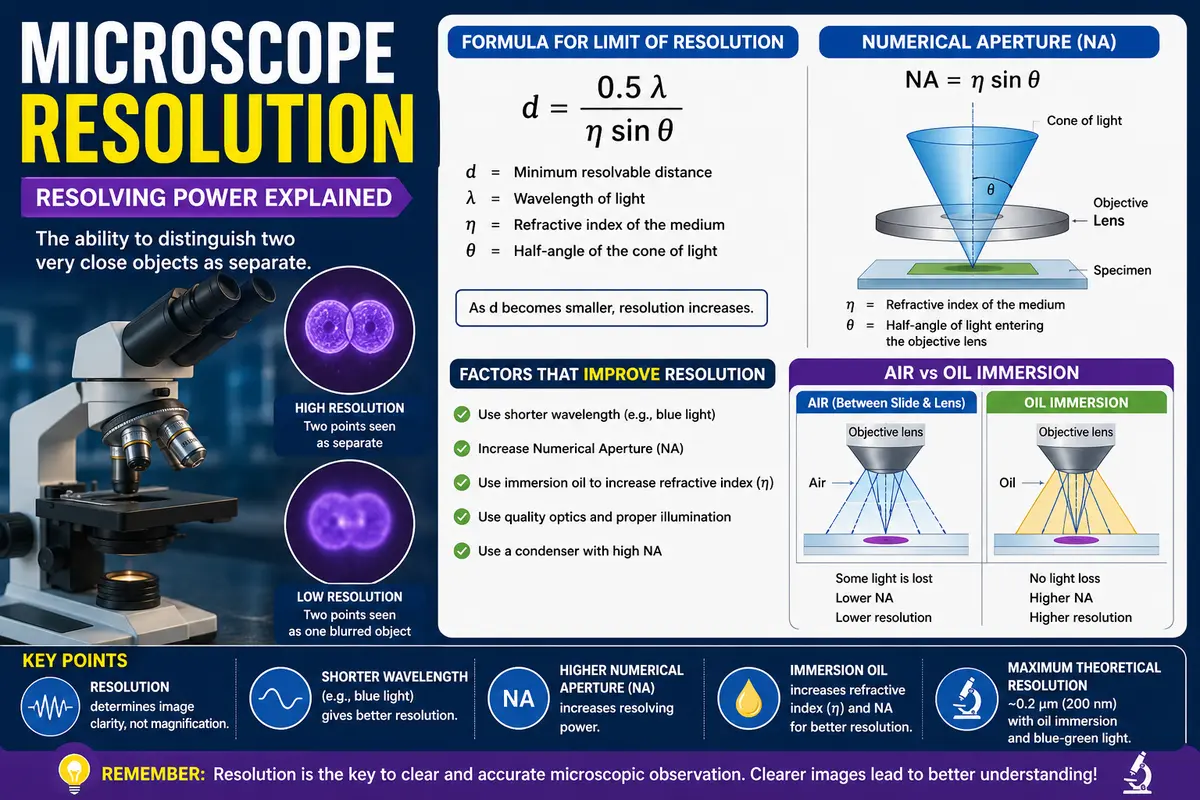
Directly related objectives are the most crucial characteristics of a microscope. It is crucial that the objectives yield a magnified and clear image resolution. The capacity of a lens to separate or differentiate between two spots that are near to one another within the specimen is known as resolution, or, in other words, resolution is the ability of a lens to separate or distinguish between two points that are close together within the specimen. The following formula provides the minimum distance (d) between two places that identifies them as separate:
The formula for the limit of resolution of a microscope is,
Where,
- “λ” is the wavelength of light used to illuminate the specimen.
- “η sin θ” is numerical aperture.
- As “d” becomes smaller, resolution increases.
The wavelength must be shorter than the distance between 2 objects or will not be seen properly. Light with a short wavelength yields the highest resolution. Thus, we can conclude that the light wave employed has a major influence on resolution.
The angle at which light enters an object (numerical aperture) and the refractive index of the material it passes through before entering the microscope objective both affect resolution. The relationship of these is stated in the formula:
Where,
- “η” Refractive index through which light passes before entering the objective lens.
- “θ” is the angle formed by light rays coming from the condenser passing through the specimen.
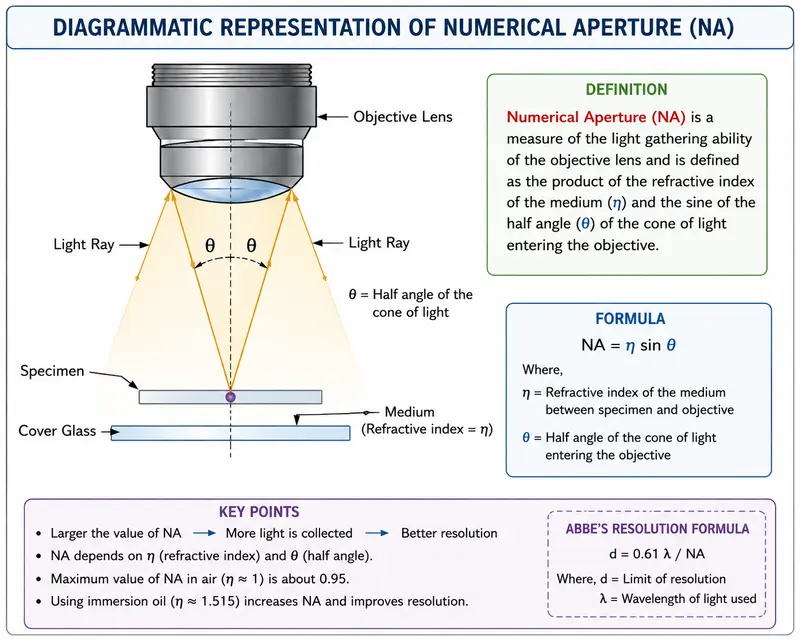
On objective barrels, numerical aperture (NA) values are etched. The refractive index (η) of the medium the lens operates in determines the angle of the cone of light that enters the lens. Air has a refractive index of 1.00. No lens operating in air may have a numerical aperture (NA) larger than 1.00 since sin θ cannot be bigger than 1. Immersion oil, a colorless liquid with the same refractive index as glass, is the only realistic means to raise numerical aperture (NA) above 1.00 and hence achieve greater resolution. Cedar wood oil is frequently utilized. One benefit of oils is that they don’t evaporate when exposed to air for extended periods of time.
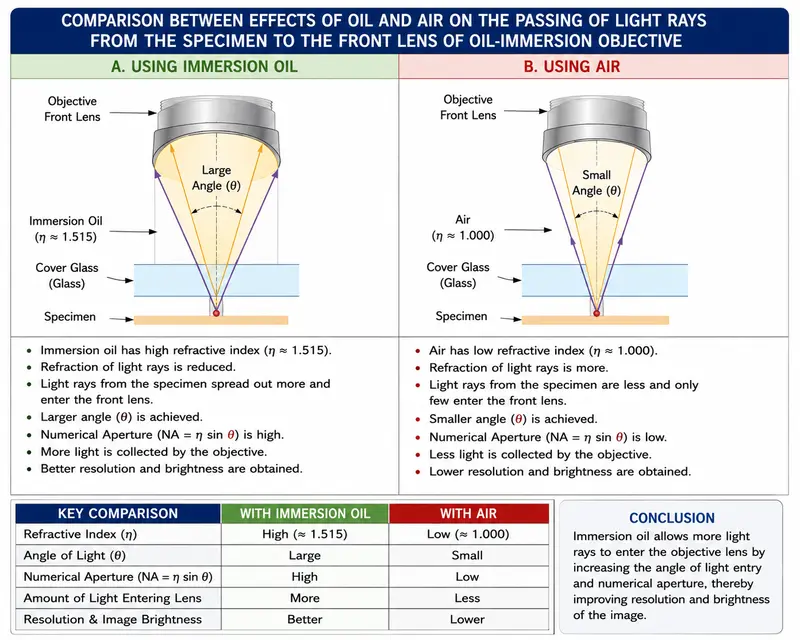
Oil does not bend light rays entering the front lens of an oil immersion objective because its refractive index is equal to that of glass (shown in the figure below). Some light is lost if there is air instead of oil between the specimen and the objective. The image is blurry, making it difficult to see finer details. By acting as an extra lens in the system, the oil increases the oil immersion objective’s resolving power (RP) by preventing the loss of essential light rays.
The maximum theoretical RP of a microscope with an oil immersion objective (NA 1.25) and blue-green light is 0.2 µm, the same size as a very small bacterium:
Objectives with high RP and high NA have short working distances. For improved resolution, lighting is crucial. A concave mirror with a numerical aperture and a narrow cone of light lights the slide between the source and the specimen. A substage condenser that increases the numerical aperture can enhance resolution. Achromatic, variable focus, and Abbe condensers are frequently utilized. Occasionally, excessive light traveling through the specimen and into the objective lens reduces the specimen’s contrast and results in a loss of resolution. Iris diaphragms are typically used in microscope condensers to adjust light intensity. The diaphragm’s aperture is narrowed while examining unstained material, such as live properties of hanging drop preparations.
Properties of Microscope Resolution (Resolving Power)
- Resolution Determines Image Clarity—Resolution affects the sharpness and clarity of the image. Higher resolution produces clearer and more detailed images.
- Resolution is More Important than Magnification—A microscope can magnify an object many times, but if the resolution is poor, the image will remain blurry. Good resolution is essential for accurate observation.
- Resolution Depends on the Wavelength of Light (λ) – Shorter wavelengths (e.g., blue light) provide better resolution. Longer wavelengths produce lower resolution.
- Resolution Depends on Numerical Aperture (NA)—A higher numerical aperture (NA) increases the resolving power. NA depends on the refractive index of the medium and the angle of light entering the objective lens.
- Resolution is inversely related to the value of d—a smaller value of d indicates better resolution.
- Resolution Enables Separation of Close Objects—It allows two closely spaced points to appear as two distinct objects instead of one blurred image.
- Resolution Improves with Immersion Oil—Using immersion oil increases the refractive index (η), which increases NA and improves resolution.
- Resolution Has a Physical Limit – In a standard light microscope, the maximum practical resolution is about 0.2 µm (200 nm) due to the wavelength of visible light.
- Resolution is Essential in Biological Studies—High resolution is necessary to observe bacteria, cells, organelles, tissues, and other microscopic structures accurately.
Conclusion
The resolution or resolving power of a microscope is one of the most important factors in obtaining clear and detailed microscopic images. While magnification enlarges an object, resolution determines how clearly the fine details can be seen. A microscope with high resolving power can distinguish two closely spaced objects as separate, making it essential for accurate observation and research.
Resolution mainly depends on the wavelength of light and the numerical aperture (NA) of the objective lens. Using shorter wavelengths of light, a higher numerical aperture, and immersion oil significantly improves image quality by allowing more light to enter the objective lens and reducing light refraction.
Understanding the principles of microscope resolution helps students appreciate why image clarity is more important than magnification alone. This knowledge is fundamental in microbiology, pathology, cell biology, and medical laboratories, where the ability to observe tiny structures accurately is essential for diagnosis, research, and scientific discoveries.
If you want to learn advanced microscopy techniques and optical principles, visit ZEISS Microscopy Knowledge Base.
Frequently Asked University Questions (Previous 5 Years)
Long Answer Questions (10–15 Marks)
- Explain the resolution or resolving power of a microscope with a suitable diagram.
- Define resolution and derive the formula for the limit of resolution of a microscope.
- Discuss the factors affecting the resolving power of a light microscope.
- Explain the role of numerical aperture (NA) in improving microscope resolution.
- Compare the effects of air and immersion oil on the passage of light rays and explain how immersion oil improves resolving power.
Short Notes (5 Marks)
- Write a short note on Numerical Aperture (NA).
- Explain the formula of microscope resolution.
- State the properties of microscope resolution.
- Write a note on the importance of immersion oil in microscopy.
- Explain the relationship between magnification and resolution.
- Describe the effect of wavelength on microscope resolution.
- What is the working principle of an oil immersion objective?
- Explain the significance of 0.2 µm resolution in a light microscope.
Short Answer Questions (2–3 Marks)
- Define resolution or resolving power.
- What is Numerical Aperture (NA)?
- Write the formula for the limit of resolution.
- What is the unit of microscope resolution?
- Why is blue light preferred for better resolution?
- What is the refractive index of air and immersion oil?
- Why is immersion oil used with the 100× objective lens?
- What is meant by the minimum resolvable distance (d)?
- State any two factors affecting microscope resolution.
- What is the maximum theoretical resolution of a light microscope?
Very Important Viva Questions
- What is the difference between magnification and resolution?
- Why is resolution more important than magnification?
- What is the function of immersion oil?
- What is the numerical aperture of an objective lens?
- Why should oil be used only with the 100× oil immersion objective?
- What happens if air is present between the slide and the oil immersion lens?
- Why does increasing the numerical aperture improve resolution?
- Why does a shorter wavelength produce better resolution?
Most Important Questions for University Exams
- Explain the resolution or resolving power of a microscope with a neat, labeled diagram.
- Derive and explain the formula for the limit of resolution.
- Explain Numerical Aperture (NA) and its significance.
- Compare air and oil immersion in terms of light transmission and resolution.
- Discuss the factors affecting microscope resolution.
- Differentiate between magnification and resolution.
- Explain why immersion oil increases the resolving power of a microscope.
FAQs
1. What is resolution in a microscope?
Answer: Resolution (or resolving power) is the ability of a microscope to distinguish two closely spaced objects as separate and distinct instead of seeing them as one blurred image.
2. Which microscope achieves the greatest resolution and highest magnification?
Answer: The Transmission Electron Microscope (TEM) provides the highest magnification and the greatest resolution because it uses a beam of electrons instead of visible light.
3. How could we build a microscope with a higher resolution?
Answer: A microscope can achieve higher resolution by using shorter wavelengths, increasing the numerical aperture, using immersion oil, or using electrons instead of visible light.
4. Define microscope resolution.
Answer: Resolution (resolving power) is the minimum distance at which two closely spaced points can be seen as separate under a microscope.
5. In an electron microscope, the resolution that can be achieved?
Answer: An electron microscope can achieve a resolution of about 0.1–0.2 nanometers (nm), which is much higher than that of a light microscope.
References
- Prescott’s Microbiology – Joanne M. Willey, Kathleen M. Sandman & Dorothy H. Wood. McGraw Hill Education
- Brock Biology of Microorganisms – Michael T. Madigan et al. Pearson Higher Education
- Microbiology: An Introduction – Gerard J. Tortora, Berdell R. Funke & Christine L. Case. Pearson Higher Education
- Medical Microbiology – Patrick R. Murray, Ken S. Rosenthal & Michael A. Pfaller. Elsevier Health
- Fundamentals of Light Microscopy and Electronic Imaging—Douglas B. Murphy. Wiley
- Olympus Life Science – Microscopy Resource Center
- Nikon MicroscopyU
- Leica Microsystems – Science Lab
- ZEISS Microscopy Knowledge Base
- Encyclopaedia Britannica – Microscope