
What is the Golden Era of Microbiology? Explore Pasteur, Koch, Cohn, TMV, bacteriophages, germ theory, endospores, and discoveries that shaped modern microbiology.
Introduction
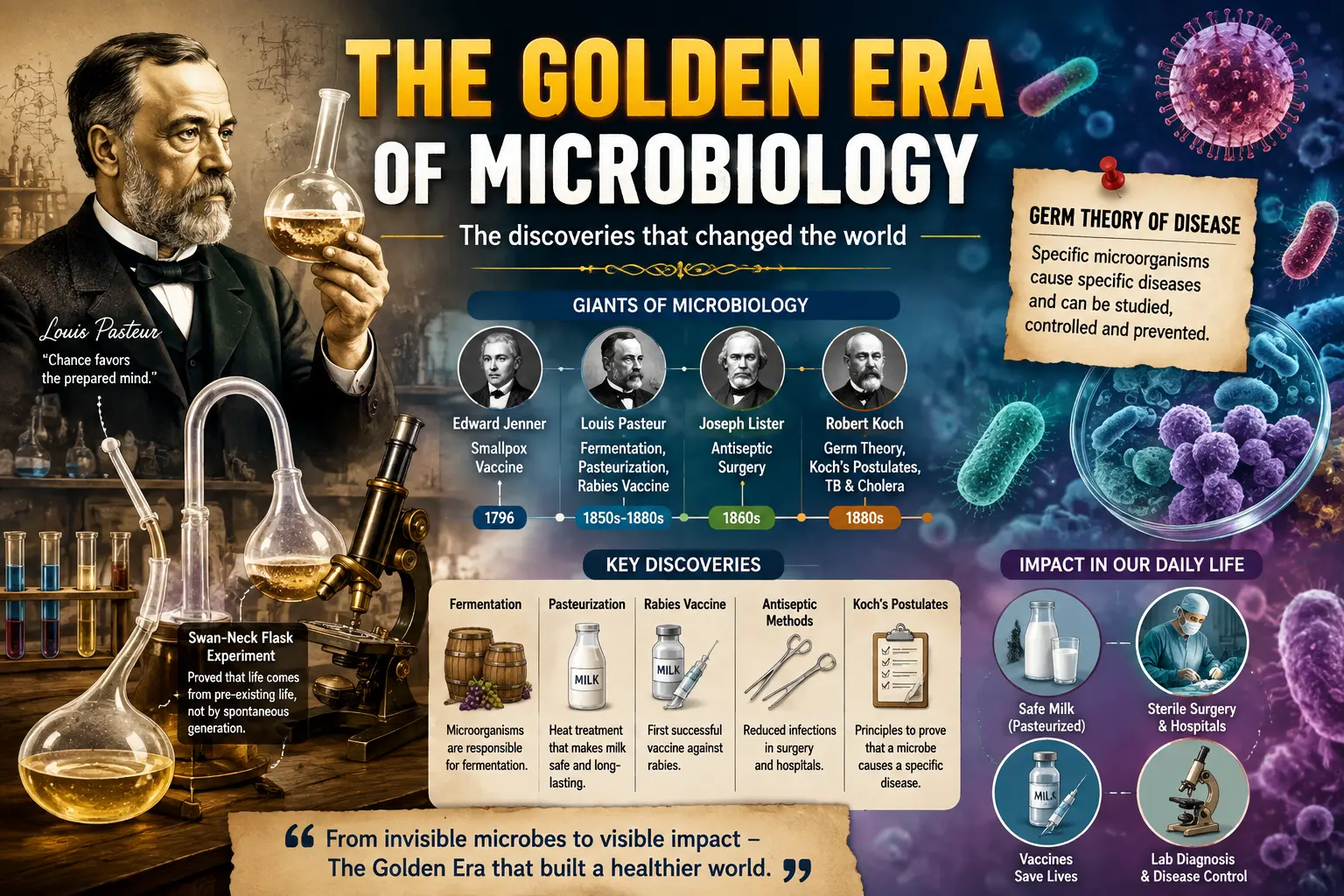
The Golden Era of Microbiology is usually considered to be from the 1850s to the early 1900s, a time when scientists made a number of revolutionary discoveries in the areas of microorganisms, infectious diseases, fermentation, vaccination, and infection control. The development of microbiology into a scientific discipline was largely influenced by scientists like Louis Pasteur, Robert Koch, Joseph Lister, and Edward Jenner. Many diseases were not well understood prior to this time and were often attributed to bad air or other false explanations.
During the Golden Age, scientists presented strong evidence for the germ theory of disease, developed techniques for isolating and growing microorganisms, linked specific microbes to specific diseases, and created improved methods of sterilization, antisepsis, and disease prevention.
The significance of this age can be easily understood in daily examples. Drinking pasteurized milk is drinking a product of a controlled heating process to reduce harmful microorganisms and add to the safety and shelf life of the product. This process is closely associated with the work of Louis Pasteur. Similarly, the sterilization of surgical instruments by hospitals, the hand hygiene and antiseptic procedures of doctors, and the identification of infection-causing bacteria by laboratories are all applications of principles that developed in this period.
To summarize, the Golden Era changed our view from diseases occurring mysteriously to specific microorganisms causing specific diseases, and these microorganisms can be studied and controlled. It thus established the basis for modern medical microbiology, immunology, biotechnology, food microbiology, vaccination, and infection control.
What is the golden era of microbiology?
Louis Pasteur
Louis Pasteur (1822-1895) was a French chemist and microbiologist who transformed our understanding of microorganisms, fermentation, infectious diseases, and vaccination through his experiments. His work laid the scientific foundations of modern microbiology, immunology, and food microbiology.
Pasteur’s science also came to include the crucial insight that microorganisms were not only agents of disease but could also be responsible for useful biological processes, such as fermentation. He later showed that weakened microorganisms could be used to protect against infectious diseases.
Louis Pasteur and Fermentation
Fermentation is a metabolic process in which microorganisms or cells convert organic substances into other products, often producing energy in the process.
Pasteur’s work was particularly important because fermentation was once thought to be primarily a chemical process. In the 1850s Pasteur was consulted by producers in Lille, France, who had problems making alcohol out of beets. Pasteur studied the process and found that fermentation was associated with living microorganisms.
He showed that different kinds of fermentation were caused by different micro-organisms. His observations helped to establish the idea that microorganisms have a specific biological function. Louis Pasteur’s fermentation studies ushered in a major change in scientific thought:
Fermentation → microorganism → special biological activity.
The idea became one of the central tenets of microbiology and industrial biotechnology. His research also led him to a larger question: if microorganisms could change food and beverages, could microorganisms cause disease? That question would become central to his later work.
The notion of spontaneous generation was also called into question by Pasteur’s research.
He used swan-neck flasks to conduct well-known experiments. When airborne dust and germs were kept out of the liquid, boiled nutritional solutions continued to be free of microbial development.
The conclusion that microbes originated from preexisting bacteria rather than emerging on their own in sterile nutritional material was confirmed by these tests. In addition to promoting better hygiene, sterilization, and aseptic procedures, this study reinforced the evolving germ theory of illness.
Louis Pasteur and Rabies
One of Pasteur’s most celebrated scientific accomplishments was his work on rabies.
What made rabies so terrifying was that once clinical disease appeared, it was almost always fatal.
The agent of rabies could not be seen with the microscopes Pasteur had. Pasteur therefore employed experimental animals in his study of the disease. His team examined infected nervous tissue and found a way of making the infectious material less virulent by drying it.
By suspending spinal cords of rabies-infected rabbits in dry air, their virulence was gradually lost. Then Pasteur applied increasingly virulent preparations in experimental animals.
Pasteurization
One of Pasteur’s most famous contributions to food science is pasteurization.
What is pasteurization?
Pasteurization is a controlled heat-treatment process for foods and beverages that reduces the number of harmful or spoilage-causing microorganisms while maintaining their quality.
It’s not like sterilization. Pasteurization is not designed to kill all micro-organisms.
Pasteur found that the degeneration of wine and other items was caused by germs. He discovered that spoiling could be avoided with modest heating. He received a patent in 1865 for a method of preserving and enhancing wine that involved regulated heating. After Pasteur, this procedure came to be known as pasteurization.
Cholera vaccine-fowl cholera experiment
An unexpected finding about cholera in birds led to one of Pasteur’s most significant discoveries. Pasteurella multocida is the infectious agent that causes fowl cholera.
Using cultures of the culprit bacterium, Pasteur and his associates, including Émile Roux and Charles Chamberland, were investigating the illness. Chickens were once inoculated with an older culture of the bacterium. The chickens did not die or suffer from the terrible illness that was anticipated. Then Pasteur made an important discovery. These previously exposed chickens survived a subsequent challenge with a new, more virulent culture, whereas susceptible fowl suffered far more severe consequences.
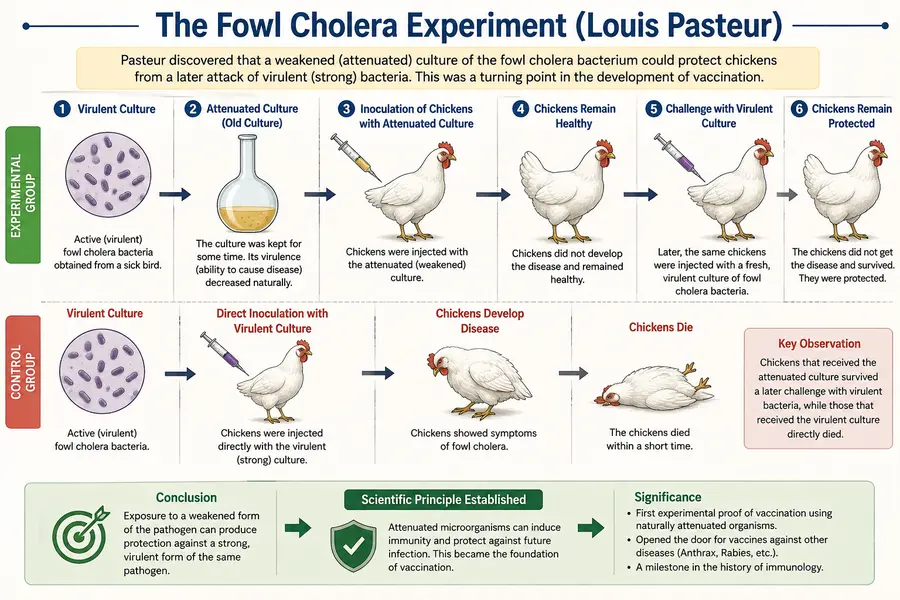
This observation suggested that exposure to a weakened form of a microorganism could protect an animal against a stronger form of the same infection. Pasteur recognized that the microorganism’s virulence could be attenuated—in other words, its ability to cause severe disease could be reduced. This became a fundamental principle in the development of several vaccines. The Institute Pasteur describes Pasteur’s fowl-cholera work as an early example of vaccination using microorganisms with attenuated virulence
| Area | Pasteur’s contribution | Scientific importance |
|---|---|---|
| Fermentation | Demonstrated the role of microorganisms | Established microbial involvement in fermentation |
| Pasteurization | Developed controlled heating to reduce spoilage | Major contribution to food microbiology |
| Germ theory | Demonstrated the importance of microorganisms | Strengthened modern microbiology and infectious disease science |
| Fowl cholera | Demonstrated protection using attenuated cultures | Important foundation for attenuated vaccines |
| Anthrax | Developed an attenuated vaccine | Demonstrated practical microbial vaccination |
| Rabies | Developed an effective post-exposure vaccination approach | Major breakthrough in infectious disease prevention |
| Microbiology | Connected microorganisms with biological processes and disease | Helped establish modern microbiology |
Robert Koch
Robert Koch (1843–1910) was a pioneering German physician and microbiologist and one of the most influential scientists of the Golden Era of Microbiology. He was instrumental in the development of the germ theory of disease by showing that specific microorganisms are the cause of specific infectious diseases. His work gave systematic methods for isolation, cultivation, staining, and identification of disease-causing bacteria. This provided a scientific basis for medical microbiology and laboratory diagnosis. Koch received the Nobel Prize for Physiology or Medicine in 1905 for his work on tuberculosis.
Koch’s Postulates
Robert Koch, a German physician, in his studies on the etiology of anthrax disease, provided the first direct evidence of the role of bacteria as a causative agent of disease. This has been confirmed later by Louis Pasteur.
It was noticed earlier, however, that rod-like forms appeared in the blood and organs of sheep dying of anthrax. The proof that these rods were pathogenic and that they caused the anthrax disease was obtained by the application of four postulates. Robert Koch used the criteria proposed by his former teacher Jacob Henle (1809-1885) to establish the relationship between pathogenic microbes and disease.
Robert Koch used sick animals, such as those afflicted with anthrax, in his experiments. In his lab, he injected mice with infectious material from lesions (in this case, the eyeballs of sick cattle) or other clinical specimens. All of the mice became infected after a few days. A portion of the now-infected mice’s spleen was dissected. In order to supply nutrients, it was moved to the beef serum. The shaped bacilli found in the diseased spleen multiplied and developed in pure form. He noticed that all rod-shaped entities transformed into circular, oval, refractile bodies known as endospores after a specific incubation period.
These endospores did not proliferate, but under the right circumstances, they might regenerate into huge rod-shaped cells. The new, healthy mice in the lab also get infected when these bacterial entities from the sea are introduced into them. When Bacillus anthracis multiplies in the blood of animals that have been infected, the same kinds of illness symptoms appear.
Koch published four crucial criteria known as Koch’s postulates based on observations of outcomes in laboratory-inoculated animals.
The steps of Koch’s postulates are as follows:
(1) In every case of disease, a specific microorganism must be found infecting man or animal, and it must be absent in healthy individuals.
(2) The suspected microbe should be isolated from infectious material from an infected animal and should be grown in a pure culture.
(3) When injected into normal healthy experimental animals like mice, an isolated pure culture of the pathogen should develop the same types of symptoms of disease. It means it must reproduce a specific disease in laboratory animals.
(4) The same microorganism must be recovered in pure form and again experimentally infect host animals.
With relatively few exceptions, the causal relationship between pathogenic bacteria and a particular disease has been shown according to the tenets of Koch’s postulates. At the time when Koch’s Postulates were formulated, true viral pathogens were unknown.
Germ theory of disease
The germ theory of illness, which holds that certain microbes cause infectious diseases, received substantial experimental backing from Koch’s work. Koch created techniques that enabled researchers to isolate a suspected pathogen, grow it independently, examine its traits, and show how it relates to illness rather than merely noticing that microbes were present in diseased tissues.
His method contributed to the development of the notion that repeatable laboratory findings should serve as the foundation for illness inquiry. Because it made microbes identifiable targets for diagnosis, prevention, and therapy, this was a significant shift in medicine.
Tuberculosis and Cholera (isolation and staining techniques of causative agent)
1. Tuberculosis – Mycobacterium tuberculosis
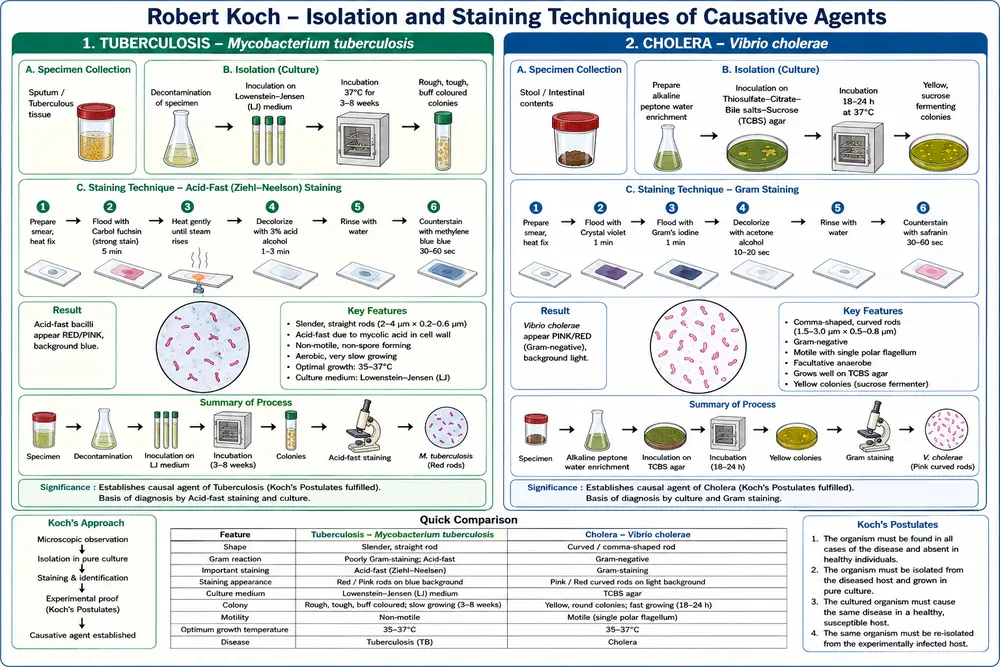
In 1882, Robert Koch made a significant contribution to microbiology when he discovered that Mycobacterium tuberculosis is the cause of tuberculosis. Although the precise etiology of tuberculosis remained unknown at the time, it was a leading cause of death. Koch studied tissues from individuals with tuberculosis and showed that sick tissue contained distinctive rod-shaped, thin bacilli.
Koch created techniques for isolating and identifying the tuberculosis bacillus from afflicted tissues and cultivating it in a lab setting. To examine the organism, he employed controlled incubation and specific culture media. One of the organism’s key traits is that it develops much more slowly than many ordinary bacteria. Koch then established its connection to tuberculosis using experimental data that supported his hypotheses.
Staining: M. tuberculosis is resistant to standard staining and has the characteristic of acid-fastness due to its waxy, lipid-rich cell wall that contains mycolic acids. Koch created a pioneering staining technique that allowed the bacilli to be seen under a microscope. The Ziehl-Neelsen acid-fast staining technique later gained popularity as a means of identifying M. tuberculosis. Using this technique, the background and non-acid-fast organisms absorb the counterstain, but the bacteria maintain the primary stain and appear red or pink even after being treated with acid-alcohol. We refer to this characteristic as acid-fastness.
Koch’s discovery proved that tuberculosis was a bacterial infectious disease and provided a scientific basis for laboratory diagnosis, epidemiological investigation, and later development of effective methods for prevention and treatment.
2. Cholera – Vibrio cholerae
During his studies of cholera epidemics in Egypt and India in the 1880s, Robert Koch also made a significant addition to our understanding of the disease. He discovered the culprit, which is now known as Vibrio cholerae, a distinctive gram-negative bacterium with a comma or curved form.
Isolation: Koch found a lot of curved bacteria in material taken from cholera sufferers’ intestines. He created techniques for separating the organism from intestinal fluids and growing it in a lab. The organism could be isolated from other intestinal microbes and examined as a comparatively clean culture. Its distinctive cellular and colony shape made identification easier.
Gram staining makes Vibrio cholerae appear pink or red because it is Gram-negative. The organism usually appears as a short, curled, or comma-shaped rod under a microscope. Koch also examined its distinctive shape under a microscope and stained it. Strong motility is provided by the organism’s single polar flagellum, which may be seen with the proper microscopic methods.
Koch’s research on cholera showed how a particular microbe could be linked to a particular infectious disease. It contributed to the development of scientific methods for diagnosis, epidemiology, sanitation, and disease prevention as well as the establishment of the bacteriological understanding of cholera.
Ferdinand Cohn (Endospore discovery)
During the Golden Age of Microbiology, German botanist and microbiologist Ferdinand Julius Cohn (1828–1898) made significant discoveries. He was one of the first researchers to systematically categorize bacteria according to their form and other traits, and he is recognized as one of the pioneers of bacteriology. His research on bacterial endospores, especially in Bacillus species, was one of his most significant achievements.
Discovery of Endospores
Cohn examined germs like Bacillus subtilis and found that certain bacterial cells evolved extremely resistant internal structures when exposed to adverse environmental circumstances. Later on, these structures were referred to as endospores. He realized that these structures were survival mechanisms that allowed bacteria to endure harsh environments rather than reproductive cells.
Certain bacteria can develop endospores when their surroundings become adverse, such as when they are exposed to heat, dryness, or a lack of nutrition. A highly resistant spore forms inside the vegetative cell after it goes through a number of alterations. The endospore can germinate and create a new vegetative bacterial cell when the right circumstances arise again.
Structure and Resistance
An endospore is encased in multiple protective layers and contains the bacterial genetic material. It features a dehydrated core that contains vital biological components, a robust cortex, and protective spore coatings. An endospore’s unique structure allows it to withstand environments like heat, dryness, radiation, and numerous chemical agents that would kill regular vegetative bacterial cells.
Food sterilization and preservation are two basic examples from daily life. Endospores produced by certain bacteria, like Bacillus and Clostridium, may withstand normal heating. As a result, not all spores can be eliminated by just boiling or slightly heating some meals. For this reason, autoclaving—which uses pressurized steam at an appropriate temperature and exposure duration—is used in microbiological labs to provide successful sterilization.
Cohn’s research on endospores contributed to the understanding of how some microbes might withstand extreme environmental conditions before reactivating. Understanding food spoilage, sterilization, food preservation, and bacterial survival also benefited from his observations. He contributed to the development of the scientific underpinnings of contemporary bacteriology and microbiology, together with Pasteur, Koch, Lister, and other researchers.
Discovery of viruses (TMV and bacteriophages)
An essential turning point in the evolution of contemporary microbiology was the discovery of viruses. Researchers discovered that certain diseases might be spread by infectious agents that could slip through filters that held germs and were too small to be seen under a standard light microscope. Strong proof for the existence of a novel class of infectious organisms known as viruses was supplied by the discovery of Tobacco Mosaic Virus (TMV) and later bacteriophages.
Tobacco Mosaic Virus (TMV)
Tobacco mosaic disease, which results in a distinctive mosaic or mottled pattern on tobacco leaves, is where the narrative of virus discovery started.
When Dmitri Ivanovsky studied the illness in 1892, he discovered that the infectious agent could pass through a Chamberland porcelain filter that retained microorganisms. Healthy tobacco plants could nevertheless get sick from the filtered sap. This implied that an infectious agent that was either smaller than common bacteria or able to get past the filter was the cause of the illness.
Martinus Beijerinck reproduced and expanded on these findings in 1898. He identified the infectious agent as a “contagium vivum fluidum,” or contagious living fluid, after concluding that it differed from bacteria. He proved that the chemical could only proliferate within living plant cells. The idea that a virus is a unique infectious agent was established by this work.
TMV was later effectively crystallized by Wendell M. Stanley in 1935. Because it showed that a virus could persist in a crystalline form outside of a living host while maintaining its infectiousness under the right circumstances, this finding was astounding. In 1946, Stanley was awarded the Nobel Prize in Chemistry for his research and development of the tobacco mosaic virus.
Discovery of Bacteriophages
Phages, also known as bacteriophages, are viruses that infect bacteria. Another significant advancement in our knowledge of viruses was made possible by their discovery.
Frederick W. Twort noted in 1915 that bacterial colonies occasionally generated distinct regions where bacterial cells had been killed. He suggested that this occurrence could be caused by a filterable infectious pathogen.
While researching bacterial dysentery in 1917, Félix d’Hérelle independently looked into a similar issue. He noticed distinct patches in bacterial cultures known as plaques. He realized that an infectious agent that could grow inside bacteria and kill them was responsible for these. He referred to the agent as a “bacteriophage,” which is a virus that consumes bacteria.
The discovery of TMV showed that infectious agents smaller than bacteria existed, while the discovery of bacteriophages demonstrated that viruses could infect and multiply within bacteria. Together, these discoveries established the foundation of virology as a major branch of microbiology.
River’s postulates
In 1937, T.M. Rivers created a similar group of rules to establish the causal role of viruses in disease. River’s postulates, applicable to animals, plants, and viruses, are as follows:
(1) The viral agent must be found either in the host’s body fluids at the time of disease or in the cells showing specific lesions.
(2) The viral agent obtained from the infected host must produce the specific disease in a suitable healthy animal or plant or provide evidence of infection in the form of antibodies against the virus. It is important that all host material used for inoculation be free of any bacteria or other microbes.
(3) Similar material from such newly infected animals or plants must be capable of transmitting the disease in question to other healthy hosts
Conclusion
The Golden Age of Microbiology was a major turning point in understanding microorganisms, infectious diseases, and prevention of disease. The pioneering work of Louis Pasteur, Robert Koch, Ferdinand Cohn, and others established microorganisms as important agents of fermentation, disease, and biological processes. The work of Pasteur on fermentation, pasteurization, vaccination, and germ theory and of Koch on Koch’s postulates, tuberculosis, cholera, and identification of bacteria provided the firm scientific basis for modern microbiology.
The knowledge of bacterial survival and sterilization improved with the discovery of endospores by Ferdinand Cohn, and the discoveries of tobacco mosaic virus (TMV) and bacteriophages extended microbiology into virology. These accomplishments collectively transformed medicine from a largely empirical practice to a science based on observation, experimentation, microbial identification, prevention, and control.
Thus, the Golden Era of Microbiology laid the scientific foundation for today’s medical microbiology, immunology, virology, biotechnology, food microbiology, vaccination, sanitation, and infection control. Its findings continue to shape medical care and scientific research today.
FAQs
1. What is the golden era of microbiology?
Answer: The Golden Era of Microbiology refers to the period from the 1850s to the early 1900s, when major discoveries established the role of microorganisms in disease, fermentation, vaccination, and infection control. Scientists such as Louis Pasteur, Robert Koch, and Ferdinand Cohn laid the foundation of modern microbiology during this period.
2. Which period is known as the golden era?
Answer: The period from the 1850s to the early 1900s is known as the Golden Era of Microbiology.
3. Who is the father of microbiology?
Answer: Antonie van Leeuwenhoek is widely known as the Father of Microbiology. He was the first to observe and describe microorganisms using a microscope.
4. What is a significant discovery from the golden age of microbiology?
Answer: A significant discovery was the establishment of the germ theory of disease, showing that specific microorganisms can cause specific diseases.
5. Who is the father of virology in microbiology?
Answer: Martinus Beijerinck is widely regarded as the Father of Virology for his pioneering work on viruses, particularly Tobacco Mosaic Virus (TMV).
References
- Pasteur, L. (1862–1877). Louis Pasteur and his scientific contributions. Institut Pasteur. Institut Pasteur
- Koch, R. (1905). Nobel Lecture: The Nobel Prize in Physiology or Medicine. Nobel Prize.
- Centers for Disease Control and Prevention (CDC). Tuberculosis: Historical Perspectives. CDC
- Stanley, W. M. (1946). The isolation and properties of crystalline tobacco mosaic virus. Nobel Prize.
- PubMed. Tobacco Mosaic Virus (TMV): Historical and Scientific Background. PubMed
- FEMS Microbiology Reviews. Endospores and bacterial survival. FEMS Microbiology Reviews
- Pasteur, L. Studies on fermentation, germ theory, vaccination, and pasteurization. Institut Pasteur.
- Encyclopaedia Britannica. History of Microbiology and Microorganism Discovery.